SI
SI
discoversearch

We've detected that you're using an ad content blocking browser plug-in or feature. Ads provide a critical source of revenue to the continued operation of Silicon Investor.  We ask that you disable ad blocking while on Silicon Investor in the best interests of our community.  If you are not using an ad blocker but are still receiving this message, make sure your browser's tracking protection is set to the 'standard' level.
Politics : Rat's Nest - Chronicles of Collapse

 Public ReplyPrvt ReplyMark as Last ReadFilePrevious 10Next 10PreviousNext  
To: Wharf Rat who wrote (9721)2/12/2010 1:20:51 PM
From: Wharf Rat  Read Replies (1) of 24235
 
Mot recent comment from Ace...
in
Petrobras Shares Some Considerations in a Response
Posted by Prof. Goose on February 11, 2010 - 9:59am

===

Lucio Pimentel of Petrobras sent The Oil Drum a response to Tony Eriksen's post World Oil Capacity to Peak in 2010 Says Petrobras CEO that TOD published last week. In the spirit of courtesy and the exchange of ideas, it is posted below the fold in its entirety with the permission of Mr. Pimentel.

theoildrum.com
ace on February 11, 2010 - 10:26pm
It's very good that Petrobras has replied to my previous post! I wish that Saudi Aramco would also reply to some of my Saudi posts.

I appreciate Petrobras' reply but it would have been good if some positive statements could have been made rather than negative ones such as "we do not believe it is possible to predict a peak oil date" and "we do not believe it will happen in 2010".

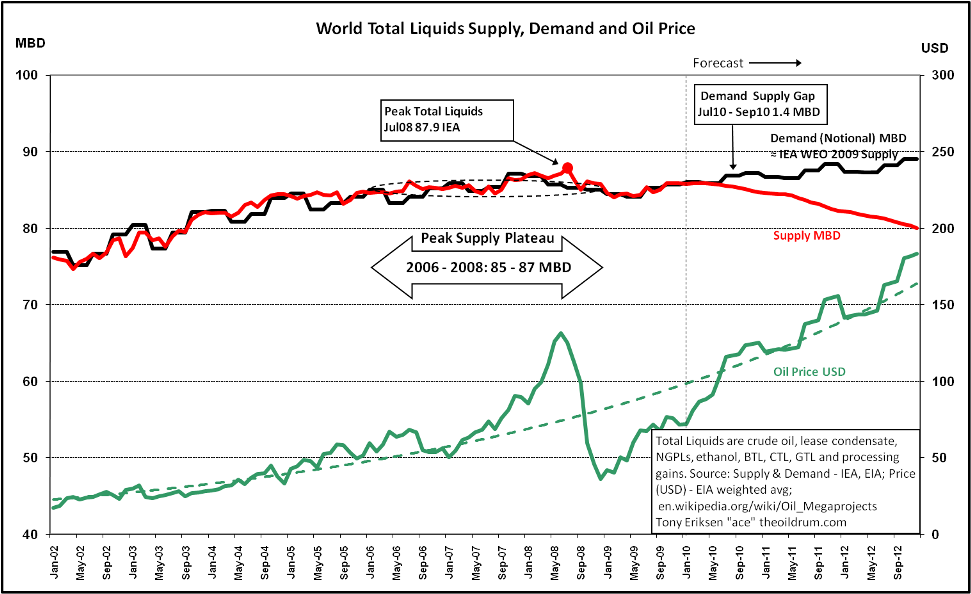
Peak oil capacity will probably be this year if you believe OPEC's surplus capacity numbers, but of more importance is peak oil production. According to IEA historical data, the peak oil date was July 2008 as shown in the chart below updated for the IEA Oil Market Report for Feb 2010.
omrpublic.iea.org

The chart also shows that oil supply and demand have been well balanced since Oct 2009. Oil supply has been just under 86 mbd since Oct 2009 and is expected to remain just under 86 mbd until about Jun 2010. Thus, oil supply and demand should stay in balance until about Jun 2010.

From Jul 2010 to Sep 2010, it is estimated that a supply shortfall of over 1 mbd will happen unless OPEC can increase production further. This means that Saudi Arabia needs to increase production to help meet expected world demand in 2010Q3. We won't have to wait long to see if Saudi Arabia does or wants to increase production to a higher level.


The IEA OMR Jan 2010 report said that Dec 2009 world oil production was 86.17 mbd.
omrpublic.iea.org

The IEA OMR Feb 2010 report says that Jan 2010 oil supply was 85.8 mbd, down by 45 kbd from Dec 2009. This means that the revised figure for Dec 2009 production is 85.85 mbd, revised downwards by 0.33 mbd. It appears that world oil production is struggling to exceed 86 mbd, creating a temporary oil supply plateau from Oct 2009 to Jun 2010. The OPEC OMR Feb 2010 also stated that Jan 2010 world oil supply was just under 86 mbd, at 85.67 mbd.
opec.org.

Parts of the world oil supply chain have become more fragile as Middle East stability is not improving as Iran faces more sanctions and Iraq's production is not increasing yet, Venezuela is having serious power shortages, big oil companies are looking to exit Nigeria and increased US Gulf of Mexico production is vulnerable to hurricane outages.

Production in the US GoM Federal in Sep 2009 was 1.65 mbd up from lows of about 1.3 mbd in 2007 and almost surpassing its previous peak of 1.69 mbd in Jun 2002.
tonto.eia.doe.gov.
If hurricane outages occur in 2010Q3 then world supplies could be reduced further which would place enormous pressure on OPEC to increase production.

Oil prices could easily exceed $100 later this year if demand continues to increase and supply is unable to meet demand.
Report TOU ViolationShare This Post
 Public ReplyPrvt ReplyMark as Last ReadFilePrevious 10Next 10PreviousNext