Point Woronzof a few miles west of me has a 200-foot high sandy bluff that's being gradually eroded by the wind and rain. Small amounts of fine gold particles wash out and collect on the clay substrate below the beach sands and gravel, but not enough to make mining worthwhile.
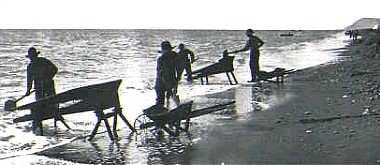
The classic instance of ocean beach gold mining is at Nome, Alaska beginning in 1898...
The Nome Gold District
nevada-outback-gems.com
A serious attempt at large-scale offshore ocean gold dredging at Nome was attempted several decades ago, with mixed results...
Marine Dredging for Gold, Offshore Alaska
onepetro.org
To mine the marine deposit, WestGold purchased second-hand the world's largest, ocean-going, bucket-ladder dredge, the 'Bima'. Designed for original use on a very different tin deposit in Indonesian waters, the dredge arrived in Nome in 1986. With an overall length of 140m and >7,000 hp installed, it could dig to 45m depth at a rate of 2,000 m3/hr.Ttreoffshore conditions in Alaska, however, were entirely different from those where the dredge had operated previously. The highest gold grades were in the uppermost 2m, and the sediments were much coarser and very resistant (o digging. The marine conditions were considerably more onerous and the wind/wave conditions grossly exceeded design specifications. Sea ice limited operations to the months June through November, reducing the availability to an average of about 70%. The throughput rate averaged 457 mshour over 4 years. Very high operating costs necessitated an elevated cutoff grade and much more drilling than originally anticipated in order to define a dredge course, Altogether, 1I8,078 oz. of gold were recovered from 1987 to 1990, inclusive, when the operation was stopped because of the low gold price and structural failure. The experience illustrates the need to match marine mining equipment to each unique deposit and to delineate the reserves ahead of mining start-up. |



