Most or All of The Pay Gap Disappears After Controlling for Marriage and Having Children
CARPE DIEM
By Mark J. Perry
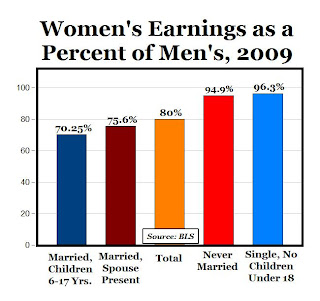
The Department of Labor recently released its annual study Highlights of Women's Earnings in 2009 and opens the report with the following statement:
"In 2009, women who were full-time wage and salary workers had median weekly earnings of $657, or about 80 percent of the $819 median for their male counterparts. In 1979, the first year for which comparable earnings data are available, women earned about 62 percent as much as men. After a gradual rise in the 1980s and 1990s, the women's-to-men's earnings ratio peaked at 81 percent in 2005 and 2006."
MP: Doesn't the BLS' use of the term "male counterparts" (Webster definition: "one remarkably similar to another") imply an "apples to apples" comparison between male and females workers, as if all relevant explanatory factors have been controlled for, i.e. the ceteris paribus condition has been imposed?
As the chart above shows, BLS data clearly show that marriage and having children affect male and female earnings differently, so that men and women workers can't really be considered "counterparts" in a statistical sense, and any unadjusted comparisons would be comparing apples to oranges. For example, single women earn about 95% of what men earn, but married women earn 75.6% of what married men earn, and married women with children between the ages of 6-17 earn 70.25% of their male "counterparts."
In other words, getting married and having children have significant effects on the "gender pay gap" that have nothing to do with "gender discrimination." And for the BLS category for marital status includes never married, divorced, separated and widowed, with no children under 18 years old, women make 96.3% of their "male counterparts." |



