Wealth, Income, and Power
by G. William Domhoff
September 2005 (updated July 2010)
This document presents details on the wealth and income distributions in the United States, and explains how we use these two distributions as power indicators.
Some of the information might be a surprise to many people. The most amazing numbers on income inequality come last, showing the change in the ratio of the average CEO's paycheck to that of the average factory worker over the past 40 years.
First, though, some definitions. Generally speaking, wealth is the value of everything a person or family owns, minus any debts. However, for purposes of studying the wealth distribution, economists define wealth in terms of marketable assets, such as real estate, stocks, and bonds, leaving aside consumer durables like cars and household items because they are not as readily converted into cash and are more valuable to their owners for use purposes than they are for resale (see Wolff, 2004, p. 4, for a full discussion of these issues). Once the value of all marketable assets is determined, then all debts, such as home mortgages and credit card debts, are subtracted, which yields a person's net worth. In addition, economists use the concept of financial wealth -- also referred to in this document as "non-home wealth" -- which is defined as net worth minus net equity in owner-occupied housing. As Wolff (2004, p. 5) explains, "Financial wealth is a more 'liquid' concept than marketable wealth, since one's home is difficult to convert into cash in the short term. It thus reflects the resources that may be immediately available for consumption or various forms of investments."
We also need to distinguish wealth from income. Income is what people earn from wages, dividends, interest, and any rents or royalties that are paid to them on properties they own. In theory, those who own a great deal of wealth may or may not have high incomes, depending on the returns they receive from their wealth, but in reality those at the very top of the wealth distribution usually have the most income.
As you read through these numbers, please keep in mind that they are usually two or three years out of date because it takes time for one set of experts to collect the basic information and make sure it is accurate, and then still more time for another set of experts to analyze it and write their reports. It's also the case that the infamous housing bubble of the first eight years of the 21st century inflated some of the wealth numbers.
So far there are only tentative projections -- based on the price of housing and stock in July 2009 -- on the effects of the Great Recession on the wealth distribution. They suggest that average Americans have been hit much harder than wealthy Americans. Edward Wolff, the economist we draw upon the most in this document, concludes that there has been an "astounding" 36.1% drop in the wealth (marketable assets) of the median household since the peak of the housing bubble in 2007. By contrast, the wealth of the top 1% of households dropped by far less: just 11.1%. So as of April 2010, it looks like the wealth distribution is even more unequal than it was in 2007. (See Wolff, 2010 for more details.)
The Wealth Distribution
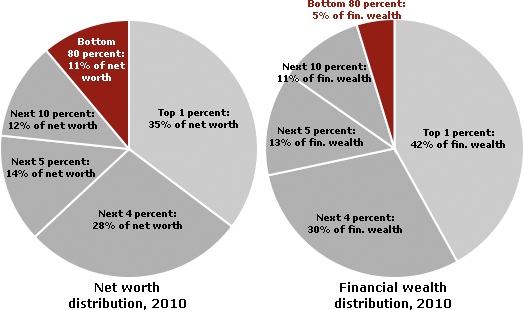
In the United States, wealth is highly concentrated in a relatively few hands. As of 2007, the top 1% of households (the upper class) owned 34.6% of all privately held wealth, and the next 19% (the managerial, professional, and small business stratum) had 50.5%, which means that just 20% of the people owned a remarkable 85%, leaving only 15% of the wealth for the bottom 80% (wage and salary workers). In terms of financial wealth (total net worth minus the value of one's home), the top 1% of households had an even greater share: 42.7%. Table 1 and Figure 1 present further details drawn from the careful work of economist Edward N. Wolff at New York University (2010).
hell of a lot more to read.....
sociology.ucsc.edu |



