Tech Talk - The Coming Problems for the Alaskan Pipeline Posted by Heading Out on August 28, 2011 - 4:57am
Topic: Supply/Production
Tags: alaska, ice formation, north pole refinery, north slope, northumberland, pipe corrosion, prudhoe, wax buildup [ list all tags]
The original Prudhoe is a small village with a medieval castle on the south bank of the Tyne, in the north-east of England. It lies in a coal-mining region within 5 miles of Prudhoe Colliery, where there were, over time, an additional 157 mines and pits and worked five seams of coal in the 1860’s. Not in itself out of the ordinary, but by 1828 had given its name to a region in Alaska. The naming recognized Admiral Algernon Percy, the first (and only) Baron Prudhoe (after the castle), who later became the 4th Duke of Northumberland. (His dad, the 2nd Duke, led the British retreat from Lexington after the initial battle).
As with the region of Southern Alaska I mentioned last week, Prudhoe Bay would have faded into the obscurity of the original, were it not that oil seeps had been reported there by the Inupiat Eskimo. After the area had been prospected and surveyed between 1901 and 1919, President Warren G. Harding established the Naval Petroleum Reserve No. 4, a region now called the National Petroleum Reserve-Alaska (NPR-A) in an adjacent area of the North Slope of Alaska, that region that lies north of the Brooks Range. This led on to further exploration, and on March 13, 1968, the Prudhoe Bay discovery well was announced.
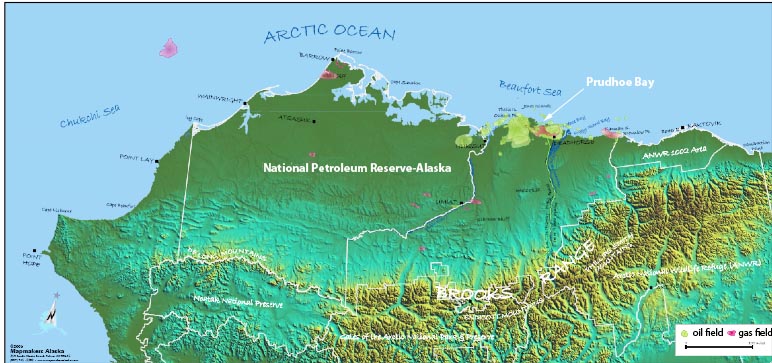
The North Slope of Alaska ( DOE)
I am going to forgo a discussion of the development of the fields that were then discovered in Prudhoe Bay and its adjacent fields until next time, because the oil reserve in Alaska is only a reserve if it can economically be accessed. Otherwise, it is only a resource and the transition from one to the other, in Alaska, came about with the development of the Alaskan pipeline.
The Trans-Alaska Pipeline System (TAPS) is the conduit that makes it possible for oil to flow from Prudhoe Bay some 800.302 miles down to the ice-free port at Valdez. From Valdez it can be shipped by tanker (about 25 a month) to customer refineries further south.
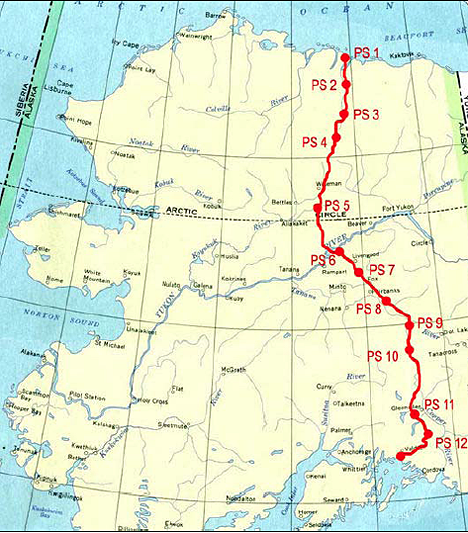
The Trans-Alaska Pipeline System ( Alyeska Low Flow Report) (The PS points are the pumping stations).
In July of 2011, TAPS averaged a flow of 459,376 barrels of oil a day, which is down from the average over the past year of some 572,835 bd. And those numbers are becoming something of a concern. While the pipeline produced about 15% of the national domestic production in 2010, the pipeline requires a certain flow level if it is to effectively deliver oil....
theoildrum.com |



