Astronauts' tracks, trash seen in new moon photos  By SETH BORENSTEIN - AP Science Writer | AP – 22 hrs ago By SETH BORENSTEIN - AP Science Writer | AP – 22 hrs ago
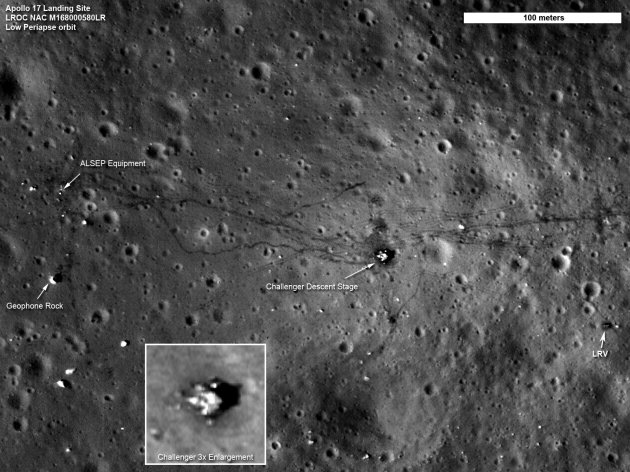 REUTERS - NASA's Lunar Reconnaissance Orbiter (LRO) image released on September 6, 2011 shows the Apollo 17 site on the moon, where the tracks laid down by the lunar rover are clearly visible, along with the …more last foot trails left on the moon. The images also show where the astronauts placed some of the scientific instruments that provided the first insight into the moon's environment and interior. LRO captured the sharpest images ever taken from space of the Apollo 12, 14 and 17 landing sites. Images show the twists and turns of the paths made when the astronauts explored the lunar surface. NASA says the image brightness and contrast have been altered to highlight surface details. REUTERS/NASA's Goddard Space Flight Center/ASU/Handout (UNITED STATES - Tags: ENVIRONMENT SCIENCE TECHNOLOGY TPX IMAGES OF THE DAY) FOR EDITORIAL USE ONLY. NOT FOR SALE FOR MARKETING OR ADVERTISING CAMPAIGNS. THIS IMAGE HAS BEEN SUPPLIED BY A THIRD PARTY. IT IS DISTRIBUTED, EXACTLY AS RECEIVED BY REUTERS, AS A SERVICE TO CLIENTS less REUTERS - NASA's Lunar Reconnaissance Orbiter (LRO) image released on September 6, 2011 shows the Apollo 17 site on the moon, where the tracks laid down by the lunar rover are clearly visible, along with the …more last foot trails left on the moon. The images also show where the astronauts placed some of the scientific instruments that provided the first insight into the moon's environment and interior. LRO captured the sharpest images ever taken from space of the Apollo 12, 14 and 17 landing sites. Images show the twists and turns of the paths made when the astronauts explored the lunar surface. NASA says the image brightness and contrast have been altered to highlight surface details. REUTERS/NASA's Goddard Space Flight Center/ASU/Handout (UNITED STATES - Tags: ENVIRONMENT SCIENCE TECHNOLOGY TPX IMAGES OF THE DAY) FOR EDITORIAL USE ONLY. NOT FOR SALE FOR MARKETING OR ADVERTISING CAMPAIGNS. THIS IMAGE HAS BEEN SUPPLIED BY A THIRD PARTY. IT IS DISTRIBUTED, EXACTLY AS RECEIVED BY REUTERS, AS A SERVICE TO CLIENTS less
tweet 196 Share19 EmailPrint
Related Content
 This August 2011 image made available by NASA shows paths left by walking astronauts, … This August 2011 image made available by NASA shows paths left by walking astronauts, …
WASHINGTON (AP) — A spacecraft circling the moon has snapped the sharpest photos ever of the tracks and trash left behind by Apollo astronauts in their visits from 1969 to 1972.
Images taken by NASA's Lunar Reconnaissance Orbiter from 13 to 15 miles up show the astronauts' paths when they walked on the moon, as well as ruts left by a moon buggy. Experts could even identify the backpacks astronauts pitched out of their lunar landers before they returned to Earth.
"What we're seeing is a trail," said Arizona State University geology professor Mark Robinson, the orbiter's chief scientist. "It's totally awesome."
However, the photos were not close enough to see individual bootprints, Robinson said.
The pictures were taken two weeks ago and show the landing sites for Apollo 12, 14 and 17. The closest images are of the 1972 Apollo 17 site, the last moon mission.
Apollo 17 Commander Eugene Cernan wrote in an email to The Associated Press that the photo gives him a chance to revisit those days, "this time with a little nostalgia and disappointment. Nostalgia because those special days are fondly etched in my memory and disappointment because it looks like now we will not be going back within the days I have left on this planet."
Two years ago, images from the same spacecraft from 30 and 60 miles out showed fuzzier images. But this year the orbiter dipped down to take about 300,000 more close-ups. The trails left by the astronauts are clear, but the places where backpacks were discarded, Apollo 17's moon buggy, and the bottom parts of the three lunar landers are blurry.
"You have to really look at it for a long time to figure out what you're looking at," Robinson said. For example, when it comes to the moon buggy he said, "if you squint really hard you can resolve the wheels and that the wheels are slightly turned to the left."
At first, scientists thought they had a bit of a mystery: They saw more stuff than they expected. It turned out to be packing material and an insulation blanket, Robinson said.
After 40 years there does not seem to be much moon dust covering the manmade trails. It probably will take about 10 million to 100 million years for dust to cover them, Robinson said.
The photos were released a few days after the debut of the new fictional movie "Apollo 18" and before Thursday's planned launch of NASA's twin robotic spaceships to explore the moon's gravity.
___ |



