I am not qualified to recommend firearms, although I do have my opinions. My opinion at the end of this message.
Though I like guns and want to exercise my right to have them, I believe that for most people (including myself most of the time) the best self-defense is to avoid situations, neighborhoods, people, and times of day when bad things are more likely to happen.
ManyMoose's take on the Double Tap: I would like to have one but I don't think it would be fun to shoot.
A person carrying one of the Double Taps (or any other weapon) should bear in mind always that they are armed, and follow gun safety practices TO THE LETTER. You can NEVER forget that you have one, especially when going shopping or visiting a hospital.
- All guns are always loaded. (Means that you should assume that they are. --MM)
- Never let the muzzle cover anything you are not willing to destroy. (This goes for guns that you have just verified as unloaded in #1 too. It's just plain good practice.--MM)
- Keep your finger off the trigger until your sights are on the target. (ESPECIALLY with semi-autos like the Glock. MM)
- Be sure of your target and what is beyond it
—Jeff Cooper [1]
The NRA provides a similar set of rules:
- ALWAYS keep the gun pointed in a safe direction.
- ALWAYS keep your finger off the trigger until ready to shoot.
- ALWAYS keep the gun unloaded until ready to use.
—The National Rifle Association, The fundamental NRA rules for safe gun handling [2]
ManyMoose's additional rule: Never hand a gun to another without breaking the action to reveal whether it is loaded or not.
It would also be a good idea to get conversant in the following principles, developed by Col. Jeff Cooper:
The most important means of surviving a lethal confrontation, according to Cooper, is neither the weapon nor the martial skills. The primary tool is the combat mindset, set forth in his book, Principles of Personal Defense. [5] In the chapter on awareness, Cooper presents an adaptation of the Marine Corps system to differentiate states of readiness:
The color code, as originally introduced by Jeff Cooper, had nothing to do with tactical situations or alertness levels, but rather with one's state of mind. As taught by Cooper, it relates to the degree of peril you are willing to do something about and which allows you to move from one level of mindset to another to enable you to properly handle a given situation. Cooper did not claim to have invented anything in particular with the color code, but he was apparently the first to use it as an indication of mental state. [6]
White: Unaware and unprepared. If attacked in Condition White, the only thing that may save you is the inadequacy or ineptitude of your attacker. When confronted by something nasty, your reaction will probably be "Oh my God! This can't be happening to me."
Yellow: Relaxed alert. No specific threat situation. Your mindset is that "today could be the day I may have to defend myself". You are simply aware that the world is a potentially unfriendly place and that you are prepared to defend yourself, if necessary. You use your eyes and ears, and realize that "I may have to shoot today". You don't have to be armed in this state, but if you are armed you should be in Condition Yellow. You should always be in Yellow whenever you are in unfamiliar surroundings or among people you don't know. You can remain in Yellow for long periods, as long as you are able to "Watch your six." (In aviation 12 o'clock refers to the direction in front of the aircraft's nose. Six o'clock is the blind spot behind the pilot.) In Yellow, you are "taking in" surrounding information in a relaxed but alert manner, like a continuous 360 degree radar sweep. As Cooper put it, "I might have to shoot."
Orange: Specific alert. Something is not quite right and has your attention. Your radar has picked up a specific alert. You shift your primary focus to determine if there is a threat (but you do not drop your six). Your mindset shifts to "I may have to shoot that person today", focusing on the specific target which has caused the escalation in alert status. In Condition Orange, you set a mental trigger: "If that person does "X", I will need to stop them". Your pistol usually remains holstered in this state. Staying in Orange can be a bit of a mental strain, but you can stay in it for as long as you need to. If the threat proves to be nothing, you shift back to Condition Yellow.
Red: Condition Red is fight. Your mental trigger (established back in Condition Orange) has been tripped. "If 'X' happens I will shoot that person".
The USMC uses condition Black, although it was not originally part of Cooper's Color Code. Condition Black: Catastrophic breakdown of mental and physical performance. Usually over 175 heartbeats per minute, increased heart rate becomes counter productive. May have stopped thinking correctly. This can happen when going from Condition White or Yellow immediately to Condition Red.
My wife has expressed an interest in getting a pink gun because our daughter has one (and is a better shot than her Army Major husband), and she thinks I want her to have one. I've tried to convince her that I don't want her to get a pistol for that reason. I do think she should know enough about gun handling to do it safely, and to be confident in self-protection at home.
If your purse is anything like my wife's, it would be collecting whatever kinds of grit a woman's purse accumulates. This is bad for gun function. If you have trouble finding your cell phone when it rings and have to rummage around in your purse, forget carrying any kind of weapon.
I would not get a semi-auto for self protection unless I had received thorough training in its use, or were thoroughly familiar with it.
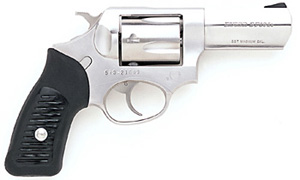
A small five shot revolver in .38 Special would be my choice for a woman to carry. It is a little more bulky than the Double Tap, which would tend to keep it from getting lost in her purse. (By the way, there are special purses adapted for carrying a weapon, and if my wife wanted to carry I would insist that she get one. That would be futile because she likes bling and has too many purses already.)
You can get revolvers in .357 magnum, which gives you the option for more power if you can handle it or want it. Such revolvers also shoot .38 Special, so they are versatile. The .38 Special is more comfortable to shoot than a .357.
Two examples: (Not to scale. They are about the same size although the one on the left is a tiny bit larger, if I'm not mistaken. It is also the heavier and more robust of the two.)
  |



