Profiling The Profiler: The Unflattering Mirror Published 1, April 14, 2012 Criminal law , Justice , Science , Society 49 Comments
By Mark Esposito, Guest Blogger

Which ethnic subset of American teens is most likely to become substance abusers and thus possessors of illegal drugs, alcohol, or tobacco?
a. Caucasians; b. Hispanics; c. African-Americans.
If you answered “c” you are wrong and probably Caucasian. Large-scale national surveys like the National Comorbidity Survey Replication (NCS-R) find that African-Americans are significantly less likely to have substance use disorders than their White counterparts. Yet African-America teens are more commonly targeted, arrested, and convicted of substance abuse crimes than Caucasians. This is particularly curious because as the majority population (African-Americans make up just 13.6% of the US population) Caucasians form the overwhelming majority of substance abusers. Are the cops blind? Or just blinded by color?
The DOJ defines racial profiling as
any police-initiated action that relies on the race, ethnicity or national origin rather than the behavior of an individual or information that leads the police to a particular individual who has been identified as being, or having been, engaged in criminal activity
Recently, Attorney General Eric Holder stated that ending racial profiling
was a “priority” for the Obama administration and that profiling was “simply not good law enforcement.” Sadly, that priority has not been accomplished.
Racial profiling usually rears its ugly head in the context of police-initiated traffic stops based on the belief of some officers that minority kids are more likely to possess contraband like drugs and alcohol. But numerous studies have determined that minorities are “no more likely to be found with drugs, and when minorities are targeted by racial profiling, one strong indication is a low ‘hit rate’ of contraband finds.”
Traffic stops are not the only place where racial profiling is rampant despite a similar “low hit rate.” The ACLU reports that:
Moreover, an exclusive focus on traffic stops fails to reveal racial disparities in stops, searches and arrests of women of color pedestrians, particularly in the context of profiling women of color as street-level “drug mules.” While this practice at the nation’s airports is well documented by a 2000 General Accounting Office study, it also extends into streets and homes across the country.Additionally, racial profiling of women of color as drug users has permeated delivery rooms across the nation, where pregnant women fitting the “profile” of drug users – young, poor, and Black – are drug-tested and sometimes subject to criminal charges.
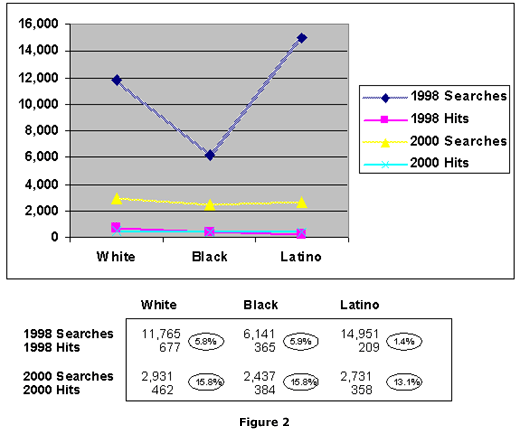
There has been some push-back against the discriminatory practice of racial profiling, but it has been limited. The ”low hit rate” was an important factor (along with persistent complaints from minorities) in the modification of the US Customs Service’s protocols in conducting searches based on racial profiling. “The Service adopted reforms designed to eliminate racial, ethnic and gender bias in their search activity, while instituting stronger supervisor oversight for searches.”
The results were telling as depicted on this graph provided by the foremost experts on racial profiling, Lamberth Consulting:

Using more objective criteria to search, the Service posted a three-fold increase in “hits” in contrast to the older and more insidious method of racial profiling.
Following the US Customs experience, numerous states have collected data from their law enforcement officers to see if racial profiling was a problem in their jurisdiction. A 2003 study in “liberal” Minnesota is indicative,and the results are discouraging:
Blacks are 214% more likely to be stopped and 155% more likely searched than expected, but during discretionary searches contraband was 35% less likely to be found. For Latinos, the corresponding figures were +95%, +73% and -47%, again showing that Latinos are more frequently stopped and searched, but much less likely found with contraband. For whites, the corresponding statistics were -13%, -37%, and +37%, confirming discriminatory policing, as whites were less likely to be stopped, less likely to be searched, but much more likely found with contraband when searched.
Given the utter and statistically demonstrated disutility of racial profiling in law enforcement, why is it still a problem today? The answers lies deep in our DNA and our psychological reliance on tribal mentality when reacting to the “other.”
At the turn of the Century, many Caucasians stereotyped African-Americans as dirty and contaminated. This perception led to the infamous “Jim Crow” laws which segregated restrooms, restaurants, and even swimming facilities. According to the mentality of the time, it was “just common sense.” The AMA even got into the act saying that African-Americans were carriers of disease, “a social menace whose collective superstitions, ignorance, and carefree demeanour stood as a stubborn affront to modern notions of hygiene…” (Wailoo, 2006).
Yet despite this obvious insult African-Americans were commonly employed in Causation homes as cleaning ladies, cooks, nannies, and maids. Africa-Americans were “clean enough” to cook the food for Caucasian tables but not clean enough to sit down to eat with them. But what was the truth about the culture? As psychologist, Monnica Williams of the University of Louisville, explains, the truth was far different:
Even today, despite lower per capita incomes, Black Americans spend more on laundry and cleaning supplies than their White counterparts, even after adjusting for differences in average annual spending. African-American women engage in increased hygiene practices and report more cleaning and grooming behaviors. In fact, a greater emphasis on cleaning behaviors appears to be a cultural norm for African-Americans.
But why are Caucasians so ready to accept stereotypical notions of African-American traits that have no basis in fact and which are evidently disregarded in personal dealings such as hiring decisions for domestic workers?
Let’s look at the commonly held Caucasian perception that African-American males are more likely to be hostile to Caucasians than the other way around. This perception featured mightily in two recent posts here on Res Ipsa Loquitur. The first is the case of Trayvon Martin and the second the beating of the Caucasian tourist in Baltimore. What does the research tell us about this perception?
In 1996, researchers Mark Chen , John Bargh, and Laura Burrows looked at the unconscious reactions of 41 Caucasian college students to subliminal photographs of African-Americans. The study consisted of a long computer generated test depicting a box containing a random number of colored circles (from 4-25) . The students were tasked with quickly identifying whether the box contained an odd or even number of circles. A new box was shown every 2-3 seconds. After about 130 trials, an error message was displayed indicating that the students’ answers had not been saved and the test would have to be retaken. A researcher would then enter the testing room and fiddle with the computer, declaring the error message was wrong and the data were actually stored. Prior to each of the 130 trials a subliminal photograph of a young African-American male or Caucasian male was flashed.
The reactions of the students were videotaped and the students completed two surveys, the Racial Ambivalence Scale (Katz & Hass, 1988) and the Modern Racism Scale ( McConahay, 1986). Both are designed to test the takers level of racism.
The results were surprising. The testing demonstrated that when Caucasian students were presented with even a subliminal picture of an African-American, they responded toward another Caucasian student in a more hostile manner, generating more hostility in the other student. The researchers described the results this way:
The presented results show that these behavioral responses become automatically linked to representations of social situations just as previous research found perceptual trait constructs, stereotypes, and attitudes to become automatically activated.
The upshot is that racial profiling is both a conscious and unconscious reaction to the “other.”
In a similar study, Dr. Monnica Williams found comparable results in a test of racial anxiety. Here’s how she described the test:
Using a diverse group of undergraduate evaluators, we individually assessed Black and White participants for anxiety and affect. I was expecting to find that Black participants would be more anxious when assessed by a White interviewer, due to concerns about being negatively stereotyped. I was completely unprepared for what I found. Black participants were fine with their White evaluator, but White participants showed significantly higher levels of negative affect when assessed by a Black evaluator. In other words, working with a Black person made the White person unhappy, grumpy, and annoyed. I imagine it didn’t help that the Black person was in the counter-stereotypical position of evaluating the White person, upsetting the unspoken but expected power differential dictated by the pathological stereotype.
How then can we overcome the moral and legal challenge presented by our own ingrained attitudes? First it’s important to remember that racial stereotyping is a reaction and not a trait. Like most emotional reactions it can be managed and mitigated with cool, calm reason. Second, racial profiling must be declared a societal anathema. It doesn’t work and it is decidedly undesirable in a society predicated on the value of every citizen to participate fully. Finally, we need to acknowledge the adverse consequences that racial profiling has wrought. Does anyone seriously contend that had George Zimmerman met a 17 -year-old Caucasian male adorned in a sweat shirt and carrying candy, the same result would have occurred? Like many, Zimmerman was influenced by his ingrained reaction to conclude that Trayvon was ”an asshole,” and a “punk” — in essence, “the other.” That reaction may not have been his fault in the sense of a conscious choice, but failing to recognize that shortcoming and acting aggressively to pursue the teen was, and may send him to the penitentiary for life.
What do you think?
Sources: PsychologyToday; Journal of Personality & Social Psychology; CafeConLecheRepublicans.com
~Mark Esposito, Guest Blogger
jonathanturley.org |