If the Left has its way with the Constition .....
West was right, the Progressive Democrats are Soviet-style Communists at heart
By Donald Sensing
... then
...the only large entity left able to speak will be the government. This is what statists like the sponsors of this proposal really want. What proposal is that? The Supreme-Soviet-sounding " People's Rights Amendment," sponsored by Democrat US Rep. Jim McGovern and supported by US House minority leader Rep. Nancy Pelosi, that would amend our Constitution to define "person" or any part of "the people," as the Constitution uses the term, to mean only individual human beings. The PRA reads as follows in entirety:
Section 1. We the people who ordain and establish this Constitution intend the rights protected by this Constitution to be the rights of natural persons.
Section 2. The words people, person, or citizen as used in this Constitution do not include corporations, limited liability companies or other corporate entities established by the laws of any State, the United States, or any foreign state, and such corporate entities are subject to such regulations as the people, through their elected State and Federal representatives, deem reasonable and are otherwise consistent with the powers of Congress and the States under this Constitution.
Section 3. Nothing contained herein shall be construed to limit the people's rights of freedom of speech, freedom of the press, free exercise of religion, freedom of association and all such other rights of the people, which rights are inalienable. The presumptive rationale for the amendment is a Supreme Court decision (Citizens United v. Federal Election Comission) that invalidated the part of the Bipartisan Campaign Reform Act (known as BCRA or “McCain-Feingold”) that restricted corporate expenditures in elections. The amendment's sponsors say that the only way to reverse the Supreme Court's decision is to amend the Constitution. Since the Court held that corporations have Constitutional status as persons before the law (in fact, a longstanding legal principle, not a novel ruling), the amendment therefore dismisses such entities from personhood as Constitutionally defined.
Rep. McGovern explains it this way:
[iframe height=315 src="http://www.youtube.com/embed/uGeCWOxzpP4" frameBorder=0 width=560 allowfullscreen=""][/iframe]
And Pelosi says,
[iframe height=315 src="http://www.youtube.com/embed/ruPn6vWcjPE" frameBorder=0 width=560 allowfullscreen=""][/iframe]
What does all this mean? According to UCLA Law School Prof. Eugene Volokh, the PRA would " Strip Most Newspapers, Churches, Nonprofits, and Other Corporations of All Constitutional Rights."
So just as Congress could therefore ban the speech of nonmedia business corporations, it could ban publications by corporate-run newspapers and magazines — which I think includes nearly all such newspapers and magazines in the country (and for good reason, since organizing a major publications as a partnership or sole proprietorship would make it much harder for it to get investors and to operate). Nor does this proposal leave room for the possibility, in my view dubious, that the Free Press Clause would protect newspapers organized by corporations but not other corporations that want to use mass communications technology. Section 3 makes clear that the preservation of the “freedom of the press” applies only to “the people,” and section 2 expressly provides that corporations aren’t protected as “the people.”
Congress could also ban the speech and religious practice of most churches [boldface added], which are generally organized as corporation. It could ban the speech of nonprofit organizations that are organized as corporations. (Congressman McGovern confirms this: “My ‘People’s Rights Amendment’ is simple and straightforward. It would make clear that all corporate entities — for-profit and non-profit alike — are not people with constitutional rights. It treats all corporations, including incorporated unions and non-profits, in the same way: as artificial creatures of the state that we the people govern, not the other way around.”) Congress could ban speech about elections and any other speech, whether about religion, politics, or anything else. It could also ban speech in viewpoint-based ways.
State legislatures and local governments could do the same. All of them could seize corporate property without providing compensation, and without providing due process. All corporate entities would be stripped of all constitutional rights. Quite a proposal; I blogged more generally about this issue here, but it seems to me that simply listing the consequences of Congressman McGovern’s proposal largely suffices to explain its flaws. As clergy, I will speak (while I can, I suppose), about the effect the PRA would have on churches or other religious assemblies. Prof. Volokh is correct that it is commonplace for churches to be incorporated as a not-for-profit corporation. One big reason is because of tort liability.
As a tort lawyer explained at a meeting I attended, if a church is not incorporated and someone is injured on the property, that person can sue not the church, which is not a legal entity (being unincorporated), but the entire membership of the church, each member being named individually in the suit. Because of the established principle of joint and several liability, each member can be ordered by the court to pay a pro-rata share of the damages. Not only that, every individual church member is potentially liable for the entire amount of the damages. This has happened, said this trial lawyer, and the only way to prevent it it to make the church a legal entity, or "person," under the law.
So Prof. Volokh also points out that the only present arrangement that would escape the PRA's tentacles is a partnership. After noting that any corporation would be stripped of Constitutional rights, including, say, media conglomerates (are you paying attention, CNN?), he goes on to say,
Now this would have two effects.
First, any media organization that wants to be free would thus have to give up the benefits of the corporate form, and will have to organized as a partnership. This will make it much harder for those media organizations to raise operating capital, dealing with changes in ownership as partners die or leave, and the like. Prof. Volohk's coblogger, Ilya Somin, Associate Professor at George Mason University School of Law, explains the tyrannical nature of the PRA thus:
Thus, the PRA would deny all constitutional rights to all entities organized as corporations. If the Amendment passes, government would be free to search corporate-owned premises at will, restrict freedom of religion at houses of worship owned by corporate entities (which includes most churches), condemn corporate-owned property for private uses and without paying compensation, and so on. This is exactly where the Left truly wants to go and has been heading for many years. Now they do not even attempt to mask it. As Prof. Somin points out, the whole point of the PRA "is precisely to deny constitutional rights to organizations utilizing the corporate form." But as he also observes, what are corporations except an expression of the "natural persons" who own them?
A word to skeptics:
I would say to readers who are skeptical of the conclusions that Professors Volokh and Somin draw, or of the implications I identify, please just consider the record of the federal government over the past half-century (or more) and ask yourself exactly why you are skeptical:
Self restraint on the part of government officials or bureaucrats? Based on what empirical or historical evidence do you think that future governments will be more restrained than those of the last several decades?
Good will on the part of government agencies? Again, based on what historical record and what reasons?
Try to think of a single time when government, having been granted (or having seized) the power to exercise more control or regulation of citizens' lives has failed to use that authority beyond what was ever envisioned -- regardless of which party has controlled the Congress or the White House at the time. We would do well to heed George Washington's warning, "Government is not reason; it is not eloquent; it is force. Like fire, it is a dangerous servant and a fearful master."
In March 2010, I asked, " Shall federalism be killed and buried or shall it be restored?" We know the Left's answer more certainly now than ever. In my post, I proposed two sets of amendments for contrast. First, Set One - Amendments to Enhance the Power of the Federal Government at the Expense of the People and the States and then Set Two - The Preservation of the Rights and Powers of the People and of the States.
Update: See my follow up post, " The Peoples Rights Amendment: Follow the money."
senseofevents.blogspot.com
The Peoples Rights Amendment: Follow the money
By Donald Sensing
I posted earlier about how some Democrats in the Congress, led by Rep. Jim McGovern (D.-Mass/8) want to amend the US Constitution to so as to mean that, "The words people, person, or citizen as used in this Constitution do not include corporations, limited liability companies or other corporate entities... ."
The presumptive rationale for the amendment is a Supreme Court decision (Citizens United v. Federal Election Comission) that invalidated the part of the Bipartisan Campaign Reform Act (known as BCRA or “McCain-Feingold”) that restricted corporate expenditures in elections. The Constitution as it is today protects the rights of "the people" or, on occasion "person" or persons." By excluding any kind of incorporated entity from being defined as part of the people or as a person before the law, the amendment strikes corporations out of entitlement to those protections. I cite extensive analysis by law professors Eugene Volokh and Ilya Somin in my post.
The first question of investigating politics, of course, is, "Who benefits?" And guess what, any political benefit that might be gained from the Supreme-Soviet-sounding "Peoples Rights Amendment" accrues almost wholly to Democrats. (I want to show you something. It's my shocked face.)
There are two main things to understand about the PRA (its full text is at my original post).
1. It permits but does not require state or local governments to dictate the activities (and not just political activities) of corporate entities. Taking action under its provision would be wholly at the discretion of a governor, attorney general or president. But hey, they would never resort to purely partisan political activities, would they?
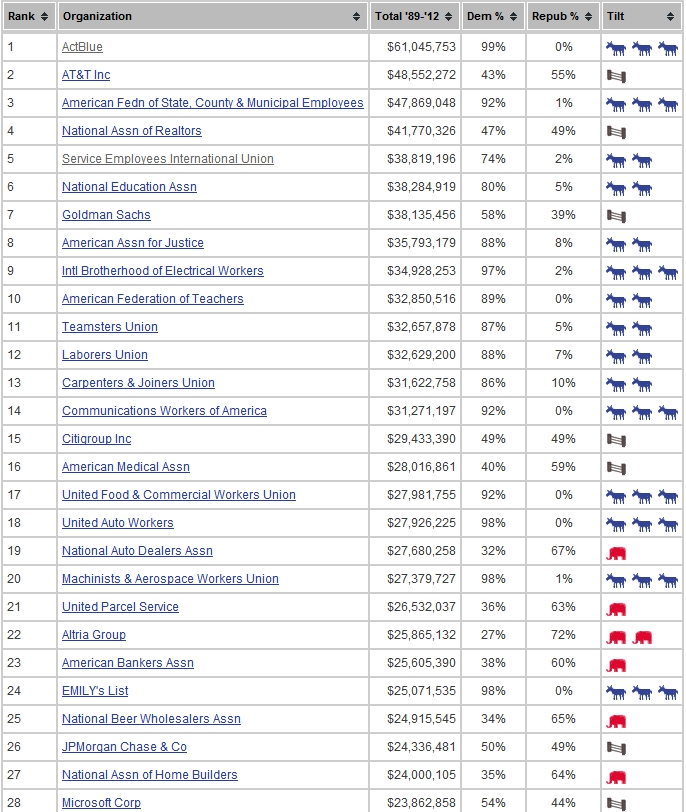
2. The second thing is this chart from OpenSecrets.org of America's top political donors. The coding in the right column is self evident.
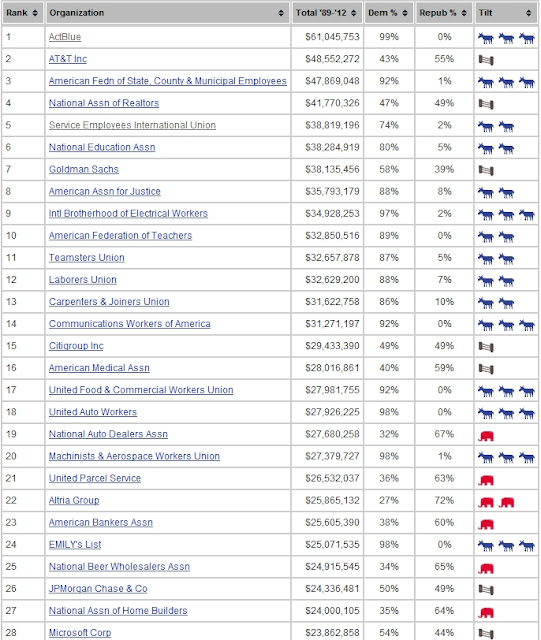
It's a safe bet that pretty much all these entities are incorporated somehow. It's an even safer bet that when political authority is majority Democrat, of the 28 corporations shown here (OpenSecrets lists 140 altogether), precisely six will come under Justice Department action.
Take, for example, Comcast Corp. Here is what its donation chart looks like:
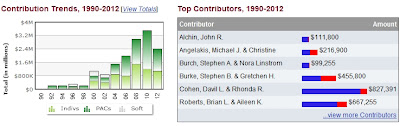
Yep, a Democrat-led Justice Dept. is going jump all over Comcast, isn't it?
And when Republicans are in majority? Well, they are hoist on their own petard. Except for RINOs like Sen. John McCain, the Republicans won't support ratification of the amendment anyway. Since the PRA does not actually require any action to be taken, pretty much none will by Republicans, who still have a shred (though only a shred) of Constitutional fealty left in them.
What the PRA would also do is let governments shake down incorporated entities: "Hey, nice incorporated business/church/LLC you got here. Be a shame if it was suddenly seized one day because your contributions are going to the wrong party."
Oh, no, who am I kidding, the federal government would never bully corporations into compliance with its wishes, would it?
No one can possibly be surprised to understand that the "Peoples Rights Amendment" is not about protecting the rights of the people, but increasing the power of the government and the money supply of its officials. The more Orwellian the Democrats call an initiative, the more certainly they are out for themselves. Progressivism is not about helping the people. it is about protecting the power of progressives.
senseofevents.blogspot.com |