For those not asleep at the wheel...this is as near real time production of crude.... as it gets.
http://www.amara.com/sl9/sl9_impactG.html
2 outtakes;
1. Fragment G, the largest and best studied, created a fireball at least 3,000 km high, at least 7,000 degrees Kelvin, and left a black eye twice the diameter of the earth. E. Shoemaker believes G's kinetic energy was equivalent to 6 trillion tons TNT, hundreds of times greater than the world's entire nuclear arsenal. If it struck the Earth instead, it would have left a crater 60 km across.
(hence we had heterogeneous Nucleation)
2. Some scientists refer to the dark material as soot, silicates, or tar-like hydrocarbons.
disclaimer...the two outtakes should not be measured by the order in which they appear.......relative to thier importance.
Bottom Line....No oil was ever a fossil.
| To: dvdw© who wrote (95829) | 10/24/2012 8:07:17 PM | | From: dvdw© | Respond to of 95889 | | Because we are in Input mode you need to review the facts Impact G reached 7000 K temperature, with this understanding;
most substances, melting and freezing points are approximately equal. For example, the melting point and freezing point of the element mercury is 234.32 kelvin (-38.83 °C or -37.89 °F). However, certain substances possess differing solid-liquid transition temperatures. For example, agar melts at 85 °C (185 °F) and solidifies from 31 °C to 40 °C (89.6 °F to 104 °F); such direction dependence is known as hysteresis. The melting point of ice at 1 atmosphere of pressure is very close [2] to 0 °C (32 °F, 273.15 K); this is also known as the ice point. In the presence of nucleating substances the freezing point of water is the same as the melting point, but in the absence of nucleators water can supercool to -42 °C (-43.6 °F, 231 K) before freezing.
The chemical element with the highest melting point is tungsten, at 3683 K (3410 °C, 6170 °F) making it excellent for use as filaments in light bulbs. The often-cited carbon does not melt at ambient pressure but sublimes at about 4000 K; a liquid phase only exists above pressures of 10 MPa and estimated 4300–4700 K. Tantalum hafnium carbide (Ta4HfC5) is a refractory compound with a very high melting point of 4488 K (4215 °C, 7619 °F). [3] At the other end of the scale, helium does not freeze at all at normal pressure, even at temperatures very close to absolute zero; pressures over 20 times normal atmospheric pressure are necessary.
[ edit] Melting point measurements
Main article: Melting point apparatus
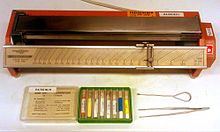

Kofler bench with samples for calibration
Many laboratory techniques exist for the determination of melting points. A Kofler bench is a metal strip with a temperature gradient (range from room temperature to 300 °C). Any substance can be placed on a section of the strip revealing its thermal behaviour at the temperature at that point. Differential scanning calorimetry gives information on melting point together with its enthalpy of fusion.

Automatic digital melting point meter M5000
A basic melting point apparatus for the analysis of crystalline solids consists of a oil bath with a transparent window (most basic design: a Thiele tube) and a simple magnifier. The several grains of a solid are placed in a thin glass tube and partially immersed in the oil bath. The oil bath is heated (and stirred) and with the aid of the magnifier (and external light source) melting of the individual crystals at a certain temperature can be observed. In large/small devices, the sample is placed in a heating block, and optical detection is automated.
The measurement can also be made continuously with an operating process. For instance, oil refineries measure the freeze point of diesel fuel online, meaning that the sample is taken from the process and measured automatically. This allows for more frequent measurements as the sample does not have to be manually collected and taken to a remote laboratory.
[ edit] Thermodynamics

Pressure dependence of water melting point
Not only is heat required to raise the temperature of the solid to the melting point, but the melting itself requires heat called the heat of fusion.
From a thermodynamics point of view, at the melting point the change in Gibbs free energy (?G) of the material is zero, but the enthalpy (H) and the entropy (S) of the material are increasing (?H, ?S > 0). Melting phenomenon happens when the Gibbs free energy of the liquid becomes lower than the solid for that material. At various pressures this happens at a specific temperature. It can also be shown that:
 Here T, ?S and ?H are respectively the temperature at the melting point, change of entropy of melting and the change of enthalpy of melting. Here T, ?S and ?H are respectively the temperature at the melting point, change of entropy of melting and the change of enthalpy of melting.
The melting point is sensitive to extremely large changes in pressure, but generally this sensitivity is orders of magnitude less than that for the boiling point, because the solid-liquid transition represents only a small change in volume. [4] [5] If, as observed in most cases, a substance is more dense in the solid than in the liquid state, the melting point will increase with increases in pressure. Otherwise the reverse behavior occurs. Notably, this is the case of water, as illustrated graphically to the right, but also of Si, Ge, Ga, Bi. With extremely large changes in pressure, substantial changes to the melting point are observed. For example, the melting point of silicon at ambient pressure (0.1 MPa) is 1415 °C, but at pressures in excess of 10 GPa it decreases to 1000 °C. [6] Melting points are often used to characterize organic and inorganic compounds and to ascertain their purity. The melting point of a pure substance is always higher and has a smaller range than the melting point of an impure substance or, more generally, of mixtures. The higher the quantity of other components, the lower the melting point and the broader will be the melting point range, often referred to as the pasty range. The temperature at which melting begins for a mixture is known as the solidus while the temperature where melting is complete is called the liquidus. Eutectics are special types of mixtures that behave like single phases. They melt sharply at a constant temperature to form a liquid of the same composition. Alternatively, on cooling a liquid with the eutectic composition will solidify as uniformly dispersed, small (fine-grained) mixed crystals with the same composition.
In contrast to crystalline solids, glasses do not possess a melting point; on heating they undergo a smooth glass transition into a viscous liquid. Upon further heating, they gradually soften, which can be characterized by certain softening points. |
|




