We've detected that you're using an ad content blocking browser plug-in or feature. Ads provide a critical source of revenue to the continued operation of Silicon Investor. We ask that you disable ad blocking while on Silicon
Investor in the best interests of our community. If you are not using an ad blocker but are still receiving this message, make sure your browser's tracking protection is set to the 'standard' level.
My goodness Mq...what are we going to do about this.. (elmat's trips would be a lot shorter in some cases :O)
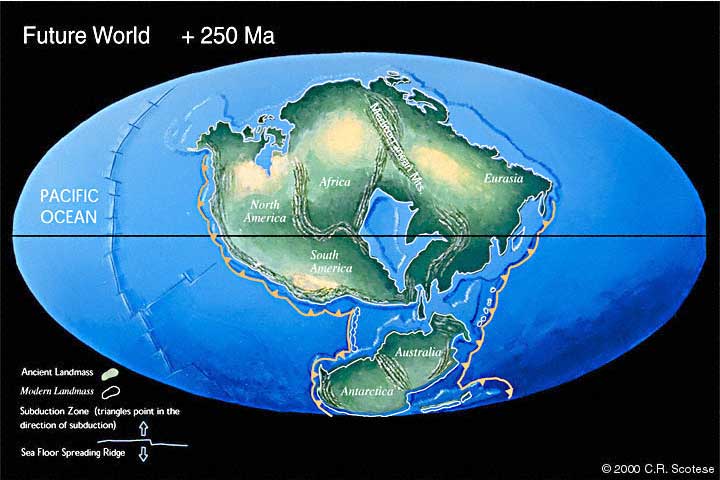
great havoc coming in the real estate market in any event... Al better get cracking on plate tectonics next.. it's a disaster :O)
We're in big trouble all very Pangean ;o)
and then there is this clear and present danger.. which offers some warming relief :o) it says we're going to get colder again eventually so it can't be very scientific though ...:O) science.howstuffworks.com
Predicting the Earth's future is a bit like predicting the weather: the further you look ahead, the more your accuracy suffers. Based on this logic, it seems impossible to look ahead 50,000 years and have any chance of being right. And yet we have more than 4 billion years of history from which to draw lessons. When you consider the history of Earth on a geologic scale, you can count on certain inexorable processes -- evolution, extinction, plate tectonics, climate change -- to continue shaping our planet far into the foreseeable future. Let's look at some of these processes to predict what the Earth might look like in 50 millennia.
First, Earth is a planet that spins on its axis as it revolves around the sun. These movements have certain implications for organisms trying to eke out an existence down on the planetary surface. For example, Earth not only rotates on its axis, it also wobbles like a spinning top. Astronomers call this precession, and it causes the axis to point to different parts of the sky in a 26,000-year cycle. Right now, the North Pole points to Polaris -- the North Star. In 13,000 years, Vega will become the new North Star. In 50,000 years, Earth will have completed two precession cycles, which means we'll be right where we are today, at least in terms of our view of the night sky.
More significant are the changes that occur because of aberrations in Earth's orbit and tilt. Over a 97,000-year cycle, Earth's orbit changes from a mostly circular shape to a somewhat elliptical shape. At the same time, the tilt of Earth's axis shifts a few degrees, from 22.1 degrees at one extreme to 24.5 degrees at the other. The combined effect of these movements has a profound impact on how much solar energy reaches the planet. When the Earth's position in space is just right, the planet experiences an ice age, a time when polar ice sheets grow thicker and cover more continental land mass. Historically, ice ages have lasted about 100,000 years, with warmer, interglacial periods lasting about 10,000 years in between. Earth is currently enjoying one of these interglacial periods, but will eventually enter another deep freeze. Many scientists think that the next ice age will reach its peak in about 80,000 years [source: Revkin]. So, in 50,000 years, the planet will likely be a much colder place, with ice sheets approaching areas as far south as New York City.
and of course NASA is in on the action too :O)
OTOH Mq if you don't relent this will be happening to you soon..
unless the women get you first.. That's my bet LOL