Speaker Boehner: GOP House Open to Returning to DC Over Holidays to Discuss 'Cliff
Speaker Boehner: GOP House Open to Returning to DC Over Holidays to Discuss 'Cilff'
Published: Friday, 21 Dec 2012 | 10:19 AM ET
With his "Plan B" in tatters, House Speaker John Boehner called on President Barack Obama on Friday to act on averting the "fiscal cliff."
He said he was not ruling out working with Democrats to address the country's "significant spending problem" and that Congress could come back to work over the Christmas break.
"Unless the president and Congress take action, tax rates will go up for every American taxpayer, and devastating defense cuts will go into effect in 10 days," Boehner said.
He spoke on the morning after he dropped his alternative tax plan because of a lack of support among fellow Republicans. After Thursday's dramatic development, the White House said Obama will press ahead with Congress in hopes of preventing across-the-board tax increases set to strike taxpayers Jan. 1.
Boehner abruptly canceled a vote in the GOP-controlled House on Thursday night, conceding the measure to raise tax rates on million-dollar earners "did not have sufficient support from our members to pass."
Markets were unsettled by the political chaos and the prospect of going over the "fiscal cliff." (Read More: Stocks Tumble on 'Fiscal Cliff' Setback.)
At the White House, Press Secretary Jay Carney said Obama's "main priority is to ensure that taxes don't go up on 98 percent of Americans and 97 percent of small businesses," citing statistics associated with Obama's campaign promise to increase top tax rates on households earning more than $250,000 a year.
"The President will work with Congress to get this done and we are hopeful that we will be able to find a bipartisan solution quickly that protects the middle class and our economy," Carney said. Pointedly, the statement didn't say whether Obama would work with Boehner to revive stalled talks or turn first to the Democratic-controlled Senate to try to salvage the situation.
Play Video
Is 'Cliff' Compromise Possible?
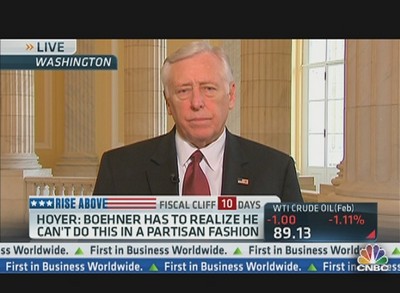
A look at the future of "fiscal cliff" talks after last's night's defeat of "Plan B" in the House, with Rep. Steny Hoyer, (D-MD), and Barry Knapp, Barclays.
Senate Majority Leader Harry Reid said the sudden development showed that Republicans must now work with Democrats to try to avoid the cliff.
"Speaker Boehner's partisan approach wasted an entire week and pushed middle-class families closer to the edge," Reid said. "The only way to avoid the cliff altogether is for Speaker Boehner to return to negotiations, and work with President Obama and the Senate to forge a bipartisan deal."
Democratic House Minority Whip Steny Hoyer told CNBC's "Squawk Box" on Friday he thought Republicans would be willing to work with the president. "We still need to focus on not going over the cliff," he said. "It's not good for the country, not good for the economy, not good for the confidence of the American people."
He added: "John Boehner could not get his own bill through the Republican majority. What John Boehner I think can do is come to an agreement with the president and get half of his people or a little more than half of his people" to reach a bipartisan agreement.
Thursday's dramatic events leave little time for Obama and bruised lawmakers to prevent across-the-board tax increases and deep spending cuts from taking effect with the new year. Economists say the combination threatens a return to recession for an economy that has been recovering slowly from the last one.
The House will not meet again until after Christmas, if then, and the Senate is expected to meet briefly on Friday, then not reconvene until next Thursday. (Read More: Can a Deal Still Get Done?)
Play Video
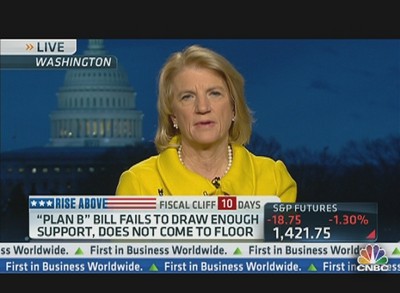
'Merry Christmas, We Don’t Have the Votes': GOP Lawmaker
Rep. Shelley Moore Capito, (R-WV), discusses the defeat of the House's "Plan B" bill and the next step in reaching a compromise on the looming "fiscal cliff."
Boehner's attempt to tactically retreat from a longstanding promise to maintain Bush-era tax rates for all was designed to gain at least some leverage against Obama and Senate Democrats in the "fiscal cliff" endgame. Thursday's drama was a major personal defeat for the speaker, who retains the respect and affection of his tea party-infused conference, but sometimes has great difficulty getting them to follow his leadership. (Read More: 'Plan B' Vote Scrapped)
Boehner's "Plan B" was crafted to prevent tax increases set to kick in Jan. 1 on virtually every taxpayer. But it also had provisions that would have let rates rise for those at the upper income range -- a violation of long-standing Republican orthodoxy that triggered the GOP revolt.
The hope was that successful House action on the measure would force Senate Democrats to respond. But Reid made clear that Plan B would have been dead on arrival in the Democratic-controlled Senate, and the White House had promised to veto it if it reached the Oval Office. (Learn More: White House Threatens Veto.)
Boehner announced he would move to Plan B after testing the waters with fellow Republicans regarding a possible pact with Obama on tax increases of $1 trillion -- including the breakthrough proposal on higher tax rates -- and finding them not very receptive.
In a statement, Boehner said the House has previously passed legislation to prevent all the tax increases from taking effect, and noted that earlier in the evening it had approved a measure to replace across-the-board spending cuts with "responsible" reductions.
In arguing for legislation with a million-dollar threshold for higher tax rates, Boehner said the president has called for legislation to protect 98 percent of the American people from a tax hike. "Well, today we're going to do better than that," he said of the measure that raises total taxes by slightly more than $300 billion over a decade. "Our bill would protect 99.81 percent of the American people from an increase in taxes."
Democrats said that by keeping tax rates unchanged below $1 million -- Obama has offered a compromise $400,000 level -- Republicans had turned the bill into a tax break for the wealthy. They also accused Republicans of crafting their measure to impose a tax increase on 11 million middle class families.
"This is a ploy, not a plan," said Rep. Sander Levin, D-Mich. He accused Republicans of being "deeply cynical," saying the legislation would scale back some education and child tax credits.
A companion bill on the evening's House agenda, meant to build GOP support for the tax bill, called for elimination of an estimated $97 billion in cuts to the Pentagon and certain domestic programs over a decade. It cleared the House on a close partisan vote of 215-209.
Those cuts would be replaced with savings totaling $314 billion, achieved through increases in the amount federal employees contribute toward their pensions and through cuts in social programs such as food stamps and the health care law that Obama signed earlier in his term.
Ironically, the votes were set in motion earlier in the week, after Boehner and Obama had significantly narrowed their differences on a compromise to avoid the fiscal cliff. (Read More: Here's How Close Boehner and Obama Are.)
Obama is now seeking $1.2 trillion in higher tax revenue, down from the $1.6 trillion he initially sought. He also has softened his demand for higher tax rates on household incomes so they would apply to incomes over $400,000 instead of the $250,000 he cited during his successful campaign for a new term.
He also has offered more than $800 billion in spending cuts over a decade, half of it from Medicare and Medicaid, $200 billion from farm and other benefit programs, $100 billion from defense and $100 billion from a broad swath of government accounts ranging from parks to transportation to education.
In a key concession to Republicans, the president also has agreed to slow the rise in cost-of-living increases in Social Security and other benefit programs, at a savings estimated at about $130 billion over a decade. (Read More: How Obama Would Change Social Security Payments.)
By contrast, Boehner's most recent offer allowed for about $940 billion in higher taxes over a decade, with higher rates for annual incomes over $1 million. |



