SI
SI
discoversearch

We've detected that you're using an ad content blocking browser plug-in or feature. Ads provide a critical source of revenue to the continued operation of Silicon Investor.  We ask that you disable ad blocking while on Silicon Investor in the best interests of our community.  If you are not using an ad blocker but are still receiving this message, make sure your browser's tracking protection is set to the 'standard' level.
Politics : Mainstream Politics and Economics

 Public ReplyPrvt ReplyMark as Last ReadFilePrevious 10Next 10PreviousNext  
To: Sdgla who wrote (42387)4/29/2013 12:47:13 PM
From: Wharf Rat  Read Replies (1) of 85487
 
WVP is a positive following feed back, and was first placed in the model by Arrhenius, at the end of the 19th century. It goes up as temperature goes up.
"The fact that the alarmists’ models utterly fail to predict actual temperatures" shows that somebody needs to explain to you the difference between shit and shinola.

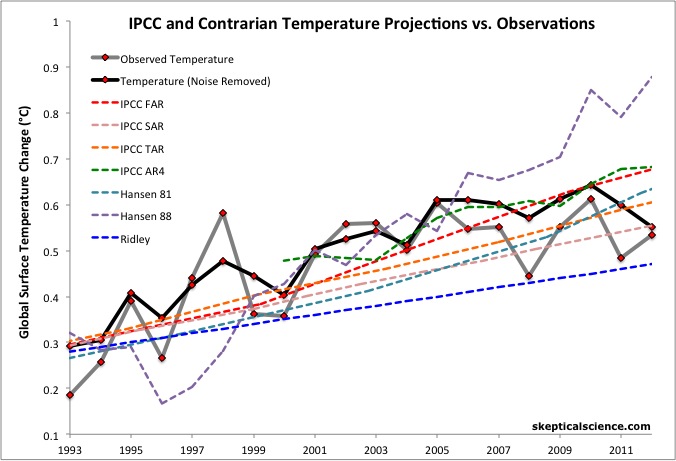
Ridley is a denier..

Matt Ridley in 1993.

"Global warming, too, has shot its bolt, now that the scientific consensus has settled down on about a degree of temperature increase over a century - that is, little more than has taken place in the past century."


Table 1: Predicted global surface warming trend for 1990, 1993, or 2000 through 2012, accounting for actual greenhouse gas emissions, and the difference from the underlying observed trend of approximately 0.16°C/decade

Predictor Predicted Trend (°C/decade) Difference from Underlying Observed Trend
IPCC FAR 0.20 25%
IPCC SAR 0.14 -12%
IPCC TAR 0.16 0%
IPCC AR4 0.18 12%
Hansen '81 0.15 -6%
Hansen '88 0.28 75%
Ridley 0.10 -38%
skepticalscience.com
Dispatch from AGU: How to Understand Water Vapor Feedback

Water vapor feedback is generally defined as the radiative and thermal consequence of changing water vapor concentrations in response to some change in global temperatures. Contrary to skeptic opinion, models don’t assume some particular value of water vapor feedback. Instead, it’s a consequence of whatever water vapor distribution the local surface fluxes and wind patterns end up producing. All models are unanimous that water vapor should be a positive feedback, because (1) higher temperatures leads to more water vapor and (2) more water vapor means that water vapor emissions escape to space from a higher altitude. They are also unanimous that the water vapor feedback is not so strong as to be a runaway feedback. But there’s no fundamental theory that says why this is so
blog.chron.com
Report TOU ViolationShare This Post
 Public ReplyPrvt ReplyMark as Last ReadFilePrevious 10Next 10PreviousNext