Irreducible Complexity in Nature Can evolution lead to IC or not? It is time to look at living examples and let nature decide. Behe's most famous example is a mousetrap. But since a mousetrap is not alive, it doesn't tell us much about whether or how living IC systems might evolve. How about a flytrap instead?
Venus' Flytrap 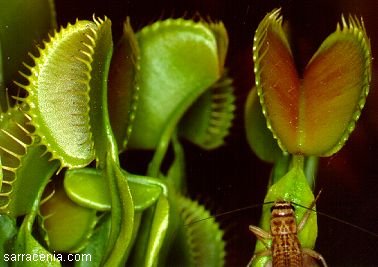
The Venus' flytrap, Dionaea muscipula, is a small flowering plant which grows naturally in acidic wetlands in North and South Carolina. It has a ferocious looking tooth-edged trap for unwary creatures. It traps and digests insects to make up for the lack of nitrogen in the soils of its habitat.
Here's how the trap works. When an insect brushes against the trigger hairs in the center, the lobes snap most of the way shut with surprising speed. If a small insect is caught, it may escape between the teeth, and then the trap reopens without fully closing. If a good sized bug is caught it is digested over the next few days as the trap closes the rest of the way. Then the trap reopens. A trap can only be fully closed about 4 times, so it must be used sparingly.
Do we have an IC system here? We must specify a function and all the parts needed to carry it out (and no extra parts). The function of interest is trapping insects for food in a manner that brings the plant more benefit than the cost of the trap. The parts are the two lobes, the hinge between the lobes (the midrib of the leaf, which anchors the lobes), the trigger hairs, and spines projecting from the edges of the lobes that make a set of bars as the trap closes. The system is just all these parts, and the trap needs all its parts in order to work. Hence it is an IC system.
How might this trap have evolved? I say 'might' have because Venus' flytraps haven't left any fossils that I know of, except a few grains of pollen. Are there any related plants that might provide a clue? Let's look at the well known sundews (Drosera). Sundews trap insects using flypaper traps, slowly closing around insects that get stuck. Darwin, whose book Insectivorous Plants ( 2) is now available online, made careful observations of these remarkable plants, especially the round leaf sundew D. rotundifolia. As Darwin notes,
If a small organic or inorganic object be placed on the glands in the centre of a leaf, these transmit a motor impulse to the marginal tentacles. The nearer ones are first affected and slowly bend towards the centre, and then those farther off, until at last all become closely inflected over the object. This takes place in from one hour to four or five or more hours. [...] Not only the tentacles, but the blade of the leaf often, but by no means always, becomes much incurved, when any strongly exciting substance or fluid is placed on the disc. Drops of milk and of a solution of nitrate of ammonia or soda are particularly apt to produce this effect. The blade is thus converted into a little cup. The manner in which it bends varies greatly. ( 2, pp 9, 12) 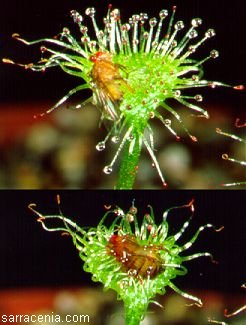
Here is D. rotundifolia with a fly; Makoto Honda ( 3) shows the action with a faster species, D. intermedia. Recent genetic research confirms that Venus's flytrap and the waterwheel plant Aldrovanda are related and are in the sundew family Droseraceae, and that snap-traps very likely evolved from flypaper traps ( 4) as Darwin thought: CONCLUDING REMARKS ON THE DROSERACEAE.
The six known genera composing this family have now been described in relation to our present subject, as far as my means have permitted. They all capture insects. This is effected by Drosophyllum, Roridula, and Byblis, solely by the viscid fluid secreted from their glands; by Drosera, through the same means, together with the movements of the tentacles; by Dionaea and Aldrovanda, through the closing of the blades of the leaf. In these two last genera rapid movement makes up for the loss of viscid secretion. [...] The parent form of Dionaea and Aldrovanda seems to have been closely allied to Drosera, and to have had rounded leaves, supported on distinct footstalks, and furnished with tentacles all round the circumference, with other tentacles and sessile glands on the upper surface. ( 2, pp 355-6, 360).
How did the Venus' flytrap avoid the argument that IC can't evolve? In two ways. First, rather than gaining a part, it lost a part - the glue that the sundews use. Even more interestingly, the trap was able to evolve because the parts evolved. The trap started out as a Drosera-like leaf, and the parts of the leaf were progressively changed. This makes a striking contrast with the mousetrap which Behe has repeatedly presented to illustrate why IC cannot evolve. As a manufactured item the mousetrap neatly illustrates his definition, but with its static parts it cannot model evolution. With evolving parts, nature can create a snap-trap after all. The mechanical and manufacturing analogies so influential in Behe's thinking miss the flexibility of living things. |



