Here Are Those Incongruent Trees From the Yeast Genome
Case Study
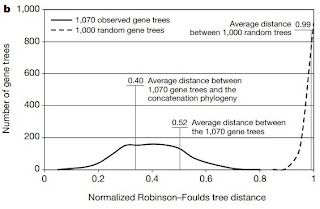
We recently reported on a study of 1,070 genes and how they contradicted each other in a couple dozen yeast species. Specifically, evolutionists computed the evolutionary tree, using all 1,070 genes, showing how the different yeast species are related. This tree that uses all 1,070 genes is called the concatenation tree. They then repeated the computation 1,070 times, for each gene taken individually. Not only did none of the 1,070 trees match the concatenation tree, they also failed to show even a single match between themselves. In other words, out of the 1,071 trees, there were zero matches. Yet one of the fundamental predictions of evolution is that different features should generally agree. It was “a bit shocking” for evolutionists, as one explained: “We are trying to figure out the phylogenetic relationships of 1.8 million species and can’t even sort out 20 yeast.”
In fact, as the figure above shows, the individual gene trees did not converge toward the concatenation tree. Evolutionary theory does not expect all the trees to be identical, but it does expect them to be consistently similar. They should mostly be identical or close to the concatenation tree, with a few at farther distances from the concatenation tree. Evolutionists have clearly and consistently claimed this consilience as an essential prediction.
But instead, on a normalized scale from zero to one (where zero means the trees are identical), the gene trees were mostly around 0.4 from the concatenation tree with a huge gap in between. There were no trees anywhere close to the concatenation tree. This figure is a statistically significant, stark falsification of a highly acclaimed evolutionary prediction.
darwins-god.blogspot.com |




