(5) game on, and let us see just how cretin an idea was to engage against young edward
scmp.com
EXCLUSIVE: Snowden reveals more US cyberspying detailsUS spies are hacking into Chinese mobile phone companies to steal text messages and attacking the servers at Tsinghua University, Edward Snowden has told theSunday Morning Post.
The latest explosive revelations about US National Security Agency cybersnooping in Hong Kong and on the mainland are based on further scrutiny and clarification of information Snowden provided on June 12.
The former technician for the US Central Intelligence Agency and contractor for the National Security Agency provided documents revealing attacks on computers over a four-year period.
The documents listed operational details of specific attacks on computers, including internet protocol (IP) addresses, dates of attacks and whether a computer was still being monitored remotely.
The Sunday Morning Post can now reveal Snowden's claims that the NSA is:
Extensive hacking of major telecommunication companies in China to access text messages
Sustained attacks on network backbones at Tsinghua University, China’s premier seat of learning
Hacking of computers at the Hong Kong headquarters of Pacnet, which owns one of the most extensive fibre optic submarine cable networks in the regionPacnet, which recently signed major deals with the mainland's top mobile phone companies, owns more than 46,000 kilometres of fibre-optic cables. The cables connect its regional data centres across the Asia-Pacific region, including Hong Kong, the mainland, Japan, South Korea, Singapore and Taiwan. It also has offices in the US.
Snowden claims that data from Chinese mobile phone companies has been compromised, with millions of private text messages mined by the NSA.
Cybersecurity experts on the mainland have long feared mobile phone companies had fallen victim to back-door attacks because they were forced to go overseas to buy core technology for their networks. In recent years, those security concerns became more vocal and as a result domestic network equipment suppliers such as Huawai, Datang and ZTE started to close the technology gap, enabling the phone companies to reduce their reliance on foreign suppliers.
As for the attacks at Tsinghua University, the leaked information points to the NSA hacking into the institute's servers as recently as January.
Tsinghua is widely regarded as China's top education and research institute and carries out extensive work on next-generation web technologies.
It is home to one of the mainland's six major network backbones, the China Education and Research Network.
China's reaction to the new revelations will play a large part in the final outcome of the Snowden episode but so far Beijing is playing its cards close to its chest.
Mainland experts said last night they believed Beijing would neither go out of its way to help the US government or give protection to Snowden.
"In the bigger scale of things, Sino-US relations outweigh any information Snowden may have. It is also impractical for China to hope Snowden will co-operate with us. If he wanted to do that, he'd have flown to Beijing," said an expert in Shanghai who requested anonymity.
"On the other hand, the Chinese government will not do anything over-and-above to help the US speed up the extradition process. It will let Hong Kong handle the case according to the protocols and laws," the expert said.
Shi Yinhong, an international relations professor at Renmin University, said eventually the best solution for Beijing is to let Snowden leave Hong Kong. "It doesn't matter where he goes, as long as he is not in Hong Kong."
Shi said Beijing would react strongly if Washington tried to strong-arm Hong Kong into cooperating. He said China would insist that everything must be done according to the city's laws.
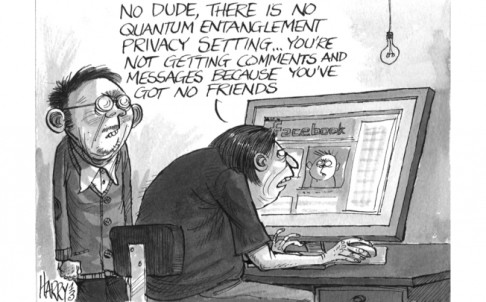 Harry's view Harry's view |



