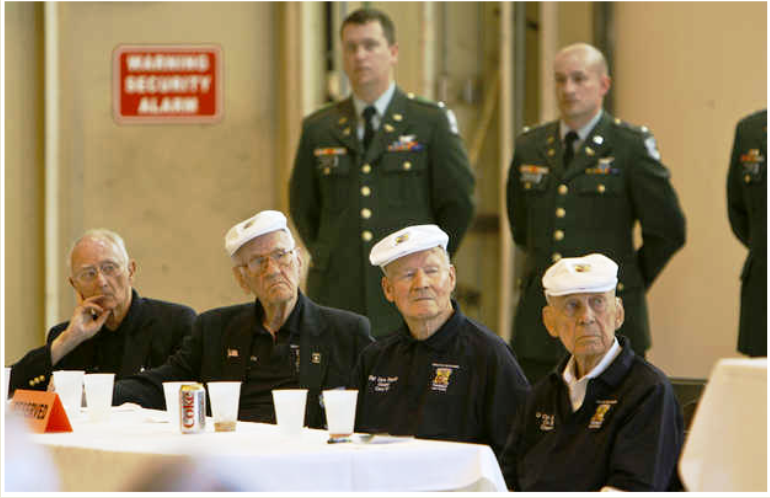
| | | The four remaining survivors of the Doolittle Raiders met together nearby in Fort Walton Beach, Florida this past Tuesday... see their picture below, the four men are seated... their story is below their photo...
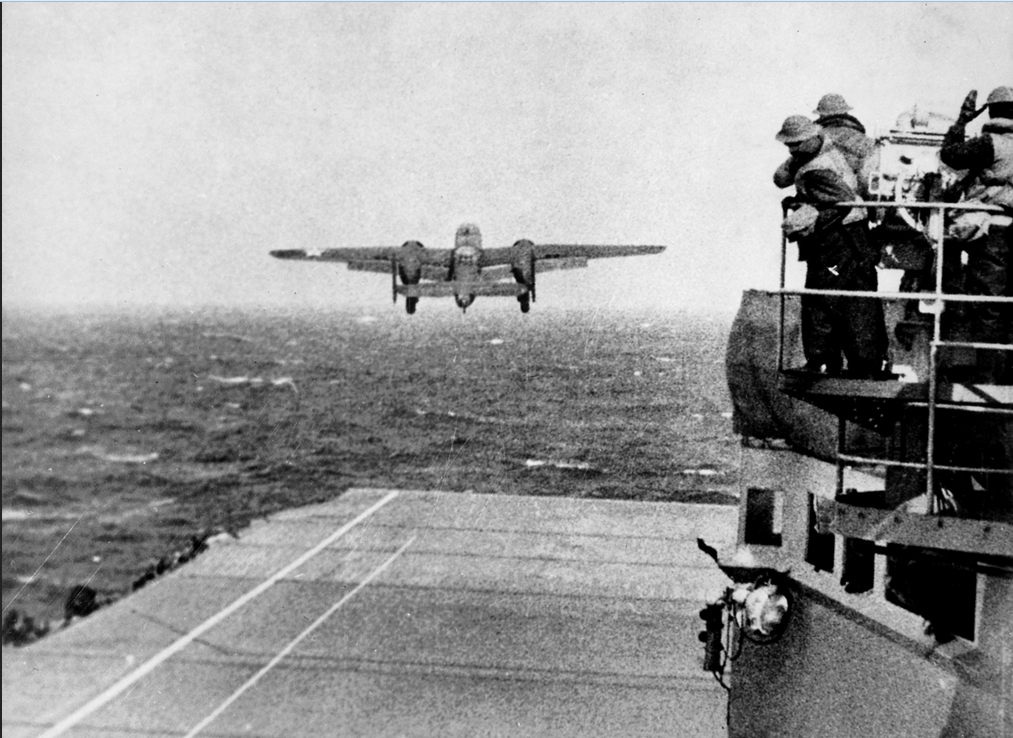
One of them taking off from the U.S.S. Hornet in their B-25 on April 18th, 1942...
Their story... actually, this is the story of all Americans who are proud of our men and women in service then and now...
The Doolittle Raid, also known as the Tokyo Raid, on 18 April 1942, was the first air raid by the United States to strike the Japanese Home Islands (specifically Honshu) during World War II. By demonstrating that Japan itself was vulnerable to American air attack, it provided a vital morale boost and opportunity for U.S. retaliation after the Japanese attack on Pearl Harbor on 7 December 1941. The raid was planned and led by Lieutenant Colonel James "Jimmy" Doolittle, U.S. Army Air Forces. Doolittle later recounted in his autobiography that the raid was intended to bolster American morale and to cause the Japanese to begin doubting their leadership, to which it succeeded:
The Japanese people had been told they were invulnerable ... An attack on the Japanese homeland would cause confusion in the minds of the Japanese people and sow doubt about the reliability of their leaders. There was a second, and equally important, psychological reason for this attack ... Americans badly needed a morale boost. [1]
Sixteen U.S. Army Air Forces B-25B Mitchell medium bombers were launched from the U.S. Navy's aircraft carrier USS Hornet deep in the Western Pacific Ocean, with five men per plane. The plan called for them to bomb military targets in Japan, and to continue westward to land in China—landing a medium bomber on the Hornet was impossible. Fifteen of the aircraft made it to China and the other one made it to the Soviet Union. All but three of the crew survived but all the aircraft were lost. Eight crewmen were captured by the Japanese Army in China and three of these were executed. The B-25 that landed in the Soviet Union at Vladivostok was confiscated and its crew interned for more than a year. Thirteen entire crews, and all but one crewman of a 14th, returned either to the United States or to American forces.However, an estimated 250,000 Chinese civilians were killed by the Japanese during their search for Doolittle's men.
Standing in front of their bomber before takeoff...
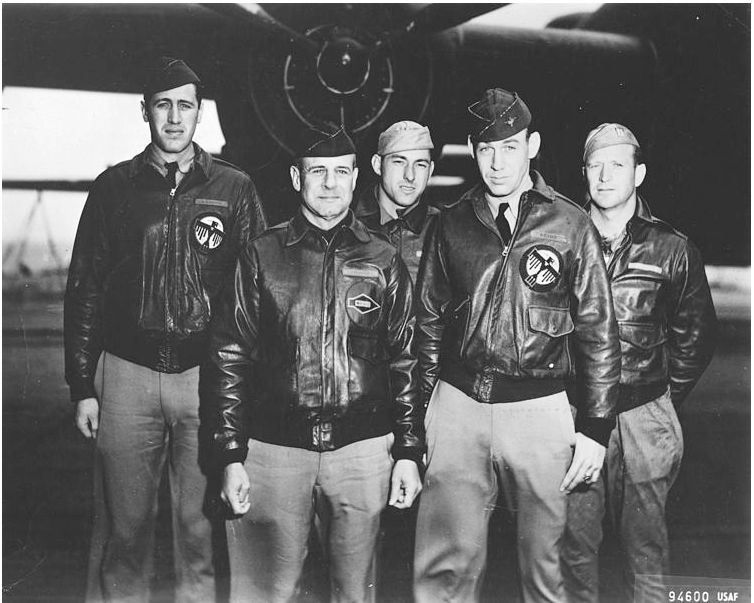
On the deck of the USS Hornet, 18 April 1942. From left to right: (front row) Lt. Col. Doolittle, pilot; Lt. Richard E. Cole, copilot; (back row) Lt. Henry A. Potter, navigator; SSgt. Fred A. Braemer, bombardier; SSgt. Paul J. Leonard, flight engineer/gunner. (U.S. Air Force photo)
GZ |
|



