Agreed. Also, when you realize that inflation is acting as another squeeze on the middle class along with income stagnation, we start to see why the 99% is suffering so much. Folks like Alex will never admit that food inflation is a problem, because the data doesn't fit nicely with his own internal dialogue about how great the Keynesian / Democrat economic policies are. I don't care who is in power, as long as we have fact based discussions about how to move this country forward for the majority of people.
----------
As Long As You Don't Eat, Price Inflation Is Under Control
The USDA reports:
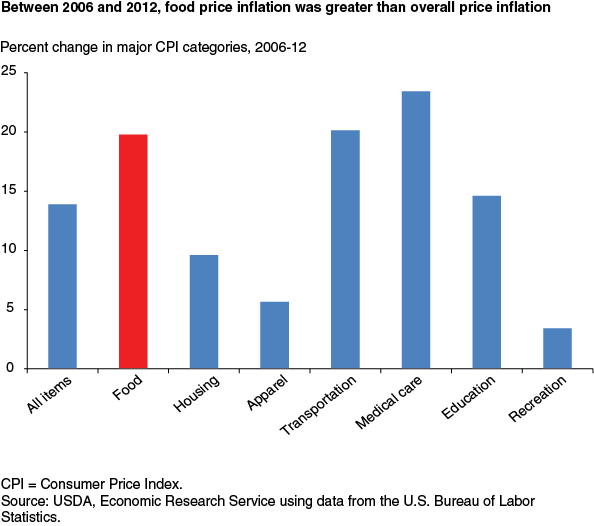
Food prices have also been rising faster than in earlier years, and food price inflation has easily outpaced price inflation for many other types of goods. Among major consumer spending categories, only prices for transportation, which include a number of energy price measures, and medical care have risen faster than food prices[...]
Since 2006, when commodity prices began their rollercoaster ride, the all-items CPI has risen 14 percent while the all-food CPI is up close to 20 percent. The wider differential in the post-2005 era means that a number of the macroeconomic inflationary factors have been specific to food prices. This effect was largely due to rising U.S. farm prices for corn, wheat, soybeans, and other food commodities
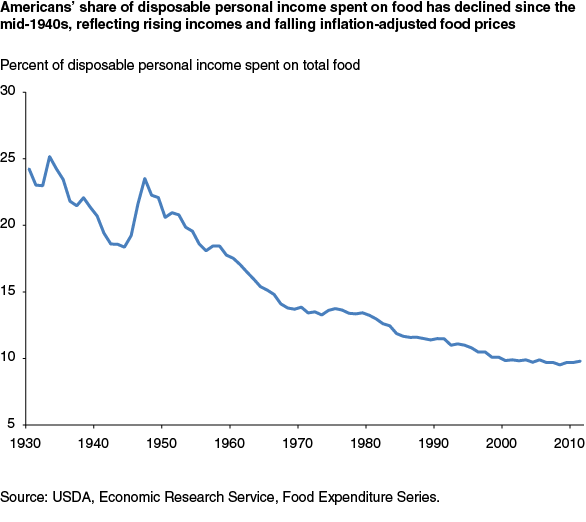
Here's the real concern, as the USDA notes, Americans are having to spend a larger portion of their disposable income on food. Something that is a reversal of decades long trend.
Historically, as food prices have fallen in real (inflation-adjusted) terms, Americans’ food expenditures as a share of disposable income have fallen at a similar rate. In 1930, Americans spent 24 percent of their disposable income on food, including both at-home food and food purchased at restaurants and other eating places. Since 1947, the share of income spent on food has trended downward, with occasional reversals in response to economic conditions, before flattening at around 10 percent for the last decade. In 2008, Americans spent 9.5 percent of their incomes on food. More recently, rising food prices, coupled with stagnant or falling incomes for many, have caused consumer spending on food as a share of disposable income to move upward. In 2011, Americans spent 9.8 percent of their disposable income on food.
|