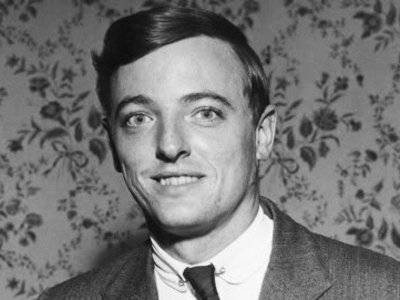
Buckley was a racist for one thing.
williamhogeland.wordpress.com
But if you noticed how he spoke with his halting speech. It was halting as he had to figure out how to spin the questions he could not answer.
"
 political operative as romantic egoist political operative as romantic egoist
In a Boston Review essay collected in my book Inventing American History, and then selected by Greil Marcus for Best American Music Writing 2009, I had occasion to explore the early writings of William F. Buckley, Jr., on racial segregation. I argued then that Buckley’s famous 2004 apology for having once held racially regressive positions — an apology cited by his fans both conservative and liberal, part and parcel of a contention that, despite a perhaps unfortunate history together, racism and American conservatism aren’t ineluctably connected — was no apology at all. The aged Buckley was renouncing a position entirely different from the one he’d actually advanced in the 1950's.
Writing in 1957, Buckley insisted that whites in the South were “entitled to take such measures as are necessary to prevail, politically and culturally, where they do not prevail numerically,” because the white race was “for the time being, the advanced race.”
In 2004, asked whether he’d ever taken a position he now regretted, he said “Yes. I once believed we could evolve our way up from Jim Crow. I was wrong: federal intervention was necessary.”
Neatly done. Where in ’57 he’d asserted a right even of a minority of whites to impose racial segregation by literally any means necessary, including breaking federal law, in ’04 Buckley expressed regret for having supposedly believed only that segregation would wither away without federal intervention. Stupid the man was not. He gets credited today both with honesty about his past and with having, in his own way, “evolved up.” Modern conservatives, more importantly, get to ignore the realities of their movement’s origins.
The persistence of the most virulent kind of racism and white supremacism in some National Review writers, leading to their recent firing, doesn’t mean to me that all of American conservatism is racist. But I think the firings, and ensuing discussion of them by, for two, Joan Walsh and Alex Pareene at Salon, support a suggestion I made in that essay regarding the nature of Buckley’s evolution away from his 1957 position. Buckley did evolve — but not in the way his fans like to imagine:
At a famous 1965 Oxford Union Debate with James Baldwin, fighting what was already a rearguard action on civil rights, Buckley . . . averred that everybody agreed that race prejudice is evil; accused the civil-rights movement of no longer seeking equality but the regression of the white race (though he also continued to call slow progress on equal rights necessary); announced that if the issue must come to race war, he was prepared (echoing Churchill for his Oxonian audience) to fight it on the beaches, in the hills, in the mountains; and suggested, for a laugh, that what he really objected to was any uneducated southerner, black or white, being allowed to vote. That joke distilled an unusual mix of states-rights populism and ruling-class prerogative put forth at length, that same year, by James J. Kilpatrick in The National Review: federalism will be destroyed unless states are free to impose voting qualifications; but those qualifications must discriminate equally, not on the basis of race.
|