| | | Got this from the book, www. Wake, Ron recommended. So cool!! Also got shannons entropy out of it.
[ Help with translations! ]

Zipf's law
From Wikipedia, the free encyclopedia
Jump to: navigation, search
Zipf's lawProbability mass function
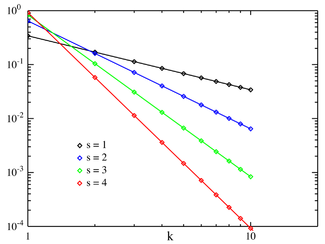
Zipf PMF for N = 10 on a log–log scale. The horizontal axis is the index k . (Note that the function is only defined at integer values of k. The connecting lines do not indicate continuity.) | Cumulative distribution function
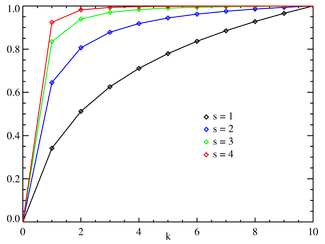
Zipf CDF for N = 10. The horizontal axis is the index k . (Note that the function is only defined at integer values of k. The connecting lines do not indicate continuity.) | Parameters0\," src="http://upload.wikimedia.org/math/e/a/8/ea85ecda234dba228545aae2bac9d73b.png"> ( real)
 ( integer) ( integer) | Support | pmf | CDF | Mean | Mode | Entropy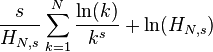 | MGF | CF | Zipf's law / ' z ? f /, an empirical law formulated using mathematical statistics, refers to the fact that many types of data studied in the physical and social sciences can be approximated with a Zipfian distribution, one of a family of related discrete power law probability distributions. The law is named after the American linguist George Kingsley Zipf (1902–1950), who first proposed it (Zipf 1935, 1949), though the French stenographer Jean-Baptiste Estoup (1868-1950) appears to have noticed the regularity before Zipf. [1] It was also noted in 1913 by German physicist Felix Auerbach. [2]
Contents [ hide]
Motivation[ edit source | editbeta]Zipf's law states that given some corpus of natural language utterances, the frequency of any word is inversely proportional to its rank in the frequency table. Thus the most frequent word will occur approximately twice as often as the second most frequent word, three times as often as the third most frequent word, etc. For example, in the Brown Corpus of American English text, the word " the" is the most frequently occurring word, and by itself accounts for nearly 7% of all word occurrences (69,971 out of slightly over 1 million). True to Zipf's Law, the second-place word "of" accounts for slightly over 3.5% of words (36,411 occurrences), followed by "and" (28,852). Only 135 vocabulary items are needed to account for half the Brown Corpus.
The same relationship occurs in many other rankings unrelated to language, such as the population ranks of cities in various countries, corporation sizes, income rankings, and so on. The appearance of the distribution in rankings of cities by population was first noticed by Felix Auerbach in 1913. [2] Empirically, a data set can be tested to see if Zipf's law applies by running the regression log R = a - b log n where R is the rank of the datum, n is its value and a and b are constants. Zipf's law applies when b = 1. When this regression is applied to cities, a better fit has been found with b = 1.07. While Zipf's law holds for the upper tail of the distribution, the entire distribution of cities is log-normal and follows Gibrat's law. [3] Both laws are consistent because a log-normal tail can typically not be distinguished from a Pareto (Zipf) tail.
Theoretical review[ edit source | editbeta]Zipf's law is most easily observed by plotting the data on a log-log graph, with the axes being log (rank order) and log (frequency). For example, the word "the" (as described above) would appear at x = log(1), y = log(69971). The data conform to Zipf's law to the extent that the plot is linear.
Formally, let:
- N be the number of elements;
- k be their rank;
- s be the value of the exponent characterizing the distribution.
Zipf's law then predicts that out of a population of N elements, the frequency of elements of rank k, f(k;s,N), is:
 Zipf's law holds if the number of occurrences of each element are independent and identically distributed random variables with power law distribution Zipf's law holds if the number of occurrences of each element are independent and identically distributed random variables with power law distribution  [4] [4]
In the example of the frequency of words in the English language, N is the number of words in the English language and, if we use the classic version of Zipf's law, the exponent s is 1. f(k; s,N) will then be the fraction of the time the kth most common word occurs.
The law may also be written:
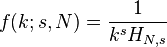 where HN,s is the Nth generalized harmonic number. where HN,s is the Nth generalized harmonic number.
The simplest case of Zipf's law is a "1/f function". Given a set of Zipfian distributed frequencies, sorted from most common to least common, the second most common frequency will occur ½ as often as the first. The third most common frequency will occur ? as often as the first. The nth most common frequency will occur 1/n as often as the first. However, this cannot hold exactly, because items must occur an integer number of times; there cannot be 2.5 occurrences of a word. Nevertheless, over fairly wide ranges, and to a fairly good approximation, many natural phenomena obey Zipf's law.
Mathematically, the sum of all relative frequencies in a Zipf distribution is equal to the harmonic series, and
 In human languages, word frequencies have a very heavy-tailed distribution, and can therefore be modeled reasonably well by a Zipf distribution with an s close to 1. In human languages, word frequencies have a very heavy-tailed distribution, and can therefore be modeled reasonably well by a Zipf distribution with an s close to 1.
As long as the exponent s exceeds 1, it is possible for such a law to hold with infinitely many words, since if s > 1 then
<img class="tex" alt="\zeta (s) = \sum_{n=1}^\infty \frac{1}{n^s}where ? is Riemann's zeta function.
Statistical explanation[ edit source | editbeta]It is not known why Zipf's law holds for most languages. [5] However, it may be partially explained by the statistical analysis of randomly generated texts. Wentian Li has shown that in a document in which each character has been chosen randomly from a uniform distribution of all letters (plus a space character), the "words" follow the general trend of Zipf's law (appearing approximately linear on log-log plot). [6] Vitold Belevitch in a paper, On the Statistical Laws of Linguistic Distribution offered a mathematical derivation. He took a large class of well-behaved statistical distributions (not only the normal distribution) and expressed them in terms of rank. He then expanded each expression into a Taylor series. In every case Belevitch obtained the remarkable result that a first-order truncation of the series resulted in Zipf's law. Further, a second-order truncation of the Taylor series resulted in Mandelbrot's law. [7] [8]
Zipf himself proposed that neither speakers nor hearers using a given language want to work any harder than necessary to reach understanding, and the process that results in approximately equal distribution of effort leads to the observed Zipf distribution. [9] [10]
Related laws[ edit source | editbeta]
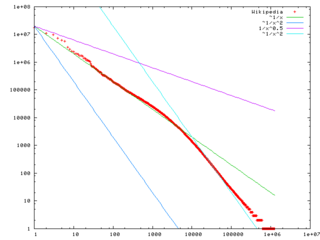

A plot of word frequency in Wikipedia (November 27, 2006). The plot is in log-log coordinates. x is rank of a word in the frequency table; y is the total number of the word’s occurrences. Most popular words are "the", "of" and "and", as expected. Zipf's law corresponds to the upper linear portion of the curve, roughly following the green (1/x) line.
Zipf's law now refers more generally to frequency distributions of "rank data," in which the relative frequency of the nth-ranked item is given by the Zeta distribution, 1/(ns?(s)), where the parameter s > 1 indexes the members of this family of probability distributions. Indeed, Zipf's law is sometimes synonymous with "zeta distribution," since probability distributions are sometimes called "laws". This distribution is sometimes called the Zipfian or Yule distribution.
A generalization of Zipf's law is the Zipf–Mandelbrot law, proposed by Benoît Mandelbrot, whose frequencies are:
 The "constant" is the reciprocal of the Hurwitz zeta function evaluated at s. The "constant" is the reciprocal of the Hurwitz zeta function evaluated at s.
Zipfian distributions can be obtained from Pareto distributions by an exchange of variables. [11]
The Zipf distribution is sometimes called the discrete Pareto distribution [12] because it is analogous to the continuous Pareto distribution in the same way that the discrete uniform distribution is analogous to the continuous uniform distribution.
The tail frequencies of the Yule–Simon distribution are approximately
 for any choice of ? > 0. for any choice of ? > 0.
In the parabolic fractal distribution, the logarithm of the frequency is a quadratic polynomial of the logarithm of the rank. This can markedly improve the fit over a simple power-law relationship. [11] Like fractal dimension, it is possible to calculate Zipf dimension, which is a useful parameter in the analysis of texts. [13]
It has been argued that Benford's law is a special bounded case of Zipf's law, [11] with the connection between these two laws being explained by their both originating from scale invariant functional relations from statistical physics and critical phenomena. [14] The ratios of probabilities in Benford's law are not constant.
 Benford's law: Benford's law: 
 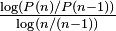 |
| 1 | 0.30103000 | | | 2 | 0.17609126 | -0.7735840 | | 3 | 0.12493874 | -0.8463832 | | 4 | 0.09691001 | -0.8830605 | | 5 | 0.07918125 | -0.9054412 | | 6 | 0.06694679 | -0.9205788 | | 7 | 0.05799195 | -0.9315169 | | 8 | 0.05115252 | -0.9397966 | | 9 | 0.04575749 | -0.9462848 |
Zipf's distribution is also applied to estimate the emergent value of networked systems and also service oriented environments.
See also[ edit source | editbeta]
References[ edit source | editbeta] |
|




