I’m amused to see Global Warmist Professor Chris Turney’s expedition to Antarctica to retrace polar explorer Douglas Mawson’s route and replicate measurements has run into a spot of bother.

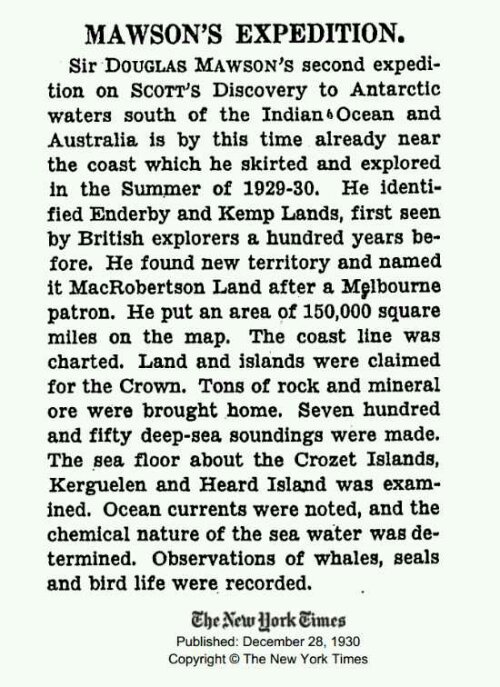
Here’s an old news report on Mawson’s expedition

It looks like that part of the Antarctic was warmer in Mawson’s day than now. In fact the antarctic is currently colder than it has been for a long time. The high latitudes of the Southern Ocean have been cooling since the 1980's according to SST data.
.....
wuwt
When climate scientologists make clowns of themselves they deserve to be mocked.
100 ya, Mawson charted the coast of Commonwealth Bay, something the modern climate scientologists can't do. To reach the hut Mawson built onshore, they had to leave the ship and travel over the ice 70 km to get there:
We've reached Mawson's Huts in Antarctica after a bone-shaking ride across the sea ice
I suppose I signed up for this: shuddering across an Antarctic ice sheet in an open-topped buggy, holding on for dear life and doing everything I could to regain the feeling in my fingers. It was barely 8am and I had at least another three hours of this to go. Assuming we didn't get stuck.
Visiting the explorer Douglas Mawson's huts at Cape Denison, around 70km across the fast ice from where our ship the Akademik Shokalskiy is moored in Commonwealth Bay, East Antarctica, had always been the target of this expedition. Several scout teams had investigated the ice sheet between the ship and the hut in the three days we had been at the frozen continent, however, and their news didn't look good: a recent warm spell had melted lots of the snow cover on the fast ice, and the route across it was riddled with pools of water covered with thin, easily broken ice.
One team, including expedition leader Chris Turney, had made it to the huts on Thursday but it had taken them a hard slog of five and a half hours, with regular stops to push their vehicles out of the sludgy snow. They decided that it was too risky to take all of the passengers to the huts and, instead, there would be just one more trip from the Shokalskiy, leaving at 7am on Friday morning. One of the expedition co-leaders came into my cabin at 10pm on Thursday night and told me that there was a space for me but I'd need to be ready by 5am the next morning if I wanted to be on it.
There were seven of us in total, including two marine biologists and an ornithologist who needed to get to Cape Denison to carry out specific updates of some of Mawson's work on the original Australasian Antarctic Expedition (AAE) between 1911 and 1913. We loaded our equipment, extra clothes, food and survival gear onto the backs of two Argo vehicles – a cross between an open-topped 4X4 buggy and a boat – and began our journey just before 8am.
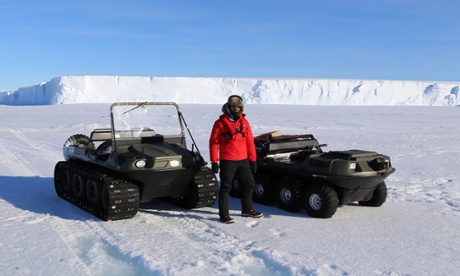 Alok and the Argo all-terrain vehicles that took him and a small team of scientists to Mawson's Huts on Friday. In the background is the edge of a massive iceberg called B09B. Photograph: /GuardianThese vehicles are not fast – a top speed of around 25kph over the sea ice whenever it was flat – and have a punishing lack of suspension. But they are rugged and shrugged off bumps and unexpected pools of water on the ice. Alok and the Argo all-terrain vehicles that took him and a small team of scientists to Mawson's Huts on Friday. In the background is the edge of a massive iceberg called B09B. Photograph: /GuardianThese vehicles are not fast – a top speed of around 25kph over the sea ice whenever it was flat – and have a punishing lack of suspension. But they are rugged and shrugged off bumps and unexpected pools of water on the ice.
We made good progress for the first hour, watching the landscape change from coastline to pure, flat white. We passed iceberg after iceberg – some the size of small towns – and, to our right, rose the immense dome of Antarctica's ice cap. Not for the first time, I had to remind myself that this epic moonscape was, in fact, on the Earth. (It didn't help that our tiny six-wheeled vehicles reminded me of the lunar buggies the astronauts took with them in the later stages of the Apollo programme.)
After 30km on solid ice, we slowed as the surface got increasingly sludgy. We spent the next hour splashing through pools of freshly melted snow on the surface of the sea ice. Freezing water went everywhere. On most occasions, this meant all over us passengers.
A bone-shaking hour later, windswept and freezing, we saw our first bit of exposed Antarctic land up ahead – Cape Hunter, named after John George Hunter, the original AAE's biologist – and we knew we were on the home strait. Every external Antarctic surface we had seen so far on the expedition had been ice, slush or water. Cape Hunter was not only the first rock but it also meant we had reached the Antarctic landmass itself. We were now only 13km west of Mawson's Huts at Cape Denison.
.......
Built in January 1912, when their ship the Aurora arrived at Antarctica, there are four huts, each with a particular purpose. The main hut has got two components: the living quarters and the workshop. Adjacent to that is the Transit Hut, which was used to make astronomical observations. Further down the hill are Magnetograph House and the Absolute Magnetic Hut, where Mawson's team studied the variations in the Earth's magnetic field as part of their scientific work. The latter three are standing ruins, only kept in minimal repair so that they don't collapse. The main hut, however, has been the centre of a conservation effort since 1996.
............
http://www.theguardian.com/science/antarctica-live/2013/dec/20/sea-ice-mawsons-huts-antarctica |