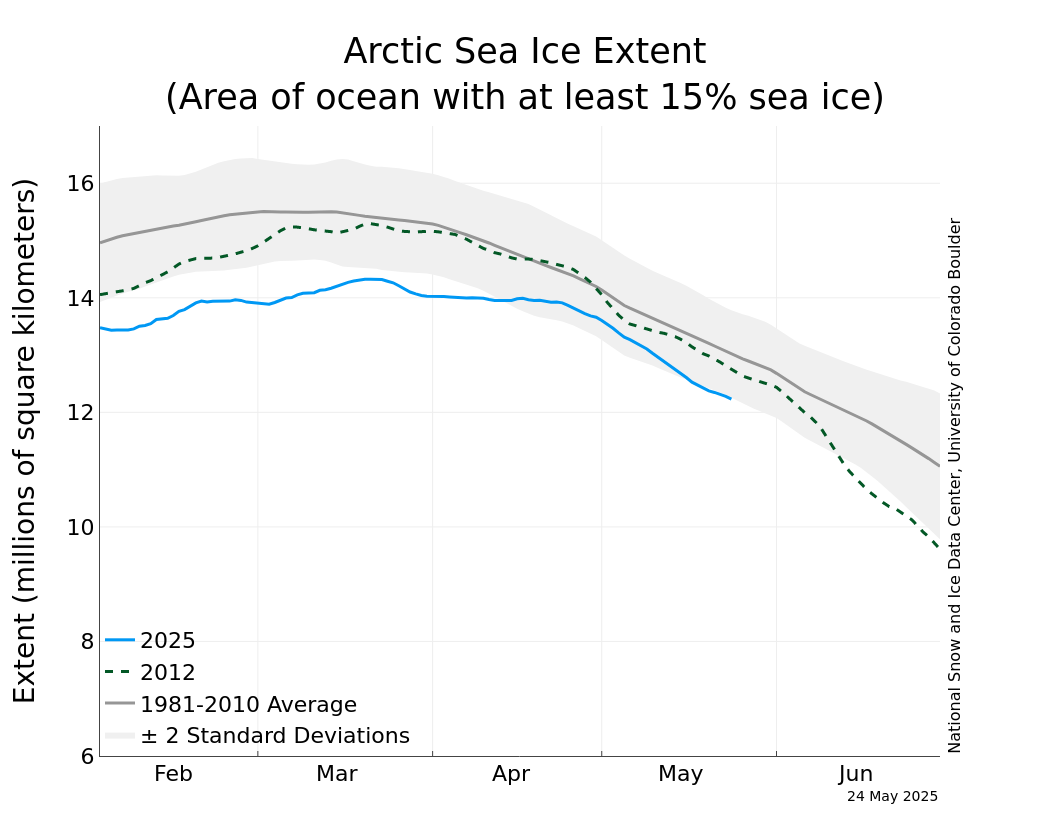
You want to point out the rapidly growing arctic ice on this graph? I'll give you a hint; it's right where it was a year ago.
If temps were flat, '05 and '10 wouldn't be tied for the hottest year ever recorded, this year wouldn't be 4th news.discovery.com
and the last decade wouldn't be the hottest recorded; but.....they are.
=
Antarctic sea ice, ha ha ha!
Posted on December 31, 2013 by andthentheresphysics
Some seem to find it somewhat amusing that an icebreaker full of journalists is currently stuck in the Antarctic sea ice, awaiting rescue (yes, Andrew Neil, I’m talking about you). To be fair, I can see the irony (a little) but it does seem a bit insensitive (I’m sure they’ll be rescued, but it can’t be all that pleasant) and indicates an element of scientific ignorance. I often think that if people want to learn more about sea ice, they should probably just go to Neven’s Arctic Sea Ice Page. It seems to be one of the best resources on this particular topic. I thought, however, that I might try and put the Antarctic sea ice issue into some kind of perspective.
The National Snow and Ice Data Center has a page dedicated to Arctic vs Antarctic sea ice. It has figures showing the Arctic and Antarctic sea ice extent since 1978 (below). I appreciate that these figure only extend to 2007, but the long-term Arctic sea ice trend (1978-2008) is a loss of 500000km2 per decade. For the Antarctic it is an increase of 100000km2 per decade. So, the long term Arctic sea ice extent trend is 5 times greater (and negative) than the long-term Antarctic sea ice trend (positive).
 Total Arctic sea ice extent 1978-2007 (credit : NSIDC) Total Arctic sea ice extent 1978-2007 (credit : NSIDC)
 Total Antarctic sea ice extent 1978-2007 (credit : NSIDC) Total Antarctic sea ice extent 1978-2007 (credit : NSIDC)
One should also recognise that an increased Antarctic sea extent has very little influence on albedo (it’s the Southern winter) while a reduced Arctic sea ice extent – in the Northern summer – can have an effect on albedo. The above figures also only consider sea ice extent/area, rather than mass/volume. The Polar Science Center also gives data for Arctic sea ice volume. This is shown in the figure below and shows a very obvious, and continuing, decrease in Arctic sea ice volume/mass.
 Arctic sea ice volume anomalies computed (for each day) relative to the 1979-2011 average for each day. (credit : Polar Science Centre) Arctic sea ice volume anomalies computed (for each day) relative to the 1979-2011 average for each day. (credit : Polar Science Centre)
If one wants to consider the influence of global warming, one should also consider both sea ice and land ice (i.e., ice sheets). The figure below is from the IMBIE experiment and shows that both Antartica and Greenland have been losing mass (H/T to Tamsin Edwards for this link). In fact, one can go further and search Google Scholar for recent papers on Antarctic sea ice trends and one would find a recent paper (Bintanja et al. 2013) which says
Specifically, we present observations indicating that melt water from Antarctica’s ice shelves accumulates in a cool and fresh surface layer that shields the surface ocean from the warmer deeper waters that are melting the ice shelves. Simulating these processes in a coupled climate model we find that cool and fresh surface water from ice-shelf melt indeed leads to expanding sea ice in austral autumn and winter. This powerful negative feedback counteracts Southern Hemispheric atmospheric warming. Although changes in atmospheric dynamics most likely govern regional sea-ice trends4, our analyses indicate that the overall sea-ice trend is dominated by increased ice-shelf melt.
So, the increase in Antarctic sea ice extent could be due to the accumulation of cold water from the melting Antarctic ice sheets. Admittedly, there are other papers (Swart & Fyfe 2013) that suggest that the fresh meltwater is having little effect, and that the Antarctic sea ice trend is simply consistent with natural variability. Either way, there appears to be little evidence that an increased Antarctic sea ice extent has any particular significance with respect to global warming.
 Antarctic and Greenland mass changes (credit : IMBIE) Antarctic and Greenland mass changes (credit : IMBIE)
So, yes maybe it is a little ironic that a high-profile Antarctic expedition is stuck in the Antarctic sea ice. However, a ship stuck in the Antarctic sea ice is not all the surprising and doesn’t really imply anything with respect to global warming/climate change. The increased Antarctic sea ice extent doesn’t really cancel the reduction in Arctic sea ice extent/volume (the long-term rate of decrease of Arctic sea ice is at least 5 times faster than the rate of increase of Antarctic sea ice). The Arctic sea ice continues to lose mass as do Greenland and Antarctica. Whether it is slightly amusing that a ship is stuck in the Antarctic sea ice or not, I hope everyone on board is safe and well and that they’re rescued soon (as I’m sure they will be).
andthentheresphysics.wordpress.com |