re..presumption........All around
" fundamentally, the Bush administration masked the cost of the war with deficit spending to ensure that the American people would not face up to its costs while President Bush was in office. Despite their recent discovery of outrage over the national debt, the Republicans followed the advice of Vice-President Dick Cheney that "deficits don't matter" and spent freely on domestic programs throughout the Bush years.."
Most..did not understand..
what was being done to them..by
the former admin...And Friends
Well...Now it seems.....the chickens have come home.....to roost
the roosts are ...foreign owned..
And
war profiteering has...resulted in a serious..social..plucking
How the US public was defrauded by the hidden cost of the Iraq war
George Bush sold the war as quick and cheap; it was long and costly. Even now, the US is paying billions to private contractors

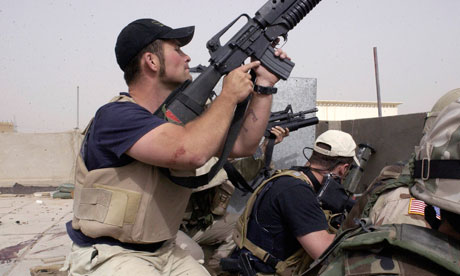
Blackwater employees in the Iraqi city of Najaf, 2004: private contracting was widely used to keep Iraq war spending 'off the books' of the Pentagon budget. Photograph: Gervasio Sanchez/AP
When the US invaded Iraq in March 2003, the Bush administration estimated that it would cost $50-60bn to overthrow Saddam Hussein and establish a functioning government. This estimate was catastrophically wrong: the war in Iraq has cost $823.2bn between 2003 and 2011. Some estimates suggesting that it may eventually cost as much as $3.7tn when factoring in the long-term costs of caring for the wounded and the families of those killed.
The most striking fact about the cost of the war in Iraq has been the extent to which it has been kept "off the books" of the government's ledgers and hidden from the American people. This was done by design. A fundamental assumption of the Bush administration's approach to the war was that it was only politically sustainable if it was portrayed as near-costless to the American public and to key constituencies in Washington. The dirty little secret of the Iraq war – one that both Bush and the war hawks in the Democratic party knew, but would never admit – was that the American people would only support a war to get rid of Saddam Hussein if they could be assured that they would pay almost nothing for it.
The most obvious way in which the true cost of this war was kept hidden was with the use of supplemental appropriations to fund the occupation. By one estimate, 70% of the costs of wars in Iraq and Afghanistan between 2003 and 2008 were funded with supplemental or emergency appropriations approved outside the Pentagon's annual budget. These appropriations allowed the Bush administration to shield the Pentagon's budget from the cuts otherwise needed to finance the war, to keep the Pentagon's pet programs intact and to escape the scrutiny that Congress gives to its normal annual regular appropriations.
With the Iraq war treated as an "off the books" expense, the Pentagon was allowed to keep spending on high-end military equipment and cutting-edge technology. In fiscal terms, it was as if the messy wars in Afghanistan and Iraq were never happening.
More fundamentally, the Bush administration masked the cost of the war with deficit spending to ensure that the American people would not face up to its costs while President Bush was in office. Despite their recent discovery of outrage over the national debt, the Republicans followed the advice of Vice-President Dick Cheney that "deficits don't matter" and spent freely on domestic programs throughout the Bush years. The Bush administration encouraged the American people to keep spending and "enjoy life", while the government paid for the occupation of Iraq on a credit card they hoped never to have to repay.
Most Americans were not asked to make any sacrifice for the Iraq war, while its real costs were confined to the 1% of the population who fought and died there. As a result, the average American was never forced to confront whether pouring money borrowed from China into the corrupt Iraqi security services was worth it, or whether it made more sense to rebuild infrastructure in Diyala, rather than, say, Philadelphia. |



