Josephus is only one of several first century historians ....were all the other mentions forgeries as well?
But only one Jewish historian, how mysterious & even the Pharisees forget to mention?
How odd...yes, all pious forgeries why you would even debate it, when most scholars have already dimissed it as fake?
(And we haven't even begun to get into the source story/myths that predate Judaism & this offshoot. Josephus would have been born just after or about the time of the crucifixion,most certainly had a father that would have had knowledge of this miracle worker first hand?)
When addressing the mythical nature of Jesus Christ, one issue repeatedly raised is the purported "evidence" of his existence to be found in the writings of Flavius Josephus, the famed Jewish general and historian who lived from about 37 to 100 CE. In Josephus's Antiquities of the Jews appears the notorious passage regarding Christ called the "Testimonium Flavianum" ("TF"):
"Now, there was about this time, Jesus, a wise man, if it be lawful to call him a man, for he was a doer of wonderful works,--a teacher of such men as receive the truth with pleasure. He drew over to him both many of the Jews, and many of the Gentiles. He was [the] Christ; and when Pilate, at the suggestion of the principal men amongst us, had condemned him to the cross, those that loved him at the first did not forsake him, for he appeared to them alive again the third day, as the divine prophets had foretold these and ten thousand other wonderful things concerning him; and the tribe of Christians, so named from him, are not extinct at this day." (Whitson, 379)
This surprisingly brief and simplistic passage constitutes the "best proof" of Jesus's existence in the entire ancient non-Christian library comprising the works of dozens of historians, writers, philosophers, politicians and others who never mentioned the great sage and wonderworker Jesus Christ, even though they lived contemporaneously with or shortly after the Christian savior's purported advent.
A False Witness Despite the best wishes of sincere believers and the erroneous claims of truculent apologists, the Testimonium Flavianum has been demonstrated continually over the centuries to be a forgery, likely interpolated by Catholic Church historian Eusebius in the fourth century. So thorough and universal has been this debunking that very few scholars of repute continued to cite the passage after the turn of the 19th century. Indeed, the TF was rarely mentioned, except to note that it was a forgery, and numerous books by a variety of authorities over a period of 200 or so years basically took it for granted that the Testimonium Flavianum in its entirety was spurious, an interpolation and a forgery. As Dr. Gordon Stein relates: Despite the best wishes of sincere believers and the erroneous claims of truculent apologists, the Testimonium Flavianum has been demonstrated continually over the centuries to be a forgery, likely interpolated by Catholic Church historian Eusebius in the fourth century. So thorough and universal has been this debunking that very few scholars of repute continued to cite the passage after the turn of the 19th century. Indeed, the TF was rarely mentioned, except to note that it was a forgery, and numerous books by a variety of authorities over a period of 200 or so years basically took it for granted that the Testimonium Flavianum in its entirety was spurious, an interpolation and a forgery. As Dr. Gordon Stein relates:
"...the vast majority of scholars since the early 1800s have said that this quotation is not by Josephus, but rather is a later Christian insertion in his works. In other words, it is a forgery, rejected by scholars."
So well understood was this fact of forgery that these numerous authorities did not spend their precious time and space rehashing the arguments against the TF's authenticity. Nevertheless, in the past few decades apologists of questionable integrity and credibility have glommed onto the TF, because this short and dubious passage represents the most "concrete" secular, non-biblical reference to a man who purportedly shook up the world. In spite of the past debunking, the debate is currently confined to those who think the TF was original to Josephus but was Christianized, and those who credulously and self-servingly accept it as "genuine" in its entirety.
To repeat, this passage was so completely dissected by scholars of high repute and standing--the majority of them pious Christians--that it was for decades understood by subsequent scholars as having been proved in toto a forgery, such that these succeeding scholars did not even mention it, unless to acknowledge it as false. (In addition to being repetitious, numerous quotes will be presented here, because a strong show of rational consensus is desperately needed when it comes to matters of blind, unscientific and irrational faith.) The scholars who so conclusively proved the TF a forgery made their mark at the end of the 18th century and into the 20th, when a sudden reversal was implemented, with popular opinion hemming and hawing its way back first to the "partial interpolation theory" and in recent times, among the third-rate apologists, to the notion that the whole TF is "genuine." As Earl Doherty says, in "Josephus Unbound":
"Now, it is a curious fact that older generations of scholars had no trouble dismissing this entire passage as a Christian construction. Charles Guignebert, for example, in his Jesus (1956, p.17), calls it 'a pure Christian forgery.' Before him, Lardner, Harnack and Schurer, along with others, declared it entirely spurious. Today, most serious scholars have decided the passage is a mix: original parts rubbing shoulders with later Christian additions."
 The earlier scholarship that proved the entire TF to be fraudulent was determined by intense scrutiny by some of the most erudite, and mainly Christian, writers of the time, in a number of countries, their works written in a variety of languages, but particularly German, French and English. Their general conclusions, as elucidated by Christian authority Dr. Lardner, and related here by the author of Christian Mythology Unveiled (c. 1842), include the following reasons for doubting the authenticity of the TF as a whole: The earlier scholarship that proved the entire TF to be fraudulent was determined by intense scrutiny by some of the most erudite, and mainly Christian, writers of the time, in a number of countries, their works written in a variety of languages, but particularly German, French and English. Their general conclusions, as elucidated by Christian authority Dr. Lardner, and related here by the author of Christian Mythology Unveiled (c. 1842), include the following reasons for doubting the authenticity of the TF as a whole:
"Mattathias, the father of Josephus, must have been a witness to the miracles which are said to have been performed by Jesus, and Josephus was born within two years after the crucifixion, yet in all the works he says nothing whatever about the life or death of Jesus Christ; as for the interpolated passage it is now universally acknowledged to be a forgery. The arguments of the 'Christian Ajax,' even Lardner himself, against it are these: 'It was never quoted by any of our Christian ancestors before Eusebius. It disturbs the narrative. The language is quite Christian. It is not quoted by Chrysostom, though he often refers to Josephus, and could not have omitted quoting it had it been then in the text. It is not quoted by Photius [9th century], though he has three articles concerning Josephus; and this author expressly states that this historian has not taken the least notice of Christ. Neither Justin Martyr, in his dialogue with Trypho the Jew; nor Clemens Alexandrinus, who made so many extracts from ancient authors; nor Origen against Celsus, have ever mentioned this testimony. But, on the contrary, in chap. 25th of the first book of that work, Origen openly affirms that Josephus, who had mentioned John the Baptist, did not acknowledge Christ. That this passage is a false fabrication is admitted by Ittigius, Blondel, Le Clerc, Vandale, Bishop Warburton, and Tanaquil Faber.'" (CMU, 47)
Hence, by the 1840's, when the anonymous author of Christian Mythology Unveiled wrote, the Testimonium Flavanium was already "universally acknowledged to be a forgery."
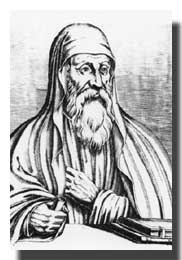 The pertinent remarks by the highly significant Church father Origen (c. 185-c.254) appear in his Contra Celsus, Book I, Chapter XLVII: The pertinent remarks by the highly significant Church father Origen (c. 185-c.254) appear in his Contra Celsus, Book I, Chapter XLVII:
"For in the 18th book of his Antiquities of the Jews, Josephus bears witness to John as having been a Baptist, and as promising purification to those who underwent the rite. Now this writer, although not believing in Jesus as the Christ, in seeking after the cause of the fall of Jerusalem and the destruction of the temple, whereas he ought to have said that the conspiracy against Jesus was the cause of these calamities befalling the people, since they put to death Christ, who was a prophet, says nevertheless--being, although against his will, not far from the truth--that these disasters happened to the Jews as a punishment for the death of James the Just, who was a brother of Jesus (called Christ)--the Jews having put him to death, although he was a man most distinguished for his justice" (Emphasis added)
Here, in Origen's words, is the assertion that Josephus, who discusses more than a dozen Jesuses, did not consider any of them to be "the Christ." This fact proves that the same phrase in the TF is spurious. Furthermore, Origen does not even intimate the presence of the rest of the TF. Concerning Origen and the TF, Arthur Drews relates in Witnesses to the Historicity of Jesus:
"In the edition of Origen published by the Benedictines it is said that there was no mention of Jesus at all in Josephus before the time of Eusebius [c. 300 ce]. Moreover, in the sixteenth century Vossius had a manuscript of the text of Josephus in which there was not a word about Jesus. It seems, therefore, that the passage must have been an interpolation, whether it was subsequently modified or not." (Drews, 9; emph. added)
According to the author of Christian Mythology Unveiled ("CMU"), this Vossius mentioned by a number of writers as having possessed a copy of Josephus's Antiquities lacking the TF is "I. Vossius," whose works appeared in Latin. Unfortunately, none of these writers includes a citation as to where exactly the assertion may be found in Vossius's works. Moreover, the Vossius in question seems to be Gerardus, rather than his son, Isaac, who was born in the seventeenth century.
Church Fathers Ignorant of Josephus PassageIn any event, as G.A. Wells points out in The Jesus Myth, not only do several Church fathers from the second, third and early fourth centuries have no apparent knowledge of the TF, but even after Eusebius suddenly "found" it in the first half of the fourth century, several other fathers into the fifth "often cite Josephus, but not this passage." (Wells, JM, 202) In the 5th century, Church father Jerome (c. 347-c.419) cited the TF once, with obvious disinterest, as if he knew it was fraudulent. In addition to his reference to the TF, in his Letter XXII. to Eustochium, Jerome made the following audacious claim:
"Josephus, himself a Jewish writer, asserts that at the Lord's crucifixion there broke from the temple voices of heavenly powers, saying: 'Let us depart hence.'"
 Either Jerome fabricated this alleged Josephus quote, or he possessed a unique copy of the Jewish historian's works, in which this assertion had earlier been interpolated. In any case, Jerome's claim constitutes "pious fraud," one of many committed by Christian proponents over the centuries, a rampant practice, in fact, that must be kept in mind when considering the authenticity of the TF. Either Jerome fabricated this alleged Josephus quote, or he possessed a unique copy of the Jewish historian's works, in which this assertion had earlier been interpolated. In any case, Jerome's claim constitutes "pious fraud," one of many committed by Christian proponents over the centuries, a rampant practice, in fact, that must be kept in mind when considering the authenticity of the TF.
For a more modern criticism, in The Jesus Puzzle and his online article "Josephus Unbound," secularist and classicist Earl Doherty leaves no stone unturned in demolishing the TF, permitting no squirming room for future apologists, whose resort to the TF will show, as it has done in the past, how hopeless is their plight in establishing an "historical Jesus." Concerning the use of Josephus as "evidence" of Jesus's existence, Doherty remarks:
"n the absence of any other supporting evidence from the first century that in fact the Jesus of Nazareth portrayed in the Gospels clearly existed, Josephus becomes the slender thread by which such an assumption hangs. And the sound and fury and desperate manoeuverings which surround the dissection of those two little passages becomes a din of astonishing proportions. The obsessive focus on this one uncertain record is necessitated by the fact that the rest of the evidence is so dismal, so contrary to the orthodox picture. If almost everything outside Josephus points in a different direction, to the essential fiction of the Gospel picture and its central figure, how can Josephus be made to bear on his shoulders, through two passages whose reliability has thus far remained unsettled, the counterweight to all this other negative evidence?"
Other modern authors who criticize the TF include The Jesus Mysteries authors Freke and Gandy, who conclude:
"Unable to provide any historical evidence for Jesus, later Christians forged the proof that they so badly needed to shore up their Literalist interpretation of the gospels. This, as we would see repeatedly, was a common practice." (Freke and Gandy, 137)
Despite the desperate din, a number of other modern writers remain in concurrence with the earlier scholarship and likewise consider the TF in toto a fraud.
The Suspect: Eusebius (c. 264-340) In addition to acknowledging the spuriousness of the Josephus passage, many authorities quoted here agreed with the obvious: Church historian Eusebius was the forger of the entire Testimonium Flavianium. Various reasons have already been given for making such a conclusion. In "Did Jesus Really Live?" Marshall Gauvin remarks: In addition to acknowledging the spuriousness of the Josephus passage, many authorities quoted here agreed with the obvious: Church historian Eusebius was the forger of the entire Testimonium Flavianium. Various reasons have already been given for making such a conclusion. In "Did Jesus Really Live?" Marshall Gauvin remarks:
"Everything demonstrates the spurious character of the passage. It is written in the style of Eusebius, and not in the style of Josephus. Josephus was a voluminous writer. He wrote extensively about men of minor importance. The brevity of this reference to Christ is, therefore, a strong argument for its falsity. This passage interrupts the narrative. It has nothing to do with what precedes or what follows it; and its position clearly shows that the text of the historian has been separated by a later hand to give it room."
Regarding the absence of the TF in the writings of earlier Christian fathers and its sudden appearance with Eusebius, CMU says:
"it has been observed that the famous passage which we find in Josephus, about Jesus Christ, was never mentioned or alluded to in any way whatever by any of the fathers of the first, second, or third centuries; nor until the time of Eusebius, 'when it was first quoted by himself [sic].' The truth is, none of these fathers could quote or allude to a passage which did not exist in their times; but was to all points short of absolutely certain, forged and interpolated by Eusebius, as suggested by Gibbon and others. Even the redoubtable Lardner has pronounced this passage to be a forgery." (CMU, 79-80)
Moreover, the word "tribe" in the TF is another clue that the passage was forged by Eusebius, who is fond of the word, while Josephus uses it only in terms of ethnicity, never when describing a religious sect. Kerry Shirts adds to this particular point:
"Eusebius studied Josephus diligently, and could thus masquerade as he, except when he used the word 'tribe' to describe the Christians. All the literature from the Ante-Nicene Fathers show they never used the word 'tribe' or 'race' with reference to the Christians, was [sic] either by the Fathers or when they quoted non-Christian writers. Tertullian, Pliny the Younger, Trajan, Rufinus--none use 'tribe' to refer to Christians. Eusebius is the first to start the practice."
In Antiqua Mater: A Study of Christian Origins, Edwin Johnson remarked that the fourth century was "the great age of literary forgery, the extent of which has yet to be exposed." He further commented that "not until the mass of inventions labelled 'Eusebius' shall be exposed, can the pretended references to Christians in Pagan writers of the first three centuries be recognized for the forgeries they are." Indeed, Eusebius's character has been assailed repeatedly over the centuries, with him being called a "luminous liar" and "unreliable." Like so many others, Drews likewise criticizes Eusebius, stating that various of the Church historian's references "must be regarded with the greatest suspicion." As Drews relates, Swiss historian Jakob Burckhardt (1818-1897) declared Eusebius to be "the first thoroughly dishonest historian of antiquity." (Drews, 32/fn) Eusebius's motives were to empower the Catholic Church, and he did not fail to use "falsifications, suppressions, and fictions" to this end.
Conclusion: Josephus No Evidence of JesusEven if the Josephus passage were authentic, which we have essentially proved it not to be, it nevertheless would represent not an eyewitness account but rather a tradition passed along for at least six decades, long after the purported events. Hence, the TF would possess little if any value in establishing an "historical" Jesus. In any event, it is quite clear that the entire passage in Josephus regarding Christ, the Testimonium Flavianum, is spurious, false and a forgery. Regarding the TF, Remsburg summarizes:
"For nearly sixteen hundred years Christians have been citing this passage as a testimonial, not merely to the historical existence, but to the divine character of Jesus Christ. And yet a ranker forgery was never penned....
"Its brevity disproves its authenticity. Josephus' work is voluminous and exhaustive. It comprises twenty books. Whole pages are devoted to petty robbers and obscure seditious leaders. Nearly forty chapters are devoted to the life of a single king. Yet this remarkable being, the greatest product of his race, a being of whom the prophets foretold ten thousand wonderful things, a being greater than any earthly king, is dismissed with a dozen lines...."
The dismissal of the passage in Josephus regarding Jesus is not based on "faith" or "belief" but on intense scientific scrutiny and reasoning. Such investigation has been confirmed repeatedly by numerous scholars who were mostly Christian. The Testimonium Flavianum, Dr. Lardner concluded in none too forceful words, "ought, therefore...to be discarded from any place among the evidences of Christianity." With such outstanding authority and so many scientific reasons, we can at last dispense with the pretentious charade of wondering if the infamous passage in the writings of Josephus called the Testimonium Flavianum is forged and who fabricated it.
|



