Hansen’s 1988 Predictions
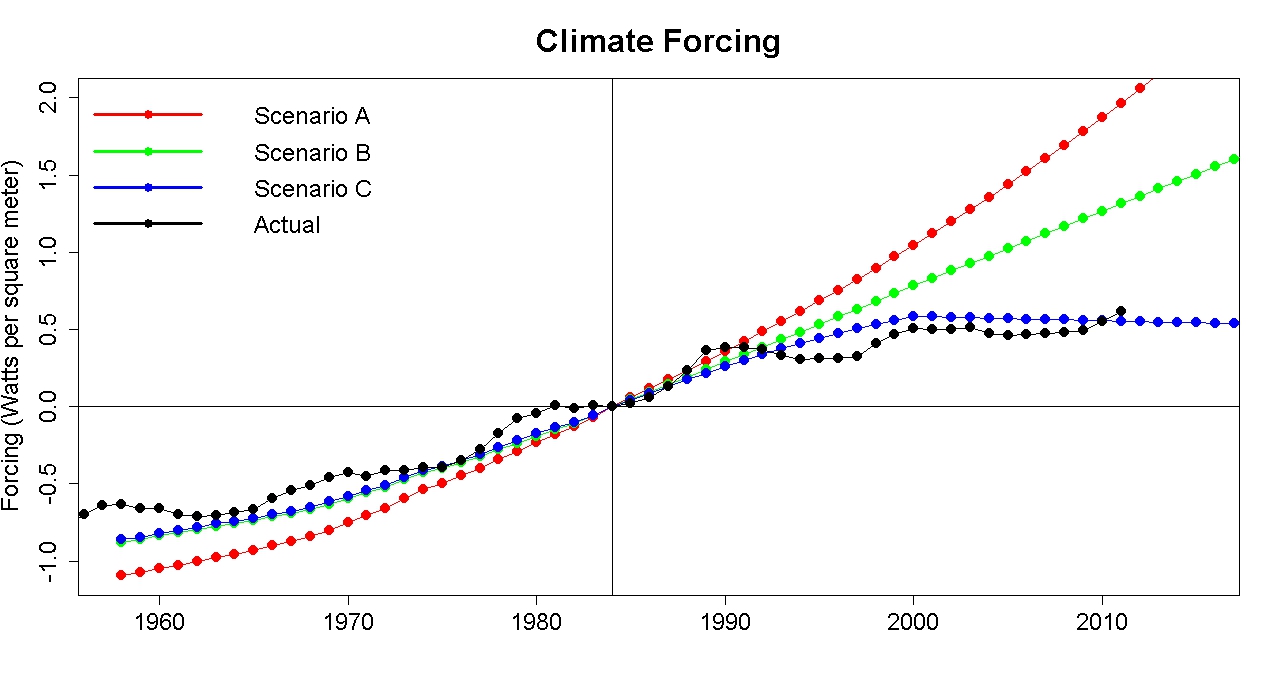
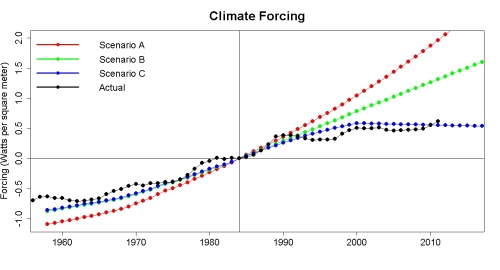 Notice that I aligned the forcing estimates at 1984, because that’s when the prediction began. The paper was published in 1988, but the models had to be run (which took a lot longer in those days) before that, the paper had to be written, and reviewed, then published. The actual prediction started in 1984. Notice that I aligned the forcing estimates at 1984, because that’s when the prediction began. The paper was published in 1988, but the models had to be run (which took a lot longer in those days) before that, the paper had to be written, and reviewed, then published. The actual prediction started in 1984.
Notice also that actual forcing follows scenario C more closely than the other scenarios. On that basis, we should expect observed temperature change to match scenario C more closely than the other scenarios. And it does.
tamino.wordpress.com
==
In his landmark testimony (PDF) before the US Senate Committee on Energy and Natural Resources on June 28, 1988, Dr. James Hansen, then director of the NASA Goddard Institute for Space Studies said,
The present temperature is the highest in the period of record…The four warmest years, as the Senator mentioned, have all been in the 1980s. And 1988 so far is so much warmer than 1987, that barring a remarkable and improbable cooling, 1988 will be the warmest year on record.
Hansen’s testimony proved to be accurate. 1988 ended up as the warmest year on record at that time, dating back to 1880, according to data from NOAA. The average global temperature in 1988 was 0.34ºC above the 20th century average, just edging out the 0.33ºC temperature anomaly from 1987.
Flash forward to today. Yesterday, NOAA reported that, globally, 2013 tied 2003 as the fourth warmest year on record. Despite abnormally cool temperatures in the continental US during November and December, those months proved to be the warmest and third warmest on record worldwide, respectively. Overall, 2013 was 0.62ºC above the 20th century average. Accordingly, the temperature anomaly for 2013 was 82% larger than that for 1988.
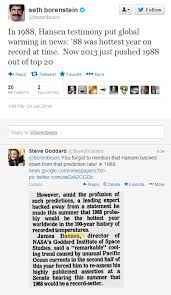
Seth Borenstein, the great AP reporter on weather/climate issues, made a remarkable observation on Twitter yesterday after NOAA released its data.
timkovach.com |