Western Antarctic ice sheet collapse has already begun, scientists warn
Two separate studies confirm loss is inevitable and will cause up to four metres of additional sea-level rise
theguardian.com, Monday 12 May 2014 12.30 EDT
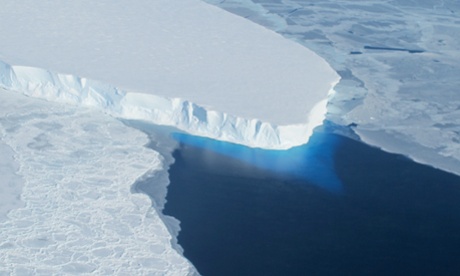
The study honed in on the Thwaites glacier – the soft underbelly of the Antarctic ice sheet. Photograph: Jim Yungel/NASA
The collapse of the western Antarctic ice sheet is inevitable and is already underway, scientists said on Monday.
The melt will cause up to four metres (13 feet) of additional sea-level rise over the coming centuries, devastating low-lying and coastal areas around the world – from Bangladesh to New Jersey – that are already expected to be swamped by only a few feet of sea-level rise.
But the researchers said the sea-level rise – while unstoppable – was still several centuries off, potentially up to 1,000 years away.
The study, from researchers at the University of Washington, was one of two sets of findings published on Monday projecting the loss of the western Antarctica ice sheet, the largest remaining grounded repositories of ice in the world.
Scientists at Nasa were also due to publish their research on Antarctic ice on Monday.
Both came to broadly similar conclusions – that scientists are now increasingly sure the thinning and melting of the Antarctic ice sheet has begun. They also suggest that recent accumulation of ice in Antarctica was temporary.
In the Nasa study, to be published in Geophysical Research Letters, researchers studied the retreat of three glaciers in western Antarctica over 20 years including the Thwaites glacier studied by the University of Washington team.
The Nasa study concluded the grounding lines of the glaciers under study were “inherently unstable”. It added that its observations “concur with recent ice sheet model simulations to indicate that this sector of west Antarctica has developed a marine instability”.
In the University of Washington study, which will be published in the journal Science, researchers used detailed topography maps, airborne radar and computer modelling to reach greater certainty about the projected timeline of the ice sheet collapse.
The study honed in on the Thwaites glacier – a broad glacier that is part of the Amundsen Sea. Scientists have known for years that the Thwaites glacier is the soft underbelly of the Antarctic ice sheet, and first documented that it was unstable decades ago.
The University of Washington researchers said that the fast-moving Thwaites glacier could be lost in a matter of centuries. The loss of that glacier alone would raise global sea level by nearly 2ft.
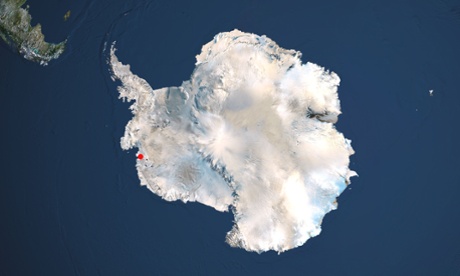
Satellite view of Antarctica with the Thwaites glacier marked in red. Photograph: UIG/Getty Images
But Thwaites also acts as a dam that holds back the rest of the ice sheet. Once Thwaites goes, researchers said the remaining ice could cause another 10 to 13ft (3-4m) of global sea-level rise.
"Many scientists suspected that this kind of behavior is under way," said Ian Joughin, a glaciologist at the University of Washington. "This study provides a more quantitative idea of the rates at which the collapse could take place."
However, he cautioned that the “collapse” of the western Antarctic ice sheet would occur over the course of centuries. The fastest scenario is within 200 years – and the collapse could be as far away as 1,000 years, depending on future warming.
The loss of the ice sheet, however, is inevitable, and the most likely timeframe was between 200 and 500 years, the scientists said.
"Previously, when we saw thinning we didn't necessarily know whether the glacier could slow down later, spontaneously or through some feedback," Joughin said. "In our model simulations it looks like all the feedbacks tend to point toward it actually accelerating over time; there's no real stabilising mechanism we can see."
The scientists use new techniques to map the layers of ice down to the continental shelf, and to study the rate of glacier movement. In some areas of Thwaites glacier, where the ice is thinner, the feature has been losing tens of feet in elevation each year.
As the ice edge retreats, the ice face becomes steeper and less stable, hastening its rate of collapse.
"All of our simulations show it will retreat at less than a millimeter of sea level rise per year for a couple of hundred years, and then, boom, it just starts to really go," Joughin said.
theguardian.com  |



