Religious Effort To Halt Climate Change Puts Rabbi Moti Reiber Behind Church Pulpits
USA Today | By Gregg Zoroya
Posted: 07/19/2014 9:35 pm EDT Updated: 07/19/2014 9:59 pm EDT
 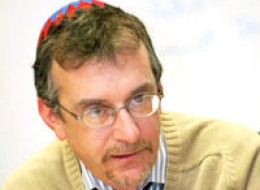 Rabbi Moti Rieber is director of the Kansas chapter for the San Francisco-based Interfaith Power & Light. Rabbi Moti Rieber is director of the Kansas chapter for the San Francisco-based Interfaith Power & Light.
(RNS) Rabbi Moti Rieber travels the politically red state of Kansas armed with the book of Genesis, a psalm and even the words of Jesus to lecture church audiences, or sermonize if they’ll let him, about the threat of global warming.
“My feeling is that I’m the only person these people are ever going to see who’s going to look them in the eye and say, ‘There’s such a thing as climate change,’” Rieber said. “I’m trying to let them know it’s not irreligious to believe in climate change.”
He is at the vanguard of religious efforts — halting in some places, gathering speed elsewhere — to move the ecological discussion from its hot-button political and scientific moorings to one based on theological morality and the right thing to do.
Where allowed behind the pulpit in a United Methodist or Lutheran church, Rieber can sense a restless shifting in the pews as he draws parallels between God asking Adam to tend the Garden of Eden and humankind’s stewardship duty to the environment.
He can see a few faces turn away while describing the disproportionate plight of human-driven climate change on the world’s poor, and reminding parishioners of Jesus’ admonition that “as you do it to one of the least of these my brothers, you do it to me.”
Rieber has his work cut out for him in a state governed by Tea Party favorite Sam Brownback — who has blasted Obama administration rules on reducing carbon emissions — and home to the conservative-activist billionaire brothers Charles and David Koch.
Rieber, who leads a congregation of about 85 families at a synagogue in Lawrence, is director of the Kansas chapter for the San Francisco-based Interfaith Power & Light — one of the most prominent groups championing greater faith-based activism on climate change.
Led by an Episcopalian priest, Sally Bingham, the organization is a network of 15,000 churches across 41 states, including some of the most conservative in the country. Members often begin with promoting green technology in a church — efficient light bulbs and solar panels — before turning to the morality of environmental stewardship.
“I honestly believe that there’s not been a single cultural change or big movement that didn’t have the voice of the religious community,” Bingham said. “It’s crucial.”
Her effort is not alone. The United Methodist Church promotes a “Green Church Initiative.” A core mission of the Episcopal Church is “to safeguard the integrity of creation and sustain and renew the life of the earth.”
In May, the U.S. Conference on Catholic Bishops urged the Environmental Protection Agency to draft new carbon-pollution rules for power plants. For years, the leader of the 300-million member Christian Orthodox faith — Ecumenical Patriarch Bartholomew, known as the “Green Patriarch” — has declared planet stewardship a spiritual duty.
And this year, Pope Francis is preparing an encyclical — one of the highest forms of papal opinion — on the “ecology of mankind.” He has already weighed in against what he calls the greedy exploitation of the environment.
“I think it will be a game changer,” said Mary Evelyn Tucker, director of the Forum on Religion and Ecology at Yale University, of the encyclical that would guide 1.3 billion Catholics. The forum is an international multireligious project that promotes dialogues with religions and other disciplines on environmental solutions.
Research scientist Anthony Leiserowitz, as director of the Yale Project on Climate Change Communication, studies the ebb and flow of discourse over environmental changes. He believes the faith-based embrace of the issue is “one of the most exciting things happening in this entire space.”
It moves the discussion, he says, beyond science and polar bears to “a whole different set of values. Not liberal vs.conservative, but now moral and religious … It can engage people in, I think, a particularly deep and powerful way.”
The toughest hurdle, however, are evangelical Christians, Leiserowitz noted in a published paper last year. One in four Americans fall into this group, a powerful supportive force for those in Congress who do not believe in global warming. Yet even among evangelicals, Leiserowitz says, there is not just one view about climate change.
When asked in a 2008 survey cited in Leiserowitz’s study whether “global warming is happening,” 44 percent of evangelicals said it is and the result of human actions, 41 percent said any warming was not caused by man.
Evangelicals tend to be less receptive to outsiders, making efforts such as Interfaith Power & Light ineffective, say evangelical leaders such as the Rev. Mitchell Hescox.
Hescox is president of the Evangelical Environmental Network, devoted to raising awareness about the threat of climate change.
Hescox said the reach of his network has grown from 20,000 evangelical Christians to 300,000 in five years. the organization has 900 “creation care specialists,” many of them evangelical ministers, trained to spread the gospel of safeguarding God’s handiwork.
When Hescox speaks to congregations across the country, he says climate change threatens a core evangelical concern — the sanctity of life.
“One of the key values of the evangelical church is being pro-life. I’m pro-life from conception to natural death. To go in and be able to talk about my values truly gives me an opening for them to hear what I have to say,” he said.
A rising star in this new firmament is Katherine Hayhoe, an evangelical Christian who is also a scientist and director of the Climate Science Center at Texas Tech University. Her husband, Andrew Farley, is an evangelical minister.
She was featured in Showtime’s climate documentary “Years of Living Dangerously,” and in April was named one of Time magazine’s 100 most influential people.
“You have to know who your audience is,” said Hayhoe who speaks at churches, evangelical colleges and conferences, half of them from red states. “I know what people are thinking. I know what many of their questions are. I know what they’ve been hearing.”
She answers their doubts even before they are raised. But more importantly, Hayhoe said, “I start out by sharing not from my head, but from my heart — what my own values are and why I care about this issue.”
(Gregg Zoroya writes for USA Today.)
huffingtonpost.com |




