Soviet propaganda posters show importance of religious freedom
[ Bentway's post shows the Soviet spirit is still alive. ]
As found on Byzantine, TX
Denver, CO ( CNA) - Some 40 Soviet propaganda posters against Christianity will soon be displayed at Denver’s Catholic cathedral as part of an exhibit dedicated to religious liberty.
“These posters remind us that societies can turn very deadly when you have a kind of radical secularism which manifests in an anti-Christian attitude … you see it in all its ugliness through the lens of these posters,” Father Doug Grandon told CNA Oct. 17.
The posters displayed at the cathedral are part of the collection of Fr. Grandon, parochial vicar at St. Thomas More parish in Centennial, Colo.
The October 1917 revolution in Russia led to the atheistic, communist government of the Soviet Union which hoped to eradicate religion, and in particular the Catholic Church, from its empire.
To do this, the government produced thousands of different propaganda posters which denigrated Christianity and which the Soviet Central Committee described in 1931 as “a powerful tool in the reconstruction of the individual, his ideology, his way of life, his economic activity.”
Between 1919 and 1922, 7.5 million of these posters were distributed in the Soviet Union. As many as 250,000 copies of a given poster could be made in the 1930s. The propaganda posters continued to be made through 1983.
The posters showing the Bolshevik worldview fall into three basic categories: icons of the worker, women, and the enemy. The Soviet government also produced anti-religious cartoons and postcards.
The posters contain such imagery as Lenin sweeping clergy from the earth, hypocritical priests, and Christians as sheep being fleeced by their priests.
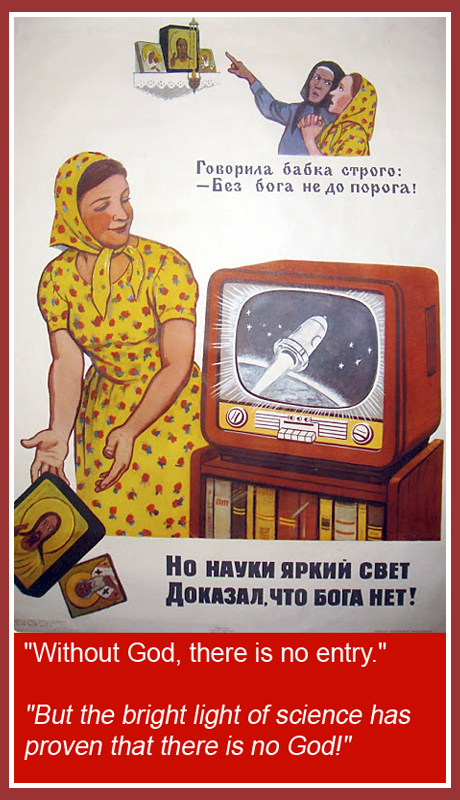
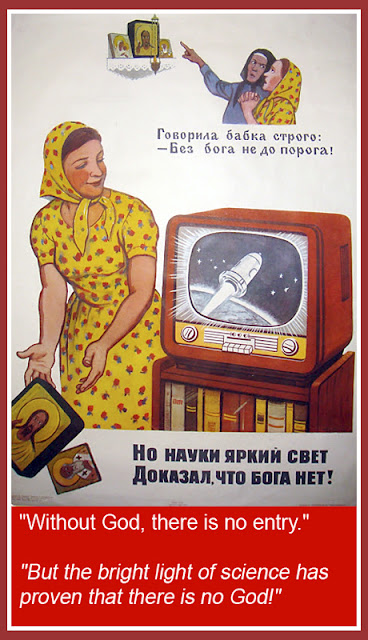
A poster from 1965 shows a young woman throwing out her icons while she watches a satellite in space on television. The poster says, “the bright light of science has proven there is no God.”
Fr. Grandon first encountered the posters at a flea market in Moscow in 1999. “When I first saw them I was fascinated by the blatant and ugly attack on religion that the posters represented,” he recalled.
He believes the posters are important for Coloradans to see because they “give us a warning that this could happen again. Where you have a disrespect for the freedom of religion, a rampant kind of secularism, this could happen again.”
“If we forget these horrific historical examples, and if we become lethargic in our political involvement, our prayers, in our practice of religion, our culture could be lost. It could happen even here.”
The communist government of the Soviet Union suppressed the Russian Orthodox Church and appropriated control over its institutions in 1917, killing over 1,200 clergy and 12,000 laymen in the process. Fr. Grandon reported that many remaining clergy of the Russian Orthodox Church became informants for the KGB.
The Russian Orthodox Church was allowed to operate openly again in 1945. I wouldn't say that in quite that way. The Church was allowed to exist under continued persecution, government control, and near universal monitoring of clergy and laypeople that chose to go to church.
The Catholic Church was attacked in 1923, and by the end of the decade it had virtually disappeared from the U.S.S.R.
In 1946, all property of the Ukrainian Greek Catholic Church was transferred to the Russian Orthodox Church, and that Church was not allowed to operate again until 1989.
Fr. Grandon described Soviet religious persecution as “not just on religion, but an attack on the human spirit, freedom, capitalism, human aspirations. It really did destroy the human spirit of the average Russian.”
He noted that even today, very few Russians practice any religion, and the country suffers from alcoholism, divorce, and devastating abortion rates.
“Communism really was devastating to the human soul, and they're still experiencing the consequences of that,” said Fr. Grandon.
Fr. Grandon is on the board of the Mary Mother of God Mission Society, which works to revive the Catholic Church in Far Eastern Russia.
“Protect Freedom of Religion” will be exhibited at the Cathedral Basilica of the Immaculate Conception on Friday, Oct. 19 from 6 to 9 in the evening, and on Oct. 20 from 9 a.m. until noon. It is being presented by the Denver archdiocese's Office of Social Ministry.
sainteliaschurch.blogspot.ca
........ Like today's atheists, communist atheist too portrayed themselves as scientific-minded[1] and religion as backward superstition that exploited the masses.
While literacy and scientific education was important to communists, they also suppressed science when it didn't conform to their atheist/materialist worldview:
A) In the mid-1930s, the agronomist Trofim Lysenko started a campaign against genetics [2] and was supported by Stalin. Mendelian genetics particularly enraged Stalin due to its founder Gregor Mendel's being a Catholic Christian priest, a fact that flew in the face of the Soviet Union's official atheism and antitheism.[3][4][5][6][7] In the late 1940s, Joseph Stalin abolished Mendelian genetics throughout the Soviet Union.[8]
In other words, Mendelian genetics was rejected by an atheistic government on the grounds that Rev. Mendel was a product of the Church, which promotes the existence of God, i.e. theism.
An entire area of science was suppressed for twenty-five years in which all existing genetic experimentation was destroyed, references to Mendel were removed, and the teaching of classical genetics was suppressed.[9] During this period, hundreds of geneticists who continued to uphold Mendel's genetic theory were imprisoned or executed, the most prominent being Nikolai Ivanovich Vavilov, who was starved to death in the Gulag in 1943.[10]
B) In the late 1940s, some areas of physics, especially quantum mechanics but also special and general relativity, were also criticized on grounds of "idealism" and contradicting atheistic dialectical materialism.[11] The suspicions of the atheistic communist critics of quantum mechanics and relativity physics were heightened when several prominent Western European philosophers and scientists concluded that the probabilistic approach of quantum mechanics meant the end of determinism as a worldview, while the equivalence of matter and energy postulated by relativity theory marked the end of materialism. Several of them concluded that relativity physics and quatum mechanics destroyed the basis of Marxist materialism.[12] Beginning in 1930 a worrisome danger arose with the appearance of the "Bolshevizers" of philosophy and science, younger militants taking advantage of Cultural Revolution then in progress and calling for the "reconstruction" of physics on the basis of dialectical materialism.[13]
Boris Mikhailovich Hessen, a Jewish physicist, attempted to defend quantum mechanics and relativity, but was denounced as a "metaphysicist of the worst sort," a "pure idealist," and as a deserter of the cause of materialism who interpreted relativity physics in the same spirit as the Western mystic astronomer Arthur Stanley Eddington.[14] On 20 December 1936 Hessen was executed by a firing squad; Hessens' promotion of the theory of relativity resulted in his execution.[15]
C) Cosmology was among the sciences that became heavily politicized and forced to conform to the doctrines of Marxism-Leninism. This field of science developed entirely differently in the Communist countries than in the West, in large measure because of political pressure. Certain cosmological models, in particular of the big bang type, were declared pseudo-scientific and idealistic because they implied a cosmic creation, a concept which was taken to be religious.[16]
Andrei Zhdanov, Stalin's notorious chief ideologue, accusing Western cosmology of being covertly religious, said in a speech of 1947 that Lemaître (Christian priest and the father of big bang cosmology) and his kindred spirits were "Falsifiers of science [who] wanted to revive the fairy tale of the origin of the world from nothing ... Another failure of the “theory” in question consists in the fact that it brings us to the idealistic attitude of assuming the world to be finite."[17]
While Soviet science was gradually depoliticized during the 1950s and 1960s, the de facto ban on cosmology in the Western sense went unchallenged in the People’s Republic of China, where radical Maoist ideologues developed their own version of dialectical materialism. The ideological interference with cosmological theory took a new turn during the Cultural Revolution in Mao Zedong’s empire, when relativistic cosmology for a period was declared a reactionary and anti-socialist pseudo-science.[18]
In 1972, physicist Fang Lizhi published a theoretical paper in a new physics journal on big bang cosmology and the cosmic microwave radiation, the first of its kind in the People’s Republic. Enraged radical Marxists immediately rallied against Fang’s heresy and its betrayal of the true spirit of proletarian science.
During the next couple of years, some thirty papers were published against the bourgeois big bang theory and cosmology in general. As late as 1976, the journal Acta Physica Sinica carried an article that warned against "the schools of physics promoting a finite universe [which] are linked up with all sorts of idealist philosophy, including theology".[19]
The thrust of the criticism was that Big Bang cosmology contradicted the dialectical materialist doctrine of the infinite universe contained in such Marxist-Leninist classics as Engels's Anti-Dühring and Dialectics of Nature, and Lenin's Materialism and Empirio-Criticism.[20]
The Big Bang cosmology was also vehemently rejected outside communist countries by other atheists like Fred Hoyle who thought this cosmology implied a Creator.[21]
In the 1920s and 1930s almost every major cosmologist preferred an eternal steady state Universe, and several complained that the beginning of time implied by the Big Bang imported religious concepts into physics; this objection was later repeated by supporters of the steady state theory,[22] who rejected the implication that the universe had a beginning.[23]
_________
References:
[1] http://books.google.ca/books?id=BGJtDwJ7aPwC&pg=PA289&lpg=PA289&dq=The+Fundamentals+of+Scientific+Atheism&source=bl&ots=eRnz5c2gQh&sig=uD3p3LFphEBGpa_xBXRJB8e8gZA&hl=en&sa=X&ei=iVZsU9yLMoSVyAT52IBw&ved=0CD0Q6AEwAg#v=onepage&q=The%20Fundamentals%20of%20Scientific%20Atheism&f=false
[2] Hudson, P. S., and R. H. Richens. The New Genetics in the Soviet Union. Cambridge, U.K.: English School of Agriculture, 1946.
[3] sis, Volume 37. History of Science Society, Académie internationale d'histoire des sciences. 1947. "The fact that Mendel was a priest has been similarly used to discredit his ideas."
[4] Eugenics: Galton and After. Duckworth. 1952. "Was not Mendel a priest ? If, as the reactionaries maintain, genetic processes are subject to the laws of chance ..."
[5] George Aiken Taylor (1972). The Presbyterian Journal, Volume 31. Southern Presbyterian Journal Co. "Mendel, of course, must be discredited, in Communist thought, because he was a product of the West and of the Church."
[6] The Australasian Journal of Psychology and Philosophy, Volumes 23-27. Australasian Association of Psychology and Philosophy. 1945. "He trenchantly criticises Lysenko's vilification of the work of Mendel and Morgan as "fascist, bourgeois-capitalistic, and inspired by clerics" (that Mendel was a priest is taken as sufficient to discredit his experiments)."
[7] Gregor Mendel: And the Roots of Genetics, Edward Edelson, p. 14. "Lysenko won the support of Joseph Stalin, the ruthless Soviet dictator, and Mendel's rules were officially outlawed in the Soviet Union and the Eastern European Countries that it controlled at that time. Under Communism, the Mendel Museum in his monastery was closed."
[8] Atlas World Press Review, Volume 24. Atlas Information Services. “The story begins in the late 1940s when Stalin had "abolished" Mendelian genetics throughout the Soviet Union.”
[9] Anna C. Pai (1974). Foundations of Genetics: a Science for Society. McGraw-Hill. “An entire area of science was suppressed for 20 years. Vavilov and other geneticists were arrested, imprisoned, and finally perished. All existing genetic experimentation was destroyed, and references to Mendel and Darwin were removed.”
[10] Andrew Pinsent. New Atheists and Old Atheists. Philosophy Now. “Since the CPSU was so keen to identify its type of atheism as the essential component of the ‘scientific, materialist weltanschauung’, problems tended to arise when scientific theories seemed to be in disagreement with the ideological positions of the party. One common consequence, at least during the Stalinist period, was simply to deny that the problematic sciences were true sciences. The most notorious episode was the banning for nearly two decades of the study and research of Mendelian Genetics (incidentally, founded by a Catholic monk). During this period, hundreds of scientists were imprisoned or killed, the most prominent being Nikolai Vavilov, who was starved to death in the Gulag in 1943. (A striking contrast with Galileo, who died in his bed.)
[11] Bulletin of the Atomic Scientists Mar 1952. SAGE Publications. “Certain physicial theories, including relativity and quantum mechanics, were sporadically attacked by party philosophers; but in vain did these critics invoke Marx and dialectical materialism–political leaders were loath to frighten the hen they expected to lay many golden eggs.”
[12] Rosalind J. Marsh. Science in Russia and the Soviet Union: A Short History. Cambridge University Press. “The suspicions of the Soviet critics of quantum mechanics and relativity physics were heightened when several prominent West European philosophers and scientists concluded that the probablilistic approach of quantum mechanics meant the end of determinism as a worldview, while the equivalence of matter and energy postulated by relativity theory marked the end of materialism. Several of them concluded that relativity physics and quatum mechanics destroyed the basis of Marxist materialism.”
[13] Rosalind J. Marsh. Science in Russia and the Soviet Union: A Short History. Cambridge University Press. “Beginning in 1930 a worrisome danger arose with the appearance of the "Bolshevizers" of philosophy and science, younger militants taking advantage of Cultural Revolution then in progress and calling for the "reconstruction" of physics on the basis of dialectical materialism.”
[14] Rosalind J. Marsh. Science in Russia and the Soviet Union: A Short History. Cambridge University Press. “Hessen and his views on physics came under very heavy criticism at a conference on the state of Soviet philosophy that was held Octover 17-20, 1930, Although present, he was not permitted to speak in his own defense. He was denounced as a "metaphysicist of the worst sort," a "pure idealist," and as a deserter of the cause of materialism who interpreted relativity physics in the same spirit as the Western mystic astronomer Arthur Stanley Eddington. He was criticized for paying insufficient attention to the ideas of Engels and Lenin. Particularly mistaken, said his detractors, was his definition of matter as a "synthesis of space and time," a wording that came from one of his defenses of relativity theory. In the final resolution of the conference Hessen was censured by name twice, one for his philosophical views on relativity theory and again for his opinions based on quantum mechanics.”
[15] Tamera Dorland. The Heirs of Archimedes: Science and the Art of War through the Age of Enlightenment. The MIT Press. “From the perspective of the history of science, the military context of early modern science attracted serious attention before the advent of the Cold War–beginning with Boris Hessen. A prominent Soviet physicist, he actively promoted Einstein's theory of relativity during the early Stalinist era–a position that ultimately resulted in his execution by the late 1930s.”
[16] http://arxiv.org/ftp/arxiv/papers/1204/1204.1625.pdf
[17] Ibid., 3.
[18] Ibid., 25.
[19] Ibid., 25.
[20] http://www.aps.org/units/fps/newsletters/201210/williams.cfm
[21] http://infidels.org/library/modern/quentin_smith/bigbang.html
[22] Kragh, H. (1996). Cosmology and Controversy. Princeton (NJ): Princeton University Press. ISBN 0-691-02623-8.
[23] Harrison, P. (2010). The Cambridge Companion to Science and Religion. Cambridge University Press. p. 9. ISBN 978-0-521-71251-4. "One reason for initial resistance to the Big Bang theory was that, unlike the rival Steady-State hypothesis, it proposed that the universe has a beginning – a proposition that for some had unwelcome religious implications."
|