We have a fairly good chronology of the Egyptian dynasties going far back 4,600yrs to Kings that built the Great Pyramids, King Sneferu & Khufu. You know, the ones the Bible forgot to ever mention? And even farther back & much more from the old kingdom. Have you been living under a rock all your life to miss these fabulous discoveries or ever chosen to go to any museum exhibition as long as you've lived?
The Bible is its own worst enemy and the "history" it represents in reality is a flyspeck
(& that's being generous)
"Chronology of Egypt, List of pharaohs"
http://en.wikipedia.org/wiki/List_of_pharaohs
Old Kingdom
The Old Kingdom is the period in the third millennium BC when Egypt attained its first continuous peak of civilisational complexity and achievement (the first of three so-called "Kingdom" periods which mark the high points of civilization in the Nile Valley), spanning the period when Egypt was ruled by the Third Dynasty through the Sixth Dynasty (2686–2181 BC). Many Egyptologists also include the Memphite Seventh and Eighth Dynasties in the Old Kingdom as a continuation of the administration centralised at Memphis. The Old Kingdom was followed by a period of disunity and relative cultural decline referred to by Egyptologists as the First Intermediate Period—or, as the Egyptians called it, the "first illness."
The royal capital of Egypt during the Old Kingdom was located at Memphis, where Djoser established his court. The Old Kingdom is perhaps best known, however, for the large number of pyramids which were constructed at this time as pharaonic burial places. For this reason, the Old Kingdom is frequently referred to as "the Age of the Pyramids".
Third Dynasty[ edit]The Third Dynasty ruled from 2686 to 2613 BC.
NameImageCommentsDatesFourth Dynasty[ edit]The Fourth Dynasty ruled from 2613 to 2498 BC and included the pharaohs who had the Great Pyramids built, Khufu (Cheops), Khafra (Chephren) and Menkaura (Mycerinus)also Thoridea
NameImageCommentsDates|
| Sneferu | 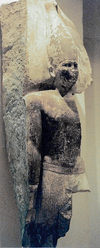 | Built the Meidum Pyramid and the Bent Pyramid (341 ft/103m from the base to the tip), which is a pyramid built at a normal angle at the bottom but drastically changes at the top. He also built the first "true" pyramid, the Red Pyramid. Some say that he was buried in the Red Pyramid, while others say that he was buried in the Bent Pyramid. Bones have been found at the Red Pyramid, but there is no evidence that this is Sneferu's body. | 2613–2589 BC | | Khufu |  | Greek form: Cheops. Built the great pyramid of Giza. Note that Khufu is spoken of in early sources as being "third" of his family to rule, although there is no known record of a Pharaoh between Sneferu and Khufu. One supposition is that there might have been a very short reign of some elder brother of Khufu, whose inscriptions, names, and monuments have perished for one reason or another. | 2589–2566 BC | | Djedefra (Radjedef) |  | Believed to have created the Great Sphinx of Giza as a monument for his deceased father. He also created a pyramid at Abu Rawash. However, this pyramid is no longer intact as it is believed the Romans recycled the materials it was made from. Before being demolished by the Romans, according to a documentary aired by the History Channel, the pyramid may actually have been the highest ever built (about 20 meters taller than the Great Pyramid of Giza although this is due to its elevated location rather than the size from base to tip). | 2566–2558 BC | | Khafra |  | Greek form: Chephren His pyramid is the second largest in Giza. Credited by some Egyptologists as the builder of the Great Sphinx of Giza. | 2558–2532 BC | | — | – | Here some authorities insert Bikheris, following Manetho | — | | Menkaura |  | Greek form: Mycerinus. His pyramid is the third and smallest in Giza. | 2532–2503 BC | | Shepseskaf |  | Broke with the tradition of pyramid building and instead had the Mastabat el-Fara'un made for himself | 2503– |
1 Existing primary old lists of pharaohs 2 Legendary period 3 Archaic period 4 Old Kingdom 5 First Intermediate Period 6 Middle Kingdom 7 Second Intermediate Period 8 New Kingdom 9 Third Intermediate Period 10 Late period A moment's thought will suggest a way of building a more art-friendly theory out of Plato's philosophy. What if the artist is somehow able to make a truer copy of the Forms than our ordinary experience offers? This theory actually appears in Plato's short early dialogue, the Ion. Socrates is questioning a poet named Ion, who recites Homer's poetry brilliantly but is no good at reciting anything else. Socrates is puzzled by this; it seems to him that if Ion has an art, or skill, of reciting poetry he should be able to apply his skilled knowledge to other poets as well. He concludes that Ion doesn't really possess skilled knowledge. Rather, when he recites Homer, he must be inspired by a god.
The Ion drips with sarcasm. Plato didn't take the "art by divine inspiration" theory very seriously. But many ancient, medieval, and modern artists and aestheticians have found it irresistible. After all, aren't artists often inspired? Doesn't their creative genius often produce wonderfully surprising results, about which the artist will say, "I don't know how I did that?" Most important, don't artists show us the essence of things, and reveal truths that we wouldn't otherwise see?
The view of the artist as inspired revealer of ideal essences fits well with the spirit of Plato's Symposium, a dialogue full of speeches in praise of Love, in which Socrates gives a compelling picture of the ascent from sexual love, to the aesthetic appreciation of beautiful bodies, to the love of beautiful souls, and finally to the the contemplation of the ideal Form of Beauty itself. The same spirit fills much classic Greek art. Late classical sculpture presents gods and heroes as ideal bodies, built in perfect proportions, and filled with a cool repose, as if they inhabited a perfect and changeless divine world. The classical ideal of the artist as capturing an essence has continued to exert great power, from the Renaissance rediscovery of the Greek canons of proportion to the twentieth century sculptures of Constantin Brancusi, the paintings of Piet Mondrian, and the color theories of Vasily Kandinsky and the Blue Rider (der Blaue Reiter) group.
The idea of the artist as divinely inspired, or even possessed, has also persisted to the present day. Some of our most common art vocabulary derives from this idea. For example, the word "music" derives from the Greek Muses, the demigods who inspired an artist's work. The notion of "genius" is originally the same; your genius was your personal daimon or inspiring spirit. There are countless paintings from the Renaissance which depict a genius of this sort, or an inspiring muse; and there are some which combine the ideas of inspiration and imitation, showing an artist or musician contemplating a divine ideal, and producing art as a result. An example, which may appear a bit differently to modern eyes than to Renaissance ones, is Titian's "Venus and Music" ( Venere, Amore e Organista). The idea of genius was strong in the Romantic period, and has certainly not gone away since that time!
Problems with the imitation theory. In either of its two versions, as imitations of the world or imitation of an ideal, the imitation theory has problems. It is at least plausible as a theory about representational painting, drawing and sculpture; and it can be stretched to fit some abstract work, as in the case of Brancusi and Mondrian. But even with such work it leaves a lot out. With an artist like Jackson Pollack it leaves out everything; what do his drip paintings imitate? And how is the theory supposed to work for music? What does music represent? Plato spoke about music representing natural sounds, and emotions, as did Aristotle. but even if one agrees that music imitates emotions, could one build a theory of music out of this fact alone?
2. Art is powerful, and therefore dangerous Poetry, drama, music, painting, dance, all stir up our emotions. All of the arts move people powerfully. They can strongly influence our behavior, and even our character. For that reason Plato insisted that music (especially music), along with poetry and drama and the other arts, should be part of the education of young citizens in his ideal republic, but should be strictly censored to present, at first, only the good. (That stories and images can shape character may seem obvious enough; but how does music do this? Plato was much impressed with the theories of Pythagoras, and his number mysticism. Early thinking about geometric ratios was partly inspired by noticing the series of overtones connected with the vibration of a string. A string, when plucked, vibrates along its whole length, but also in halves, giving the octave, and in other divisions which give the fifth, the third, and the rest of the overtone series. These are the bell-like higher tones string players produce when they play "harmonics". Plato thought that the right sort of music would help to set the soul in harmony rather than discord. But that meant excluding certain musical modes from the Republic, and keeping only those that were conducive to a properly ordered soul, i.e., one whose will ruled its passions at the direction of its reason. Only when young people were ready should the strength of their character be tested by exposing them to depictions of evil, and to the more promiscuous modes of music.)
From Plato to New York Mayor Rudolf Giuliani, influential people through the centuries and across cultures have worried about the power of the arts to influence, and potentially to corrupt. It can be hard for a twenty first century westerner to sympathize with Plato's severe censorship of the arts. Little if anything is more valuable to us than our freedom; we don't take kindly to others telling us what we can watch or listen to or read. We believe in the free exchange of ideas, and let the best idea win. We might even try to justify this idea from Plato's own dialogues. Of course, Plato did not value freedom so highly as do we; he thought that freedom with no limits and no proper training would result in no good. In fact, he thought it would leave the mass of people vulnerable to deception, manipulation, and eventual enslavement by a tyrant. In spite of this, he agreed with modern people about the free exchange of ideas. There was no other way to arrive at truth, in his view. His problem with the arts was that they operated by images rather than by ideas, and thus that they might cloud the truth rather than clarifying it.
Perhaps a bit of "sympathy for the devil" is possible here. The most famous summary of Plato's philosophy is the allegory of the Cave, found in Book VII of his Republic. There Plato asks readers to imagine prisoners chained to a bench, facing the wall of a deep cave. Behind them is a six-foot wall, behind that a fire, and in between the fire and the wall walk actors carrying puppets on sticks. All the prisoners can see are the shadows cast by the puppets. That is their world, and they think it Reality. Imagine that a prisoner is somehow released. At first he or she will stumble in the dark, and be blinded by the fire, but then come to realize that the shadows are copies of the puppets. The liberated prisoner stumbles further up, all the way out the mouth of the cave and into the sunlight. There, when the sunblindness goes away, the prisoner sees the real things of which the puppets themselves are copies. Finally, he or she is able to see the sun, by whose light the real things are visible.
Why would Plato have seen the arts as shadows on the wall of the cave, rather than as shining symbols of the true spiritual world outside? The answer is that he saw both potentials. If he did not see the possibility that art could reveal truth and form character in a good way, he would not have recommended music and stories for the young. But why so much emphasis on the seductive shadow potential of art? Put the Allegory of the Cave into its obvious 21st century version, and one answer begs to be given. The prisoner becomes a couch potato, tied to the television, and taking the images and myths purveyed by the ads and the shows as the way things are. Are those images and myths powerful? Do they shape our picture of ourselves and the world? Do they distract us from knowing who we really are, what is really best for us, who would be a good political leader? The questions answer themselves. (But for a particularly powerful, detailed description of just how they do so, see the works of Stuart Ewen, particularly All Consuming Images and PR!) Plays and public oratory were the media and propaganda of Plato's day, and painting, statuary and music often served similar ends. Think "media", "propaganda", and Entertainment Tonight, rather than "fine art", and it is easier to gain some sympathy for Plato's views. It is surely a chief challenge of our time to enable free, honest, challenging communication while resisting the unreasoned power of advertising imagery and media hype. Whatever one thinks of Plato's solution to this problem, I suggest that this is one of the problems that elicited his proposals for severe censorship of the arts he so obviously loved and had been trained in. The solution may not appeal, but the problem is a real one.
Plato's influence came into the medieval European tradition through the filter of Neoplatonism, a much later modification of Platonic teachings that flourished in the centuries just before and after the time of Jesus. The most famous neo-Platonist was Plotinus. Plotinus and the other neo-Platonists made much of the idea of Beauty, and the soul's quest for it, as described in the Symposium. Through neoplatonism, Plato's second theory (art as imitation of eternal Beauty and eternal Truth) became the channel of his influence on the western middle ages and the renaissance. |




