Destructive Cultural Vandals for Centuries, 'The Christians'
thus shall ye deal with them; ye shall destroy their altars, and break down their images, and cut down their groves, and burn their graven images with fire.
|
Deuteronomy 7:5
|
In this section we look at how the Christian Church has influenced classical culture, European culture and world culture.
The Classical WorldWhenever books are burned men also in the end are burned.
Heinrich Heine (1797-1856), Almansor
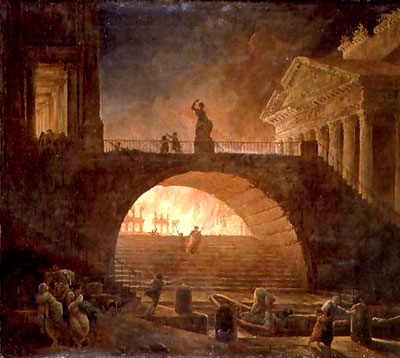
All religious traditions had been tolerated under the Roman Empire, although Christians suffered to some extent because of their sedition. They stated openly that they desired the destruction of the Empire, encouraged soldiers to desert, aparently assassinated opponents, vandalised sacred monuments and statues, and tried to destroy the city of Rome by means of arson.
Christians tried repeatedly to destroy the city of Rome
|
|
As soon as the Empire became Christian, this toleration ceased. The only writings to be permitted were those supported by the line currently regarded as orthodox. By 326 Constantine had authorised the confiscation and destruction of anything that challenged orthodoxy (i.e. the orthodoxy established the previous year). This included non-Christian places of worship as well as works by pagan authors and by all other Christian factions. Soon afterwards Constantine's mother Helena and Macarius, the Bishop of Jerusalem, were supervising the destruction of a temple in Jerusalem dedicated to Aphrodite, and building a Christian basilica on the site. This basilica, now the Church of the Holy Sepulchre, was imagined to be the very burial site of Jesus and to encompass the place of crucifixion. Evidence was conveniently discovered in the form of a tomb and miracle working splinters of the True Cross. Countless thousands of architectural treasures from classical times were soon being vandalised in the same way and turned into Churches.
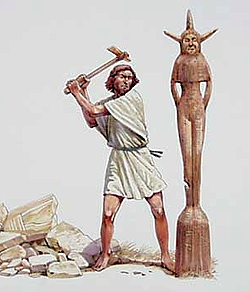
Christians were keen to emulate selected Jewish practices. Josiah enforced the exclusive worship of Yahweh (2 Kings 23). According to the biblical account, he destroyed pagan objects related to the worship of Baal or Asherah. He had pagan priests executed and had the bones of the dead priests of Bethel exhumed and burned on their own altars. According to 2 Chronicles, Josiah destroyed altars and images of pagan deities in cities of neighbouring tribes of Manasseh, Ephraim, "and Simeon, as far as Naphtali" (2 Chronicles 34:6-7)
Below, Josiah is destorying pagan religious items and a pagan altar, just as Christian missionaries were to destroy pagan religious icons and altars for centuries to come.
|

|
Christian power grew, and Christians were soon denying freedom of religion to everyone except followers of the Christian faction currently in favour. In the year that the Emperor Constantine inaugurated his new capital at Byzantium, AD 330, he prohibited the performance of rites of other faiths there. In 333, Christian censorship, pillaging, dispossession and judicial killing started in earnest. Not only were works of Arius, but also people who owned such works, to be consigned to the flames. Gold and treasure were removed from Eastern temples. Under Constantine's Christian sons, the trend developed further. More temples were destroyed, and sacrifices were forbidden. Marriages between Christians and Jews were declared illegal, and the crime was punishable by death. Constantius II passed laws against pagans in 341, and in the following years further laws were passed to the effect that all superstition (i.e. other religions) be completely eradicated. Soon, anyone performing traditional sacrifices would be liable to the death penalty. In town and country, temples were demolished or seized and turned into churches. Bands of violent monks were deployed to ensure the domination of the orthodox line. They were sometimes commanded by bishops. As a modern, devout Christian, historian says:
The monks were often formed, or formed themselves, into black-robed squads for the execution of the Church's business, first to smash up pagan temples, later to rampage through the streets in time of doctrinal controversy. Monasticism attracted misfits, bankrupts, criminals, homosexuals, fugitives as well as the pious; it was also a career for raw peasant youths who could be drilled into well-disciplined monkish regiments to be deployed as an unscrupulous bishop might think fit 1.
  Other recruits included draft-dodgers, runaway slaves and lunatics. Cultured pagans were appalled by their vandalism. The pattern continued until Julian was declared emperor in 360. Julian, known as Julian the Apostate, rejected Christianity in favour of traditional religions. He reopened and repaired pagan temples and restored the tradition of universal toleration. He restored Jerusalem to the Jews, revoked anti-Semitic legislation and authorised the rebuilding of the Jewish Temple. Other recruits included draft-dodgers, runaway slaves and lunatics. Cultured pagans were appalled by their vandalism. The pattern continued until Julian was declared emperor in 360. Julian, known as Julian the Apostate, rejected Christianity in favour of traditional religions. He reopened and repaired pagan temples and restored the tradition of universal toleration. He restored Jerusalem to the Jews, revoked anti-Semitic legislation and authorised the rebuilding of the Jewish Temple.
His toleration was not appreciated by Christians, who insulted and destroyed new temples in Syria and Asia Minor. The rebuilding of the Jewish Temple in Jerusalem was set back by a mysterious fire, possible one of the many instances of arson carried out by Christians. There is more than a suspicion that Julian's untimely death was attributable to some Christian agency. Certainly, many Christians did not trouble to disguise their glee at his demise.
 After Julian, the Empire returned to Christian government. Christian rulers resumed the destruction of temples and cancelled the rebuilding of the Jewish Temple. By 380 Christianity was the only recognised religion in the Empire. As part of its campaign books were burned, works of art destroyed, families dispossessed, and temples desecrated. Christians delighted in their victory, and seized opportunities for destruction of everything others held holy. After Julian, the Empire returned to Christian government. Christian rulers resumed the destruction of temples and cancelled the rebuilding of the Jewish Temple. By 380 Christianity was the only recognised religion in the Empire. As part of its campaign books were burned, works of art destroyed, families dispossessed, and temples desecrated. Christians delighted in their victory, and seized opportunities for destruction of everything others held holy.
The Christian Emperor Theodosius I closed pagan temples in Rome at the end of the fourth century, in line with the views of St Ambrose. Under his influence, the Emperor adopted an official policy of Christian uniformity. Christian mobs were free to attack and destroy synagogues and temples with impunity. Spies were appointed to expose those who were not sufficiently sympathetic to the Christian cause. It was Ambrose who dissuaded the Emperor from paying compensation for the destruction of a synagogue in 388.
 For a while Christians stuck to their home churches, often the private basilicas (audience chambers) of rich converts. As Christianity adopted ever more pagan practices and trapping, old pagan temples were recognized as ideal locations for their meetings and ceremonies. Pagan temples were then appropriated for use as churches. This happened to countless thousands of temples throughout the Roman Empire. In Rome itself numerous pagan temples in Rome were converted into churches, as confirmed by archeological investigations. On the Roman Forum alone, the Curia Julia or Roman Senate building became the church of Sant'Adriano in Foro, the Temple of Antoninus and Faustina became the church of San Lorenzo in Miranda, and the Temple of Romulus became the church of Santi Cosma e Damiano. St. Peter's Basilica, the church of the Vatican, was built on top of a large pagan necropolis on the Vatican Hill. Pagan gods and their temples are sometimes remembered in the names of Roman churches, for example the church of Santa Maria sopra Minerva (literally Saint Mary above Minerva). The Basilica of St. Mary of the Angels and the Martyrs (Santa Maria degli Angeli e dei Martiri) is a basilica church, built inside the frigidarium of the Baths of Diocletian in the Piazza della Repubblica in Rome. For a while Christians stuck to their home churches, often the private basilicas (audience chambers) of rich converts. As Christianity adopted ever more pagan practices and trapping, old pagan temples were recognized as ideal locations for their meetings and ceremonies. Pagan temples were then appropriated for use as churches. This happened to countless thousands of temples throughout the Roman Empire. In Rome itself numerous pagan temples in Rome were converted into churches, as confirmed by archeological investigations. On the Roman Forum alone, the Curia Julia or Roman Senate building became the church of Sant'Adriano in Foro, the Temple of Antoninus and Faustina became the church of San Lorenzo in Miranda, and the Temple of Romulus became the church of Santi Cosma e Damiano. St. Peter's Basilica, the church of the Vatican, was built on top of a large pagan necropolis on the Vatican Hill. Pagan gods and their temples are sometimes remembered in the names of Roman churches, for example the church of Santa Maria sopra Minerva (literally Saint Mary above Minerva). The Basilica of St. Mary of the Angels and the Martyrs (Santa Maria degli Angeli e dei Martiri) is a basilica church, built inside the frigidarium of the Baths of Diocletian in the Piazza della Repubblica in Rome.
 Officially sanctioned Christian Vandalism became ever more commonplace. At Alexandria in 389, Bishop Theophilus of Alexandria personally directed the destruction of the temple to the god Serapis, reputedly the largest place of worship in the known world. The statue of the god was chopped up and burned, its head being carried through the town for public ridicule. The temple precinct, or Serapeum, also housed a scientific research institute (a "Museum" named after the nine Muses) and the famous Library of Alexandria - two of the greatest academic buildings in human history. Both buildings were loathed by Christians, who hated scientific research and secular knowledge as much as they hated other people's places of worship. Both Museum and Library were destroyed around this time, probably in the same violent incident in which the bishop destroyed the temple. The destruction of the Serapeum by Patriarch Theophilus was a critical event in the history of persecution of ancient paganism. A later bishop of the same city, Saint Cyril was responsible for the murder of the pholosopher Hypatia. Officially sanctioned Christian Vandalism became ever more commonplace. At Alexandria in 389, Bishop Theophilus of Alexandria personally directed the destruction of the temple to the god Serapis, reputedly the largest place of worship in the known world. The statue of the god was chopped up and burned, its head being carried through the town for public ridicule. The temple precinct, or Serapeum, also housed a scientific research institute (a "Museum" named after the nine Muses) and the famous Library of Alexandria - two of the greatest academic buildings in human history. Both buildings were loathed by Christians, who hated scientific research and secular knowledge as much as they hated other people's places of worship. Both Museum and Library were destroyed around this time, probably in the same violent incident in which the bishop destroyed the temple. The destruction of the Serapeum by Patriarch Theophilus was a critical event in the history of persecution of ancient paganism. A later bishop of the same city, Saint Cyril was responsible for the murder of the pholosopher Hypatia.
The famous Temple of Apollo at Patara was destroyed, possibly by St Nicholas, a bishop now better known as Santa Claus. Certainly he, like many other bishops, was a keen destroyer of other people's holy places in the area. Throughout Egypt bands of monks commissioned by bishops were given military protection so that they could despoil the shrines of other faiths in safety. Notre-Dame de la Daurade is a basilica in Toulouse, France. It was established in 410 when Emperor Honorius allowed the conversion of Pagan temples to Christianity. The original building here was a temple dedicated to Apollo.
 In the fifth century, the cult of Alexander, which had survived in the desert oasis at Siwa, was suppressed. By the sixth century the Christian Emperor Justinian closed the last temples in Egypt dedicated to the cults of Isis and Ammon. Centuries later Christians were still seizing wooden icons from devotees of other religions in Egypt. They were sent to Constantinople to be burned in the hippodrome. Temples continued to be sequestered by the Church and converted for Christian use. The famous shrine of the goddess Ma in Comana in Cappadocia was converted into a church. The Parthenon in Athens was also converted, and so was the Temple of Rhea at Byzantium. The Temple of Athene at Syracuse was rebuilt as a church. Often the temples that had been dedicated to goddesses became churches dedicated to the Virgin Mary. In the fifth century, the cult of Alexander, which had survived in the desert oasis at Siwa, was suppressed. By the sixth century the Christian Emperor Justinian closed the last temples in Egypt dedicated to the cults of Isis and Ammon. Centuries later Christians were still seizing wooden icons from devotees of other religions in Egypt. They were sent to Constantinople to be burned in the hippodrome. Temples continued to be sequestered by the Church and converted for Christian use. The famous shrine of the goddess Ma in Comana in Cappadocia was converted into a church. The Parthenon in Athens was also converted, and so was the Temple of Rhea at Byzantium. The Temple of Athene at Syracuse was rebuilt as a church. Often the temples that had been dedicated to goddesses became churches dedicated to the Virgin Mary.
Even temples that Jesus himself had visited, such as the Æskelepium in Jerusalem, were replaced by Christian churches 2. Numerous hilltop temples dedicated to Hermes (Mercury) were replaced by churches dedicated to St Michael. A temple to Apollo at Monte Cassino was destroyed by followers of St Benedict in the sixth century, and a monastery was built in its place. Many future saints assisted in such destruction. St Martin of Tours, for example, was a keen destroyer of other people's holy shrines — attacking them with a pickax. Saints Justa and Rufina won their martyrdom by vandalising an image of the goddess Venus in Seville.
In Western Christendom, such practices were encouraged by Pope Gregory I, who reigned between 590 and 604. In 609 Pope Boniface IV turned the Pantheon in Rome into a church. It had been dedicated to all the Olympian gods; now it was dedicated to St Mary and all the Christian martyrs. Another Roman temple, probably dedicated to Hercules, was preserved because it was converted into a Christian church. It is now known, mistakenly, as the Temple of Vesta. Another one, probably dedicated to Portunus, survived for the same reason and is known, again mistakenly, as the Temple of Fortuna Virilis.
The main targets for concerted vandalism were religious. Other buildings were vandalised by neglect. The Flavian Amphitheatre, now called the colosseum, had no particular interest for Christians, since the fictions about Christian martydoms there were not invented until a millennium latter. The was of course an interest in stopping people being free to enjoy themselves, and by the late 6th century a small church had been built into the structure. Stones from the amphitheatre were pillaged for centuries during the Christian period, especially after earthquakes loosened the structure. Stones were taken for cardinals' palaces and churches throughout the city of Rome. A Christian Order moved into the north of the colosseum in the mid-14th century (where it remained until the early 19th century). The amphitheatre's interior was stripped of stone and its marble façade burned to make quicklime. Bronze clamps holding the stonework together were hacked out of the walls. Pope Sixtus V planned to turn the building into a wool factory, with the intention of providing employment for Rome's numerous prostitutes, his plan falling through with his death in 1590. In 1671 Cardinal Altieri authorized the amphitheatre's use for bullfights. In 1749, Pope Benedict XIV endorsed the idea that the colosseums was a site where early Christians had been martyred. This at least stopped a thousand years of Christian vandalism, since he forbade the use of the colosseum as a quarry. (No-one prior to the 16th century had suggested the colosseum had been the site of Christian martydoms). The Catholic Encyclopedia concedes that there is no evidence, yet many Christians continue to imagine gory martydoms there. Each Good Friday the Pope leads a torch-lit "Way of the Cross" procession that starts at the colosseum.
The effect of a millennium of Christian vandalism on the Colosseum. Other classical structures all around the Mediterranean, many older, but located away from Christian cities, are much better preserved than this.
| |
 In Gaul, Martin of Tours, a destroyer of countless temples and sacred sites, immediately built churches or monasteries on the sites of temples that he destroyed (Sulpicius Severus, Vita of Sain Martin, ch xiii). The monastery at Monte Cassino was constructed by Saint Benedict on a pagan site, in an area that was still largely pagan. A temple of Apollo crowned the hill hill there. Benedict's first act was to smash the statue of Apollo and destroy the temple altar. He then appropriated the temple, dedicating it to Saint Martin, and built another chapel on the site dedicated to Saint John the Baptist. (Gregory the Great, Life of Saint Benedict of Nursia). Montmartre in Paris takes its name from Mons Martyris, "Mountain of the martyr", but this is an adaption of the original name, for it was previously Mons Martis, the "Mount of Mars". It is crowned by Basilica of the Sacré Cœur which replaced a temple dedicated to Mars. Nearby a church called Saint Pierre de Montmartre replaced mercurii monte, which had been a sacred place dedicated to Lugus, a Celtic deity equated with Mercury by the Romans. In Gaul, Martin of Tours, a destroyer of countless temples and sacred sites, immediately built churches or monasteries on the sites of temples that he destroyed (Sulpicius Severus, Vita of Sain Martin, ch xiii). The monastery at Monte Cassino was constructed by Saint Benedict on a pagan site, in an area that was still largely pagan. A temple of Apollo crowned the hill hill there. Benedict's first act was to smash the statue of Apollo and destroy the temple altar. He then appropriated the temple, dedicating it to Saint Martin, and built another chapel on the site dedicated to Saint John the Baptist. (Gregory the Great, Life of Saint Benedict of Nursia). Montmartre in Paris takes its name from Mons Martyris, "Mountain of the martyr", but this is an adaption of the original name, for it was previously Mons Martis, the "Mount of Mars". It is crowned by Basilica of the Sacré Cœur which replaced a temple dedicated to Mars. Nearby a church called Saint Pierre de Montmartre replaced mercurii monte, which had been a sacred place dedicated to Lugus, a Celtic deity equated with Mercury by the Romans.
 The Abbey of Luxueil was built on the ruins of Luxovium, near to thermal baths in Burgundy, where pagan stone images crowded the nearby woods. The abbey church was built in triumph within the pagan site, with a grant from a Christian officer of Childebert's court. In Carnac, beside the Gulf of Morbihan on the south coast of Brittany, a Catholic church was constructed on top of a Neolithic Tumulus in order to Christianise it. The story was much the same in what is now the South of France. A town built around a pagan temple to Minerva is still called Minerve, and the town built around a temple to Jupiter, fanum Jovis, is today called Fanjeau. The Abbey of Luxueil was built on the ruins of Luxovium, near to thermal baths in Burgundy, where pagan stone images crowded the nearby woods. The abbey church was built in triumph within the pagan site, with a grant from a Christian officer of Childebert's court. In Carnac, beside the Gulf of Morbihan on the south coast of Brittany, a Catholic church was constructed on top of a Neolithic Tumulus in order to Christianise it. The story was much the same in what is now the South of France. A town built around a pagan temple to Minerva is still called Minerve, and the town built around a temple to Jupiter, fanum Jovis, is today called Fanjeau.
In Britain, the Christian chronicler Geoffrey of Monmouth reported that King Lucius had converted all of the old temples to churches. The idea certainly had the backing of the Church. Instead of destroying temples, they were to be sequestered for Church use. Here is an extract from a letter written by Pope Gregory I to Mellitus, as he was about to join Augustine of Kent among the Anglo-Saxons:
So when almighty God has led you to the most reverend man our brother Bishop Augustine, tell him what I have long gone over in my mind concerning the matter of the English: that is, that the shrines of idols amongst that people should be destroyed as little as possible, but that the idols themselves that are inside them should be destroyed. Let blessed water be made and sprinkled in these shrines, let altars be constructed and relics placed there: since if the shrines are well built it is necessary that they should be converted from the worship of demons to the service of the true God, so that as long as that people do not see their very shrines being destroyed they may put out error from their hearts and in knowledge and adoration of the true God they may gather at their accustomed places more readily.
 As elsewhere in the Celtic northwest of Europe, divinities associated with springs were transformed into local saints. Today hundreds of local gods, relabelled as "saints" but recognized only at the location of their own particular "holy well". As elsewhere in the Celtic northwest of Europe, divinities associated with springs were transformed into local saints. Today hundreds of local gods, relabelled as "saints" but recognized only at the location of their own particular "holy well".
They are often commemorated by annual well-dressing. In the Peak District, the well blessing ceremony is often the signal for the start of a week of celebrations (or 'wakes') between the end of May and early September, with a range of events often culminating in a carnival at the end of the week.
 The ancient Romans had a practice of adopting the gods of other peoples. In a formal ceremony (exoratio) they induced their enemies" gods to change sides before a battle with promises of bigger sacrifices and better temples. As they conquered new lands and acquired new gods, they sent effigies of them back to the Temple of Capitoline Jupiter. This collection, which should have been modern Europe's inheritance from the ancient world, disappeared in Christian times. Countless other works of art from all over the known world were also lost under Christian rule. "Lost" is the conventional euphemism to cover anything from willful negligence to deliberate seeking out and destruction. Some classical art survived in the Eastern Empire, especially in Constantinople. But when the Western Christians besieged and took the city in 1204, they immediately set about pillaging these ancient treasures, and destroying those that they could not carry away. Nicetus, a contemporary Greek writer, listed some of the treasures: statues of Juno, of Paris and Venus, of Bellerophon, of Hercules, of Helen, of the Sphinxes, and many others. Some of these statues were huge: four horses had trouble dragging away the head of the statue of Juno. The ancient Romans had a practice of adopting the gods of other peoples. In a formal ceremony (exoratio) they induced their enemies" gods to change sides before a battle with promises of bigger sacrifices and better temples. As they conquered new lands and acquired new gods, they sent effigies of them back to the Temple of Capitoline Jupiter. This collection, which should have been modern Europe's inheritance from the ancient world, disappeared in Christian times. Countless other works of art from all over the known world were also lost under Christian rule. "Lost" is the conventional euphemism to cover anything from willful negligence to deliberate seeking out and destruction. Some classical art survived in the Eastern Empire, especially in Constantinople. But when the Western Christians besieged and took the city in 1204, they immediately set about pillaging these ancient treasures, and destroying those that they could not carry away. Nicetus, a contemporary Greek writer, listed some of the treasures: statues of Juno, of Paris and Venus, of Bellerophon, of Hercules, of Helen, of the Sphinxes, and many others. Some of these statues were huge: four horses had trouble dragging away the head of the statue of Juno.
The statue of Hercules (by Lysimachus) was so large that in girth, the statue's thumbs were equal to a man's waist. Bronze work was broken up and melted down so that it could be transported more easily; marble work was simply vandalised. Much of the loot ended up in St Mark's Basilica in Venice, which to this day is a treasure house of Byzantine art — from the golden chalices and reredos (altar screens) to the emperors carved in porphyry and the four magnificent gilt horses.
The Triumphal Quadriga, is a set of bronze statues of four horses, originally part of a monument in Constantinople, depicting a quadriga (a four-horse carriage used for chariot racing) The horses were placed on the facade, on the loggia above the porch, of St Mark's Basilica in Venice, northern Italy having been looted during the sack of Constantinople in 1204. The sculptures have been removed from the facade and placed in the interior of St. Mark's for conservation purposes, with replicas in their position on the loggia.
|

|
Much of what survived the vandalism throughout Western Christendom did so either because of pagan care or Christian ignorance. The Capitoline Venus, a Roman copy of Praxiteles" Aphrodite of Cnidos, was hidden apparently to avoid its destruction by Christians. It was found, walled up, in the seventeenth century.
 Another Aphrodite, dug up on the Greek island of Milos in 1820, is now celebrated as the Aphrodite of Milos, or more commonly the Venus de Milo. Even missing her arms (which were broken after the statue was found) she is one of the most famous statues in the world. She is now in the Louvre, and is shown on the right. Another Aphrodite, dug up on the Greek island of Milos in 1820, is now celebrated as the Aphrodite of Milos, or more commonly the Venus de Milo. Even missing her arms (which were broken after the statue was found) she is one of the most famous statues in the world. She is now in the Louvre, and is shown on the right.
The arms and original plinth were lost following her discovery. The statue, in marble, was created sometime between 130 and 100 BC. From an inscription on its plinth, noted before it disappeared, she is thought to be the work of Alexandros of Antioch. According to modern experts she is not in the same class as Praxiteles" original Aphrodite, which is, of course, "lost".
Other statues, like Laocoön and his sons, and the Apollo Belvedere, both now in the Vatican Museum, were rediscovered during the Renaissance. So was the Farnese Hercules by Glycon, rediscovered in 1540. Some statues were vandalised but not destroyed. For example a statue of Isis in Rome now leads a second life as the liberally bosomed "Madama Lucrezia".
 Not only religious statues fell victim to the Christians. Early Christians destroyed secular statues and inscriptions. The great Church historian Eusebius gloated that Caesar Maximian was "the first whose complimentary inscriptions and statues, and everything else that is customarily set up, were thrown down as being reminders of a foul monster" 3. Vandalised statues of him were left as objects for jests and horseplay for anyone who might want to insult and abuse them. His portraits were destroyed and so were those of his family — some were flung from a height and smashed, others had their faces blacked out and damaged beyond repair. Similar fates befell others who were not sufficiently sympathetic to the Christian cause. Unsympathetic people were executed, and all memorials to their existence destroyed. Not only religious statues fell victim to the Christians. Early Christians destroyed secular statues and inscriptions. The great Church historian Eusebius gloated that Caesar Maximian was "the first whose complimentary inscriptions and statues, and everything else that is customarily set up, were thrown down as being reminders of a foul monster" 3. Vandalised statues of him were left as objects for jests and horseplay for anyone who might want to insult and abuse them. His portraits were destroyed and so were those of his family — some were flung from a height and smashed, others had their faces blacked out and damaged beyond repair. Similar fates befell others who were not sufficiently sympathetic to the Christian cause. Unsympathetic people were executed, and all memorials to their existence destroyed.
The West's patrimony from classical times is tiny compared to what it might have been if the early Christian authorities had allowed artistic taste to encroach on their religious prejudices 4. The little that remains has survived despite the efforts of the more zealous Christians. Statues were buried, or walled up, or cast into the sea to avoid the Christian picks and hammers. Had the Christians been more competent detectives, and less ignorant about the subject matter, then the whole patrimony would have been "lost". An equestrian statue of Marcus Aurelius in the Campidoglio in Rome survived because Christians mistook it for a statue of their hero Constantine.
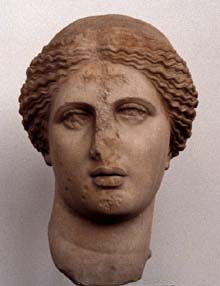
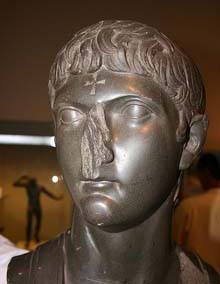
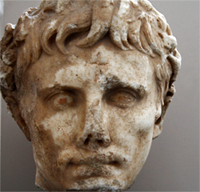
We can often tell that Christians were responsible for vandalising statues first because they made a point of disfiguring the face (as Moslems vandals still do), and secondly because they would often carve crosses on the face, most commonly a cross in the middle of the forehead, to somehow Christianise the statue. Making crosses on foreheads is a common Christian practice. It is still done with water in the course of baptisms, with ash on Ash Wednesday, and with paint on the skulls of dead monks. It was previously done with a red hot branding iron on the foreheads of supposed heretics. Below are a few examples of statues vandalised by Christians.
This statue of the goddess Aphrodite
found at the Agora at Athens
bears the hallmarks of Christian vandals,
including crosses carved on the forehead and chin.
| This statue of Germanicus
(Germanicus Julius Caesar (15 BC – AD 19)
bears the hallmarks of Christian vandals,
including a cross carved on the forehead
|
|
|
|
| This statue of Livia Drusilla, wife of the Emperor Augustus also bears the hallmarks of Christian vandals
| Another example from Turkey.
Unidentified
|

|

|
|
| Statue of Augustus from Ephesus. Now in the Ephesus Museum, Selcuk, Turkey.
| Another example from Ephesus.
Unidentified
|
|

|
 Religiously inspired philistinism extended to all corners of life. Christians were responsible for putting a stop to the original Olympic Games, of which they disapproved. The famous statue of Zeus at Olympia, wrought in gold and ivory, one of the seven wonders of the world, was carted off to Constantinople where it was later destroyed. (It is thought to have looked like the image shown on the right). The workshops of Phidias, the sculptor of the statue of Zeus, were converted into a Christian church. Religiously inspired philistinism extended to all corners of life. Christians were responsible for putting a stop to the original Olympic Games, of which they disapproved. The famous statue of Zeus at Olympia, wrought in gold and ivory, one of the seven wonders of the world, was carted off to Constantinople where it was later destroyed. (It is thought to have looked like the image shown on the right). The workshops of Phidias, the sculptor of the statue of Zeus, were converted into a Christian church.
Other wonders of the world suffered similarly. According to Christian sources, the Temple of Diana (Artemis) near Ephesus was destroyed along with the goddess's statue, first damaged by Saint John the Apostle, and then flattened by Saint John Chrysostom in 401, following a Christian emperor's Edict of Thessalonica 4a. The stones were used for a "tomb" for St John and a bath-house. A cross was raised on the spot where Diana's statue had stood. Another wonder of the world, the Mausoleum at Helicarnassus, was cannibalised to build a crusader castle, which still stands near the harbour of modern Bodrum in Turkey.
| | One of the Seven Wonders of the World, the Mausoleum (left),
before it was dismantled by Christian crusaders to build a crusader castle (right)
| | |   |
The building of temple of Diana (or Artemis) at Effesus had been a 120-year project started by King Croesus of Lydia. It was described by Antipater of Sidon, who compiled a list of the Seven Wonders:
I have set eyes on the wall of lofty Babylon on which is a road for chariots, and the statue of Zeus by the Alpheus, and the hanging gardens, and the colossus of the Sun, and the huge labour of the high pyramids, and the vast tomb of Mausolus; but when I saw the house of Artemis that mounted to the clouds, those other marvels lost their brilliancy, and I said, "Lo, apart from Olympus, the Sun never looked on aught (anything) so grand". (Antipater, Greek Anthology [IX.58])
It was destroyed by Christians, and is now an empty field. Some stones used to build a nearby church, other carted off to Contantinople. Some of the columns in Hagia Sophia came from the temple of Artemis, and statues and other decorative elements ended up in the Christian capital..
An inscription at Ephesus confirms the role of Christians in the vandalism, in particular a Christian called Demeas:
Destroying the delusive image of the demon Artemis, Demeas has erected this symbol of Truth, the God that drives away idols, and the Cross of priests, deathless and victorious sign of Christ.
A reconstruction of what the Temple of Artemis would have looked like, and a photograph of the site today (the pillar is reconstructed from stones on the site). Quality stones were carted off to Contantinople, others used in churches and eventually building like those in the background.
| |
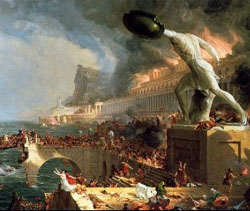 During the reign of the Christian Emperor Theodosius I, the library at Alexandria was burned. For years bands of Christian monks had been sweeping down from their desert monasteries to destroy shrines and temples. They ransacked houses, destroying all non-Christian religious objects. In 391 when they burned down the Temple to Serapis they also managed to set fire to the nearby library— the greatest library in the Western world. Some estimates put the number of volumes destroyed at 700,000 (although enough volumes remained for later Muslims to enjoy more fires when they arrived in 642). The end of progress in ancient mathematics is conventionally dated as 415, the year Hypatia was murdered by Christians in the same city, during the reign of the next bishop. The great tradition of learning at Alexandria came to an end in 517 when its world famous School of Philosophy was closed down. Elsewhere, rival Christian schools had to be eliminated too. In 489 the Emperor Zeno had closed the schools of Edessa. The end of ancient philosophy can be equated with the closing of the Academy and other philosophical Schools in Athens by the Christian Emperor Justinian in 529. Any possibility of intellectual opposition was now eliminated. During the reign of the Christian Emperor Theodosius I, the library at Alexandria was burned. For years bands of Christian monks had been sweeping down from their desert monasteries to destroy shrines and temples. They ransacked houses, destroying all non-Christian religious objects. In 391 when they burned down the Temple to Serapis they also managed to set fire to the nearby library— the greatest library in the Western world. Some estimates put the number of volumes destroyed at 700,000 (although enough volumes remained for later Muslims to enjoy more fires when they arrived in 642). The end of progress in ancient mathematics is conventionally dated as 415, the year Hypatia was murdered by Christians in the same city, during the reign of the next bishop. The great tradition of learning at Alexandria came to an end in 517 when its world famous School of Philosophy was closed down. Elsewhere, rival Christian schools had to be eliminated too. In 489 the Emperor Zeno had closed the schools of Edessa. The end of ancient philosophy can be equated with the closing of the Academy and other philosophical Schools in Athens by the Christian Emperor Justinian in 529. Any possibility of intellectual opposition was now eliminated.
 Philosophy was considered dangerous to Christianity. Philosophers were persecuted and their books burned. Such was the persecution that men of learning were driven to destroy their own libraries rather than risk a volume being seen by a Christian informer. The few intellectual Christians that there were had to be careful of offending the sensibilities of the less intellectual majority. The philosopher Boethius for example was killed by the pious Christian Ostrogoth Theodoric in the sixth century. He is reputed to have met his end by having a bowstring tightened around his temples until his eyes protruded from his head. His death marked the end of the classical tradition of learning. Philosophy was considered dangerous to Christianity. Philosophers were persecuted and their books burned. Such was the persecution that men of learning were driven to destroy their own libraries rather than risk a volume being seen by a Christian informer. The few intellectual Christians that there were had to be careful of offending the sensibilities of the less intellectual majority. The philosopher Boethius for example was killed by the pious Christian Ostrogoth Theodoric in the sixth century. He is reputed to have met his end by having a bowstring tightened around his temples until his eyes protruded from his head. His death marked the end of the classical tradition of learning.
 Any pagan work that referred to Jesus, and any works by Christians who could not accept the theology agreed atthe latest Church Council, were suppressed. The only acceptable literature was literature that conformed to the official Christian line of the moment. Gospels that did not fit requirements were discarded, and their existence denied. Other writings were creatively edited. Works by educated pagan authors were destroyed along with those of Christians whose views were not currently regarded as orthodox. Histories were either "lost" or doctored to make them acceptable. Any pagan work that referred to Jesus, and any works by Christians who could not accept the theology agreed atthe latest Church Council, were suppressed. The only acceptable literature was literature that conformed to the official Christian line of the moment. Gospels that did not fit requirements were discarded, and their existence denied. Other writings were creatively edited. Works by educated pagan authors were destroyed along with those of Christians whose views were not currently regarded as orthodox. Histories were either "lost" or doctored to make them acceptable.
Numerous works by pagan authors were known during the early centuries of the Church, and many of them were subsequently destroyed or otherwise "lost". We know for example that several biographies of Pythagoras were written. All have been "lost". One of the most famous Roman writers, Aulus Cornelius Celsus, wrote De Artibus — a work that is known to have covered agriculture, military theory, philosophy, law and medicine. He was a highly regarded thinker who had a poor opinion of the Christians, and unsurprisingly his work has disappeared. Parts of his medical writings were rediscovered in the Middle Ages, and from these it is possible to gauge the scale of our loss.
Often we know that works were still current in the early years of Christianity: for example St Augustine is known to have read Cicero's Hortensius, then part of the school curriculum but since "lost". Some pagan tracts were given Christian prefaces and conclusions, and presented as original documents. Thus the letter of Eugnostos the Blessed was converted into an account of the wisdom revealed by Jesus to the disciples after his death. Anything that could not be cannibalised in this way was discarded. Thus, no Greek secular works were preserved in the original. Secular learning and secular art, along with secular education, almost disappeared. Some works were recovered during the Renaissance. Petrarch, for example, recovered other works by Cicero. Poems by Catullus were reputedly found serving as a bung in a Mantuan wine barrel. In the nineteenth century Robert Curzon found "lost" works of Euclid and Plato serving as stoppers in olive oil jars in a Coptic Monastery (at Deir el-Suriani in the Wadi Natrum).
 Parchment was expensive so Medieval Churchmen would sometimes take a used one, scrape off the existing text, and reuse it - as a so-called palimpsest. Regarding the works of pagans of the ancient world as worthless, they destroyed, or at least thought that they had destroyed, the works of the some of the greatest minds in human history, to make prayer books. Modern science has been able to recover a few important works from these Christian prayer books. For example, in 1229 AD parchment copies of seven treatises of Archimedes were erased and overwritten by prayers, then bound in a Byzantine prayerbook (a euchologion) by a priest called Johannes Myronas. Myronas understood Greek, so must have known what he was doing. Of the seven treatises by Archimedes, two are otherwise unknown (The The Method of Mechanical Theorems and the Stomachion) and one (On Floating Bodies) is unknown in the original Greek, the language in which Archimedes wrote. Working in Jerusalem, the priest had vandalised not only treatises by Archimedes to make his prayerbook, but also other works, including 10 folios of the Attic orator Hyperides dating from the fourth century BC, one of which contained an extremely important speech that has not otherwise been preserved. 5. This copy of Archimedes Method was found in 1906. There is no way of telling how many other such palimpsests there were on which Christians did a more thorough job, and so will never be discovered. Parchment was expensive so Medieval Churchmen would sometimes take a used one, scrape off the existing text, and reuse it - as a so-called palimpsest. Regarding the works of pagans of the ancient world as worthless, they destroyed, or at least thought that they had destroyed, the works of the some of the greatest minds in human history, to make prayer books. Modern science has been able to recover a few important works from these Christian prayer books. For example, in 1229 AD parchment copies of seven treatises of Archimedes were erased and overwritten by prayers, then bound in a Byzantine prayerbook (a euchologion) by a priest called Johannes Myronas. Myronas understood Greek, so must have known what he was doing. Of the seven treatises by Archimedes, two are otherwise unknown (The The Method of Mechanical Theorems and the Stomachion) and one (On Floating Bodies) is unknown in the original Greek, the language in which Archimedes wrote. Working in Jerusalem, the priest had vandalised not only treatises by Archimedes to make his prayerbook, but also other works, including 10 folios of the Attic orator Hyperides dating from the fourth century BC, one of which contained an extremely important speech that has not otherwise been preserved. 5. This copy of Archimedes Method was found in 1906. There is no way of telling how many other such palimpsests there were on which Christians did a more thorough job, and so will never be discovered.
The loss through Christian vandalism - both deliberate and casual - is incalculable, but the scale of it can be estimated from the shreds that survive. Tacitus's surviving Histories and Annals are both incomplete. One manuscript of Lucretius's De Rerum Natura, "On the Nature of the Universe", survived the Dark Ages. Livy's lost works include his 142 volume History of Rome of which only a small part has survived. Pliny the Elder wrote numerous works of which only his Historia Naturalis survives. There is of course no way of knowing how many hundreds or thousands of important works have vanished completely — without even a passing reference in any surviving work. It was not only classical works that were destroyed. When they had the opportunity to do so Christians burned Jewish and Muslim books as well. After the Muslim city of Tripoli surrendered to the crusaders in 1109, the great library of Banu Ammar , the finest in the Muslim world, was burnt to the ground with all of its contents.
Some works were preserved because they were taken out of the reach of orthodoxy. When persecuted Nestorians fled eastward, they took ancient works with them. They enjoyed much greater freedom under Zoroastrian and Muslim rulers, and established prominent communities in what are now Iraq and Iran. Along with other refugees they translated the writings of Greek philosophers. For 1,000 years these writings were lost to the West. When they were eventually retranslated from Arabic into Latin they fired the revival of learning that we know as the Renaissance. It was through this route that the works of Aristotle were preserved. Other works survived in other ways. In 1895 the ancient rubbish dumps of Oxyrhynchus in Egypt yielded, amongst other things, a forgotten song by Sappho and fragments of "lost" plays by Aeschylus and Sophocles.
A common claim made by Christians is that Christianity single-handedly kept alight the guttering flame of learning during the Dark Ages, in the face of marauding wild barbarians. The truth is almost the exact opposite. The Church was largely responsible for plunging western Europe into ignorance and darkness. Towards the end of the fourth century for example Goths destroyed much of the Western Empire, including great cities like Delphi and Athens. But these Goths were not the pagan barbarians of traditional history books, they were Christians. These barbarians marched with bibles at the head of their armies. When they besieged Rome it was not, as is often supposed, pagans besieging civilised Christians but for the most part Christians besieging civilised pagans. To be sure there were some Christians in the city, but there is no reason to suppose that their faith was stronger than that of their bishop. Their bishop (now regarded as a Pope) consented to pagan sacrifices on the altar of St Peter's in order to save the city from the Christian hordes at its gates.
| The Sack of Rome by the Barbarians in 410
Joseph-Noël Sylvestre, 1890
It is not often mentioned that these barbarians were Christians
|

|
|
The Visigoths in Spain and southern Gaul, and the Ostrogoths in Italy were also Arian Christians. So too, the Vandals who plundered Gaul, Spain and North Africa were bible-toting Christian believers. Popular stories about pagan barbarians sacking Rome are pure fantasy. Rome was still in good shape until the middle of the sixth century when the Christian Emperor Justinian tried to reconnect Italy to the Empire. The city was repeatedly besieged and plundered by Christian forces. The Christian Emperor Constans II completed the destruction in 664 when he removed the last items of value, including any metal he could lay hands on, not only statues but also bronze fittings and lead roofs — even metal clamps and ties that kept the stone walls together. Rain and weather did further damage, but there was still enough left for later Christians to exceed the efforts of all their predecessors.
Europe... the popes wantonly ruined more of ancient Rome than Goths or Saracens had ever managed.
Guidebook to Rome 6
The true torchbearers during the Dark Ages were Arabs, Jews, heretics and pagans who kept alive pre-Christian teachings. In western Europe Christianity enforced a monopoly of thought, and the consequence of this was that Western Christendom spent the Middle Ages in abject ignorance, regarded by Byzantines and Muslims alike as hopeless philistines. Pope Paul II, a nepotist and murderer, epitomised Western Christianity at the end of the medieval period. When in 1466 the historian Bartolomeo Platina commented on his ignorance, His Holiness had him imprisoned and tortured. The same pope suppressed the Roman Academy, which he thought encouraged paganism, and also banned the reading of ancient poets by Roman children.
How great was Europe's cultural loss can be assessed by comparing the state of civilisation under the ancient Greeks with that of Christendom at the close of the Middle Ages, almost 2,000 years later. All of these areas of cultural endeavour had flourished under the Greeks — many of them are discussed in more detail elsewhere on this website.
| Area | Fate under Christian hegemony | | Architecture: | Stone buildings that had been built extensively for private and public purposes were now limited to military and ecclesiastical structures. Existing public buildings (forums, libraries, odeons, theatres, museums, stadia, hippodromes, circuses, schools, gymnasia, temples, baths, Roman amphitheatres etc.) were often vandalised or destroyed. Many building techniques were forgotten.
| | Education: | Where even the poor had been taught to read and write in pagan times, and the rich had been expected to build public schools, education became a Church monopoly, and was denied to all except prospective priests and sons of the rich. The syllabus was restricted to Christian indoctrination.
| | Dance: | Dance was prohibited as pagan and tending to promote lust. | | Democracy: | Democracy was condemned as un-Christian, since the Bible presupposed kingdoms. | | History: | Factual history was replaced by fabrications and propaganda (such as “legends”), except for sympathetic chronicles that did not reflect badly on the Church. Unsympathetic or objective histories were "lost".
| | Law: | Law was converted from an instrument of justice to a system featuring trials by ordeal, frequently serving the interests of the Church and denying the principles of natural justice. Inequality was a fundamental principle of ecclesiastical law.
| | Literature: | All literature, including the Bible, was banned to the population at large. The few who were allowed to learn to read were restricted to prayer books and Christian Legends presented as fact. Other books were generally destroyed or hidden away in monasteries.
| | Mathematics | This was limited within the Church to the arithmetic necessary to calculate the date of Easter. Otherwise it was treated with suspicion or hostility.
| | Medicine: | All medical progress was halted. Illness was considered to be a punishment for sin. Hygiene and public health were abandoned as unchristian
| | Music & Singing: | Music and singing were periodically restricted to Church music. Otherwise they were regarded as satanic. Classical opera died out under the Christian hegemony — it was re-introduced in the sixteenth century.
| | Natural history: : | The study of nature, popular in the ancient world, stagnated until the Enlightenment. Research was suppressed until then because the Church insisted on a literal interpretation of the Bible and its infallibility as a handbook of all world knowledge.
| | Painting and Art: | All representation was first banned, then restricted to religious themes from the fifth century. Existing non-Christian art was destroyed. The rules of perspective, known in ancient times, were “lost” until rediscovered by Brunelleschi at the dawn of the Renaissance. In 1563, the Council of Trent confirmed Art as a conformist naturalistic propaganda tool.
| | : Philosophy: | A Church monopoly was established. The subject was then reduced to scholasticism. Existing philosophical works were destroyed. Genuine philosophers were censored, persecuted and sometimes killed. No significant progress (except by “heretics”) was to take place from the murder of Hypatia until Cosimo de" Medici revived ancient philosophy with his Platonic Academy in Florence 7
| | Public Service: | The charitable endowment of public buildings (schools, libraries, theatres, sports stadia, baths, horse racing cources, etc.) ceased almost completely when the Church enjoyed total control. Almost every village in Europe has a medieval church, generally built in better materials than any other local building. A vanishingly small number have comparable church built schools, hospitals or other useful public buildings. The first modern public library was founded by Cosimo de" Medici, “godfather” to the Renaissance 8
| | Sculpture: | Non-religious sculpture ceased to be produced. The best examples from antiquity were "lost". Inferior material was produced for the Church, generally for propaganda purposes. Nothing comparable in quality to classical work was produced until the Renaissancet.
| | Sport: | Sports were suppressed, along with international sporting events. They were replaced by various kinds of animal torture and pastimes too local to be controlled by the Church.
| | Theatre: | Acting was banned, except for propaganda purposes: religious ceremonies, mystery plays and morality plays.
| | Public Health | Public baths, sophisticated aquaducts and sewers were all destroyed or allowed to fall into desuetude (the only exception being baths which were preserved in monasteries for the use of monks) | | Infrastructure | Streets and viaducts were used but not maintained. They survived into secular times only because they had been so well built.
|
It is notable that all of these areas flourished again as the hand of the Church was progressively relaxed, prized off by Renaissance Humanists, Enlightenment thinkers, scientists and secular philosophers.
Typical Classical sculpture
before the Christian era
| Typical Christian sculpture,
after a millennium of Christian hegemony
|

|

|
 Church vandalism continued for centuries after the Middle Ages. The canopy under the dome of the present St Peter's is made from 200 tons of bronze stripped from the Pantheon in the sixteenth century (the rest reputedly went to make papal canon). Construction of St Peter's had been started by Bramante. He destroyed much that could have been preserved from the old basilica, and pillaged various old buildings for marble and other materials. Raphael, who took over after his death, called him Ruinante. Roman Christians were not content with destroying their own city. Rome, the Eternal Parasite, is still furnished with treasures pillaged from elsewhere. There are for example more large obelisks in Rome than remain in Egypt. Church vandalism continued for centuries after the Middle Ages. The canopy under the dome of the present St Peter's is made from 200 tons of bronze stripped from the Pantheon in the sixteenth century (the rest reputedly went to make papal canon). Construction of St Peter's had been started by Bramante. He destroyed much that could have been preserved from the old basilica, and pillaged various old buildings for marble and other materials. Raphael, who took over after his death, called him Ruinante. Roman Christians were not content with destroying their own city. Rome, the Eternal Parasite, is still furnished with treasures pillaged from elsewhere. There are for example more large obelisks in Rome than remain in Egypt.
 Book burning — that favourite activity of the Christians throughout the Dark Ages — continued throughout the Middle Ages. Medieval Christians claimed that Holy Books could be easily identified because they would not burn. It was the same technique supposedly used by early Christians to determine the cannon of the New Testament - Heretical books burned: Holy books did not. As Voltaire noted, it is a great pity that this simple method of distinguishing the two no longer works - Holy Testaments have burned just as well as heretical ones since the end of the Middle Ages. In any case, this supposed method enabled Churchmen like Saint Dominic to destroy any book they wanted, and acclaim their vandalism as proof of heretical content. Book burning — that favourite activity of the Christians throughout the Dark Ages — continued throughout the Middle Ages. Medieval Christians claimed that Holy Books could be easily identified because they would not burn. It was the same technique supposedly used by early Christians to determine the cannon of the New Testament - Heretical books burned: Holy books did not. As Voltaire noted, it is a great pity that this simple method of distinguishing the two no longer works - Holy Testaments have burned just as well as heretical ones since the end of the Middle Ages. In any case, this supposed method enabled Churchmen like Saint Dominic to destroy any book they wanted, and acclaim their vandalism as proof of heretical content.
When 240 wagonloads of Jewish books were burned in 1242 the incident provoked an official inquiry. A committee, including the great churchman Albertus Magnus, was appointed by Pope Innocent IV. The committee approved of the destruction of the books. As a result more mass burnings were held. Talmudic studies were banned, and centres of Jewish scholarship were destroyed. In 1415 a papal bull forbade Jews to possess or read the Talmud. Hundreds of thousands of Jewish books, including rare manuscripts, were burned in Italy by the Roman Inquisition. In 1629 an Italian cardinal could boast of having collected 10,000 Jewish books for destruction 9. Classical books, if discovered, were burned or hidden, Arabic books were burned, heretical books were burned, books exposing forgery and corruption were burned, books containing original thought were burned. Not only were factual information and opinions in need of suppression. Some churchman could generally be found to condemn any item of innocent fun, amusement, interest or beauty. In 1497 the Christian citizens of Florence were inspired by the Friar Savonarola (and armed guards) to burn material possessions. Countless works of art went onto a "bonfire of the vanities". Pictures, books, musical instruments, songs, poems, even jewellery — all were consigned to the flames. Known books included works by Ovid, Cicero, Boccaccio, Petrarch, and Poliziano. One bonfire, lit on Shrove Tuesday 1497, was 100 feet wide and sixty feet high. The crowd sang Te Deum laudamus as it burned.
 Soon the Church would be suppressing nudity too. Paul IV (pope 1555-1559), defaced many statues and paintings by covering up or painting over disconcerting genitals. Michelangelo's Last Judgement in the Sistine Chapel was sanitised in this way, the artist who carried out the task, Daniel of Volterra, earning the nickname il braghettone ("the trouserer"). Innocent X (pope 1644-1655) installed metal fig leaves on the nude statues in the Vatican. Soon the Church would be suppressing nudity too. Paul IV (pope 1555-1559), defaced many statues and paintings by covering up or painting over disconcerting genitals. Michelangelo's Last Judgement in the Sistine Chapel was sanitised in this way, the artist who carried out the task, Daniel of Volterra, earning the nickname il braghettone ("the trouserer"). Innocent X (pope 1644-1655) installed metal fig leaves on the nude statues in the Vatican.
Numerous keen Christians have occupied their time in chipping the genitals off male statues throughout Christendom. This is one of the areas where Protestants and nonconformists have excelled Roman Catholics. In the nineteenth century notable figures like Comstock campaigned in the USA to protect the public from much of the greatest art ever produced. Others established pressure groups to clothe animals and to suppress other manifestations of vice.
 Such distinctively religeous attitudes persisted throughout the twentieth century and beyond. In 1996 devout American Christians mounted a campaign to have two statues used at the Olympic Games covered up. They were offended that representations of human figures should be furnished with genitalia. Not so long before that the Australian authorities had impounded a copy of Michelangelo's David on the grounds that it was indecent. In 2005, officials in Bartholomew County, Indiana, required copies of classical art to be moved out of public view because they would be considered obscene under Indiana law. The statutes included copies of Michelangelo's David and the Venus de Milo. Such distinctively religeous attitudes persisted throughout the twentieth century and beyond. In 1996 devout American Christians mounted a campaign to have two statues used at the Olympic Games covered up. They were offended that representations of human figures should be furnished with genitalia. Not so long before that the Australian authorities had impounded a copy of Michelangelo's David on the grounds that it was indecent. In 2005, officials in Bartholomew County, Indiana, required copies of classical art to be moved out of public view because they would be considered obscene under Indiana law. The statutes included copies of Michelangelo's David and the Venus de Milo.
Ancient monuments throughout Europe also suffered at the hands of Christians. Following the methods advocated by Pope Gregory I, wherever the Church spread it destroyed or took over the sites held holy by the local inhabitants. In Britain the traditional holy sites included yew groves, which helps to explain why yew trees are so common in English churchyards to this day. Neolithic stones were revered too. Churches were often built next to them in the hope that they would inherit the stones" sanctity. In this way the Church could represent itself as belonging to an existing sacred tradition. Christian churches were sometimes built within ancient circles.
St Michael's Tower, a Christian edifice on Glastenbury Tor in England.
It was built here because of the Tor's significance in Celtic and even older religions.
|

|
In later centuries, when the population had been converted and the earlier beliefs forgotten the Church could denounce the ancient stones as satanic, and set about destroying them. Many ancient standing stones were vandalised by the Church on this pretext. Lacking the elementary technology for splitting them, priests often had them tipped over or buried in pits. Later, they rediscovered an ancient method of breaking up large stones. They lit a fire around the stones, then doused them with water so that the thermal shock splintered them. The practice was called stone killing. It was popular wherever ancient stones were to be found, and its religious significance was clearly recognised.
Everywhere the Church took hold, it made a point of either adopting local gods as saints or denouncing them as satanic. Sacred trees, groves and other sites were desecrated everywhere. St Martin had felled holy trees in Gaul in the fourth century. John of Ephesus felled them in Asia Minor in the sixth century. Other zealous Christians committed arboreal genocide all around the Mediterranean. In the 770s a holy wood at Eresburg, also sacred to the Saxons, was taken in battle by Charlemagne. The victorious Christian forces destroyed the holy Irminsul, a tall pillar in the wood representing the world-tree Yggdrasil. Surviving Saxon boys were carried off to be indoctrinated and trained as missionaries.
A modern reconstruction of Irminul.
This is what Irminsul is thought to have looked like
| The destruction of Irminsul by Charlemagne
(1882) by Heinrich Leutemann
|

|

|
Sometimes, for policy reasons, sacred places were tolerated for a while, but the end result was much the same. As Robert Graves explained of Ireland:
...the age of toleration did not last long; once Irish princes lost the privilege of appointing bishops from their own sept, and iconoclasts were politically strong enough to begin their righteous work, the axe rose and fell on every sacred hill 10
Prince Vladimir's forcible conversions in Russia around AD 1000 were complemented by the destruction of an image of the god Perun, at Kiev. Such destruction was adduced as evidence of the powerlessness of pagan gods, although it cannot have proved more than the destruction of Christian icons by Muslims and other iconoclasts. It merely deprived Europe of its history.
Bishop Absalon topples the god Svantevit at Arkona in 1169 proving that it was just an idol
Bishop Absalon led military crusades against the Wends, whose crime was not to be Christian. They were forcibly converted to Christianity and their temples and religious icons destroyed. The same fate befell the god Rugievit at the Wendish capital of Rügen.
|

|
Darvell Gathern, the wooden image of a Welsh god, was brought to London to be publicly burned in the 1530s. The result of such destruction is that we now know much less about pre-Christian European cultures than we otherwise would. We know next to nothing about Druidism, the religion of the ancient Britons. Neither do we know much about our Anglo-Saxon ancestors. Their extensive writings are for the most part "lost". The only substantial early ones that have survived, such as Beowulf, are ones that deal with Christian themes. We know little about the related Germanic and Norse religions either. Some of what we do know comes from Iceland, where Christianity was late on the scene, although even there much history was lost, including an unknown number of Eddas (collections of folk-tales) and even histories of the Kings of Norway written in Latin 11.
Without Christianity the European patrimony from the ancient world might have been ten times what it is; perhaps a hundred times; perhaps a thousand times; perhaps more. We shall never know.
 Church vandalism was not only directed against non-Christians. Christians have been persecuting other Christians and vandalising their possessions for almost two thousand years - executing them for heresy, burning their books for blasphemy, destroying their icons as impious. It happened throughout Christendom during the early centuries, followed by iconoclast wars in the Orthodox Church and religious wars in the Catholic West. The tombs of Crusader Kings of Jerusalem, once stood in the Church of the Holy Sepulchre. Over the centuries they had not been touched by the Moslems rulers of Jerusalem, who had every reason to resent them. They were destroyed in the nineteenth century by Orthodox Monks. Nor was this exceptional. When Sir Ronald Storrs, military Governor of Jerusalem during the Great War discovered a previously unknown Crusader grave near the south door of the church, the Orthodox priests were so furious about it that Storrs had the grave guarded by British soldiers 12. Church vandalism was not only directed against non-Christians. Christians have been persecuting other Christians and vandalising their possessions for almost two thousand years - executing them for heresy, burning their books for blasphemy, destroying their icons as impious. It happened throughout Christendom during the early centuries, followed by iconoclast wars in the Orthodox Church and religious wars in the Catholic West. The tombs of Crusader Kings of Jerusalem, once stood in the Church of the Holy Sepulchre. Over the centuries they had not been touched by the Moslems rulers of Jerusalem, who had every reason to resent them. They were destroyed in the nineteenth century by Orthodox Monks. Nor was this exceptional. When Sir Ronald Storrs, military Governor of Jerusalem during the Great War discovered a previously unknown Crusader grave near the south door of the church, the Orthodox priests were so furious about it that Storrs had the grave guarded by British soldiers 12.
Protestant reformers encouraged the removal of religious images by invoking the Second Commandment's prohibition of idolatry and the manufacture of graven (sculpted) images of God. Reformers attacked statues and images. Others others were damaged or stolen during iconoclastic riots. These Christians specifically targeted faces of images, just as their predecessors had a thousand years earlier.
Horrible Cruelties of the Huguenots, 1562
According the Catholic propaganda, Hugenots (French Protestants) executed images of Christ on the Cross by firing squad (an updated version of what Catholics had done to pagan images for many centuries)
|

|
Iconoclastic riots took place in Zurich (in 1523), Copenhagen (1530), Münster (1534), Geneva (1535), Augsburg (1537), Scotland (1559), and Saintes and La Rochelle (1562). The Seventeen Provinces (now the Netherlands, Belgium and parts of Northern France) were disrupted during the "Beeldenstorm" by widespread Protestant iconoclasm in the summer of 1566. The Beeldenstorm marked the start of the revolution against the Spanish forces and the Catholic Church.
Statues with vandalised heads in the Cathedral of St. Martin in Utrecht, Netherlands
Just one of countless thousands of vestiges of Christian on Christian vandalism that survive.
|

|
 During the English Civil War, Bishop Joseph Hall of Norwich described the events of 1643 when troops and citizens, encouraged by a Parliamentary ordinance against superstition and idolatry, behaved thus: During the English Civil War, Bishop Joseph Hall of Norwich described the events of 1643 when troops and citizens, encouraged by a Parliamentary ordinance against superstition and idolatry, behaved thus:
Lord what work was here! What clattering of glasses! What beating down of walls! What tearing up of monuments! What pulling down of seats! What wresting out of irons and brass from the windows! What defacing of arms! What demolishing of curious stonework! What tooting and piping upon organ pipes! And what a hideous triumph in the market-place before all the country, when all the mangled organ pipes, vestments, both copes and surplices, together with the leaden cross which had newly been sawn down from the Green-yard pulpit and the service-books and singing books that could be carried to the fire in the public marketplace were heaped together.'
Protestants destroyed Catholic trappings in exactly the same way early Christians had destroyed pagan trappings, and for exactly the same reason - according the the Bible they were idolatrous. In England, William Dowsing was commissioned by the government to tour of East Anglia to destroy images in churches. His detailed record of his work in Suffolk and Cambridgeshire survives:
We broke down about a hundred superstitious Pictures; and seven Fryars hugging a Nunn; and the Picture of God and Christ; and divers others very superstitious; and 200 had been broke down before I came. We took away 2 popish Inscriptions with Ora pro nobis and we beat down a great stoneing Cross on the top of the Church.
Just as Christians have suffered more persecution at the hands of Christians than at the hands of any other group, so Christian churches and icons have suffered more iconoclasm at the hands of Christians than at the hands of any other group. |




