" Smart Structures: Blurring the Distinction Between the Living and the Nonliving "
http://ukcatalogue.oup.com/product/9780199229178.do#.UcRnsNhc3rM
A friend from India who is a condensed matter physicist who writes very clear scientific approaches, just upgraded his status with this intriguing read:
Complexity Science and My Worldview
vinodwadhawan.blogspot.com
We humans have a strong sense of self-awareness and we seek answers to questions like why the universe is what it is, why the laws of Nature are what they are, who created the universe, who created life, . . . etc. In this partly autobiographical article I describe how the science of complexity has given me the answers to such questions and moulded my worldview.

http://www.sandia.gov/casosengineering/complexity_primer.html
The God Question
Many of us take it for granted that for every effect there must be a cause, and that that cause is the effect of a previous cause, and so on: Cause – effect – cause – effect - . . . . Is there (and can there be) an ultimate cause, the cause of all the ensuing effects? Many people are of the belief that ‘God’ is that ultimate and final cause, the ‘uncaused cause’.
But how can there be an uncaused cause? If you truly believe that God must be there because for every effect there must be a cause, then God also must be the effect of some still higher-level cause, and so on, ad infinitum. So, postulating the existence of God does not really help; it just pushes the ultimate question to ‘Who created God?’.
Suppose you say that one must stop somewhere in the reverse chain effect-cause-effect-cause-effect- . . . and then say ‘I do not know’. If you are willing to say that, then the God postulate becomes a superfluous and unnecessary hypothesis: You may as well say that we do not know how the universe came into existence, why is there anything at all, why are the laws of Nature what they are, etc. In fact it turns out that modern science (particularly its somewhat new branch called ‘complexity science’) does have credible answers to these questions now.
There has been a raging (even violent) debate on such issues among human beings. There are three types of people:
(1) Those who believe that there is a God (or many gods), and certain questions must not even be asked about God.
(2) Then there are those who take the stand that God is an unnecessary (and ‘failed’) hypothesis, and we should simply admit that there are some questions we cannot answer very well at present. I subscribe to this viewpoint, and therefore call myself an atheist.
(3) There is also a third group of people who are willing and able to be logical all the way, except that their belief in the existence of God or ‘some higher power’ must not be questioned!
Needless to say, it would be highly desirable to find a convergence ground for all these groups. I think the most pertinent and helpful question we should be asking in this context is: Is it always the case that if there is a design (or order) somewhere or anywhere, there must be a Designer or a designer; or is it that order and design can emerge even when there is no designer involved?
I wrote a series of 127 blog posts under the label ‘ Understanding Natural Phenomena’ to explain how order can emerge and evolve even when there is no designer present. I give an easily comprehensible example here to illustrate this point.
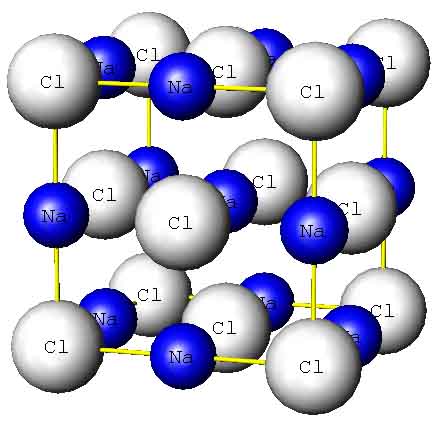
Diamonds, as also silicon chips (used in integrated circuits (ICs)), are examples of crystals. Crystals differ from, say, glass in that in crystals the atoms or molecules are arranged in a highly ordered manner on a regular lattice. Is there a Designer involved here for creating this remarkably high degree of order? Certainly not. Who put the atoms or molecules on a regular lattice? Nobody. Small crystals of, say, common salt (NaCl) can grow spontaneously very easily. Here is how:
Take some water in a container and add a little bit of common salt to it. It may need some stirring to dissolve the salt. Add more salt and stir again. It dissolves. Go on adding salt in small amounts and stir the solution every time for dissolving the salt. There will come a stage when, no matter how much stirring you do, some salt is always left undissolved at the bottom of the container. Decant the clear solution into another container and let it just lie in a cool corner somewhere. When sufficient time has passed, you will see beautiful, cube-shaped, crystals of NaCl in the container. This well-defined shape is because of the underlying regular arrangement of the ions of Na+ and Cl- in the crystals.
http://www.geocities.jp/ohba_lab_ob_page/structure6.html
Which designer is responsible for this design and order? Not any that I know off!
What I find amazing is that most people do not find this occurrence as something extraordinary or ‘miraculous’. There is the emergence of a highly ordered and extremely well-designed array of an enormous number of ions or atoms, and most people do not think much about it. And yet these same people find the ‘creation’ and existence of life as something which cannot emerge ‘just like that’, so there must be a designer or Designer (God). The fact is that both a crystal and a living being have a high degree of order and design, and they differ only in the ‘degree of complexity’.
‘Degree of complexity’ is a technical term in complexity science. A very good description of it was given by Murray Gell-Mann.
At a personal level, as I went deeper and deeper into what constitutes the essence of complexity science and what ‘degree of complexity’ really means (I have given a detailed answer in the 127 blog posts I mentioned above), my worldview and life philosophy underwent a change. It was a gratifying experience because, like everybody else, I also wanted answers to the usual fundamental questions we all ask about ourselves and about our universe. Complexity science provides the best such answers we have at present.
Why is it that I find it easy to accept what complexity science says, and many other people do not? It is because I have made a lot of effort to understand the finer points of complexity science. It is also because I have imbibed, at an early age, the spirit of the all-important ‘scientific method’ of interpreting information or data.
The Scientific Method
‘The scientific method’ is a technical term which needs to be understood by everybody, although that is far from the case at present. I have explained the 8-old way of the scientific method in a blog post Science, Scientists, and Scientific Temper in Society, but I shall repeat much of the description here for completeness. This method is actually a very potent tool, not only for investigating natural phenomena, but also for solving or preventing a number of social maladies afflicting society all over the world.
In the Wikipedia the scientific method is described as follows: 'The scientific method is a body of techniques for investigating phenomena, acquiring new knowledge, or correcting and integrating previous knowledge. To be termed scientific, a method of inquiry must be based on empirical and measurable evidence subject to specific principles of reasoning. The Oxford English Dictionary defines the scientific method as: "a method or procedure that has characterized natural science since the 17th century, consisting in systematic observation, measurement, and experiment, and the formulation, testing, and modification of hypotheses"'.
The scientific method for explaining a set of observations about a natural phenomenon is the following 8-fold way:
1. Axioms. There is an agreed set of axioms, which are taken as givens (their validity is either a matter of assumption, or has been established already).
2. Logic. There is an agreed set of rules for logical reasoning.
3. Hypothesis. The logical rules for reasoning, as well as the axioms, are used along with a hypothesis (or model) for describing and interpreting the observations we humans have made about the natural phenomenon under investigation. It is not important how the hypothesis is arrived at.
4. Agreed meaning of each word. Every word used for making any statement in science should have the same meaning for everybody.
5. Reproducible verification. A hypothesis must be able to explain the observations in a logically consistent way, and it must successfully stand the test of repeated experimental verification. If its success is only partial, we try to modify and improve it, and then check against the observations again. That is how we arrive at the best, i.e. the most successful, hypothesis at a given point of time in our history.
6. Predictive capability of the hypothesis. Our confidence in the validity of the hypothesis grows if it not only explains what is already observed, but also makes correct predictions about what more can be expected to be observed about the natural phenomenon under investigation.
7. Elevation to the status of a theory. A hypothesis (or a set of hypotheses) that has repeatedly stood the test of experiment, and that can successfully explain a whole range of experimental observations, gradually acquires the status of a theory.
8. The falsifiability requirement. During the entire process of: (i) statement of the research problem, (ii) use of logical reasoning, and (iii) drawing of conclusions from the data and the reasoning, the most important constraint put in by the scientific method is that only falsifiable statements can be made. I explain the meaning of ‘falsifiable statement’ with the help of an example. Consider the following statement ( Wudka 1998):
S1: 'The moon is populated by little green men who can read our minds and will hide whenever anyone on Earth looks for them, and will flee into deep space whenever a spacecraft comes near '. This statement is so worded that no one can ever observe the postulated green men and prove the statement to be false, so the statement is unfalsifiable.
Next, consider the following statement:
S2: 'There are no little green men on the moon '. This is a falsifiable statement. All you have to do to prove it false is to show material evidence for the existence of even one green man.
Only falsifiable statements are permitted in the scientific method. Therefore S1 is an unscientific statement or theory, and S2 is a scientific statement or theory.
In work beginning in the 1930s, Karl Popper gave falsifiability a renewed emphasis as a criterion for acceptable statements in science. He also pointed out that not all unfalsifiable claims are fallacious; they are just unfalsifiable. As long as proper skepticism is retained and proper evidence is given, even an unfalsifiable claim can be a legitimate form of reasoning (but not of what finally becomes a part of science). We should never assume that we must be right simply because we cannot be proved wrong.
Notice the intellectual humility of the true scientist. The scientific spirit implies an ever-present willingness to give up even our pet theories and opinions if the evidence demands so. Contrast this with what is said in most of the organized religions. In them, certain statements cannot be questioned, and there are many statements or beliefs in them which are unfalsifiable.
Votaries of faith may be quick to point out that the axioms mentioned in the 8-fold way above are also a matter of faith. No, they are not. To understand why, let us consider the example of quantum theory.
All natural phenomena are governed by the laws of quantum mechanics. Why the laws of Nature are what they are is something I have discussed elsewhere. Another article of mine on the anthropic principle is also relevant in this context. The laws of quantum mechanics are highly counter-intuitive for us humans. The quantum theory is based on certain assumed axioms, like any theory is. But the most important thing here is that the quantum theory is the most repeatedly and the most thoroughly tested theory ever. It is the best theory we have at present for understanding the world around us. If anybody does not agree, he/she is most welcome to come up with another theory, with its own set of axioms and logical structure. If the new theory is better supported by experimental evidence than the present quantum theory, science and scientists will have no compunctions whatsoever in abandoning the existing theory, and accepting the new one. This is not faith and reverence; it is, in fact, the negation of all that.
My Evolution as a Humanist Atheist
Ever since the Big Bang our universe has been expanding and cooling. This means that gradients of various types have been getting created all the time. And the second law of thermodynamics says that phenomena occur so that some gradient or another may get annulled. This is how atoms emerged.
Our Earth condensed out of interstellar dust and gas ~4.6 billion years ago, and life emerged ~4 billion years ago. The 0.6 billion years before the appearance of life were the years of chemical evolution on Earth, leading to the gradual appearance of life as an emergent phenomenon. Lightning and UV rays from the Sun broke up the simple hydrogen-rich molecules and the fragments combined into increasingly complex molecules. These dissolved in the oceans and moved around, interacting in various ways. Given enough time even a rare event may occur. One such event was the chance emergence of a molecule that could use the smaller molecules floating around in the organic soup to make crude copies of itself. This was the ancestor of DNA, and the rest is history. The important message here is that with reproduction, mutation, and selective elimination of lest efficient types of molecules, (chemical) evolution was occurring all the time, and is still occurring in the oceans and perhaps elsewhere. This was the mechanism for the emergence of life from nonlife. No miracles there. No Creator needed.
With the further passage of time, molecules with specialized functions got together, resulting in the emergence of the first biological cell. The coming together of single-celled organisms into multi-cellular conglomerates was the next big development, culminating ultimately in the emergence of humans.
I came across an internet meme recently, which said something to the effect that atheism is the belief that ‘there was nothing and nothing happened to nothing and then nothing magically exploded for no reason, creating everything, and then a bunch of everything magically rearranged itself into self-replicating bits which then turned into dinosaurs. Makes perfect sense . . . matter of faith . . . ’.
No. Such a definition of atheism is from a person who has a vested interest in ridiculing and demeaning atheism. As I said before, an atheist is one who says that the God hypothesis is unnecessary and therefore superfluous, because it explains nothing and simply shifts the fundamental question to a different fundamental question. The God hypothesis stems from the causality argument: There must a cause for every effect, so there must be a cause (God) for the existence of the universe. But by this logic there must also be a cause for God. The people who oppose atheism say that God is an uncaused God. But if they are willing to accept that, they may as well accept that the universe is an uncaused cause.

https://www.facebook.com/Pantheism/photos/pb.89590536080.-2207520000.1415019804./10152828902041081/?type=3&theater
That reminds me of a sensible variant of atheism, namely scientific pantheism. The best known votary of pantheism was Einstein. And as Richard Dawkins has explained (in the book ‘The God Delusion’), pantheism is nothing but ‘sexed-up atheism’. The pantheism philosophy says that Nature is all we have. We do not know why it is there, or how it came to be there, but it is something tangible and tenable (unlike the God concept), and it is a jolly good idea to respect it, cherish it, love it, and, of course, try to understand its secrets and laws by the scientific method. This is how a votary of pantheism has expressed his sentiments: ‘We are part of nature. Nature made us and at our death we will be reabsorbed into nature. We are at home in nature and in our bodies. This is where we belong. This is the only place where we can find and make our paradise, not in some imaginary world on the other side of the grave. If nature is the only paradise, then separation from nature is the only hell. When we destroy nature, we create hell on earth for other species and for ourselves. . . . Nature is our mother, our home, our security, our peace, our past and our future. We should treat natural things and habitats as believers treat their temples and shrines, as sacred - to be revered and preserved in all their intricate and fragile beauty’ (Paul Harrison: Revering the Universe. Caring for Nature. Celebrating Life).

https://www.facebook.com/Pantheism/photos/pb.89590536080.-2207520000.1415019804./10152834962156081/?type=3&theate
To conclude, complexity science has taught me that there can be art without an artist, order without anybody trying to create order, and life without the intervention of a Life Giver. And modern quantum field theory has a credible answer to the question: How could our universe have arisen out of nothing? (cf. Lawrence Krauss (2012): ‘ A Universe from Nothing: Why There is Something Rather than Nothing’).
read more... |



