Precisely, while stations adjust locations and methods.
A necessary adjustment - Time of Observation
Sceptics complain a lot about adjustments made in indexing temperatures. Rarer is an acknowledgement of the argument for the adjustments. The fact is that if an adjustment is appropriate, then it is required. It's not optional.
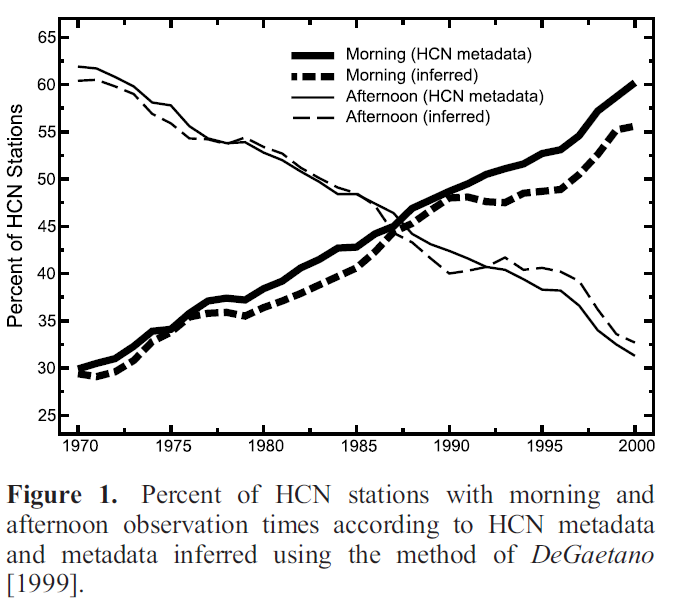
This post will set out the quantitative basis for one of the larger adjustments to USHCN, a frequent object of this complaint. This is TOBS, the time of observation. It arises because USHCN gets its data from a wide variety of observers, many voluntary. The time at which min/max thermometers are read and reset is recommended but not mandated, but is on record. For many stations it has changed, and this matters.
In this post I take a USCRN station, Boulder, Colorado, with hourly data from 2009-2011. I calculate the effect of varying the notional reading time of a min/max thermometer. There is a positive bias of about 1.3°F if it is read in mid-afternoon, tapering to nearly nil around midnight. There is potentially a cooling bias in the morning, though for this site it was small.
But firstly, a discussion of why temperature measurement is relevant to the climate debate, and what kind of measure should be used.
moyhu.blogspot.com.au
The necessity of TOBS
Below is a histogram of the effect of changing TOB from 5pm to 9am for each of the 190 stations considered by Jerry, and of subsequent changes to midnight (standard). There is also a table from the original paper by Karl et el, 1986, which showed that over the years in the US, about 30% of stations made such a change to 1986. Many more stations would have changed to effectively midnight reporting when MMTS came in. Ther mean effect of the change is 0.66°C cooling. It is no surprise that USHCN adjustments have the effect of "cooling the past".
moyhu.blogspot.com |



