SI
SI
discoversearch

We've detected that you're using an ad content blocking browser plug-in or feature. Ads provide a critical source of revenue to the continued operation of Silicon Investor.  We ask that you disable ad blocking while on Silicon Investor in the best interests of our community.  If you are not using an ad blocker but are still receiving this message, make sure your browser's tracking protection is set to the 'standard' level.
Politics : Formerly About Advanced Micro Devices

 Public ReplyPrvt ReplyMark as Last ReadFilePrevious 10Next 10PreviousNext  
To: Brumar89 who wrote (826050)12/27/2014 11:54:42 AM
From: Wharf Rat  Read Replies (2) of 1578510
 
Thanks for helping the Arctic to be the fastest warming region on the planet.

How global warming could turn Siberia into a giant crater ‘time bomb’
By Anna Liesowska & Derek Lambie
25 December 2014
Scientists say there is growing evidence that rising temperatures were catalyst for massive unexplained holes in ground.


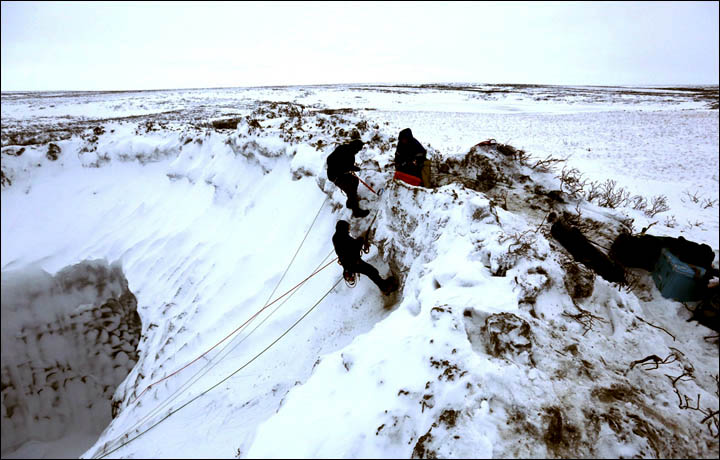
Scientists studying one of the massive holes on the Yamal Peninsula say there is growing evidence that rising temperatures is the main catalyst. Picture: Vladimir Pushkarev/Russian Centre of Arctic Exploration
Global warming could leave parts of Siberia exposed to a wave of underground explosions like those behind the recent unexplained giant craters phenomenon.

Scientists studying one of the massive holes on the Yamal Peninsula say there is growing evidence that rising temperatures is the main catalyst triggering the blasts.

They believe warming air is melting the thick permafrost, leading to the accumulation and release of volatile 'fire ice' gases which then explodes to create the giant funnels.

Overall temperatures in Yamal, in northwest Siberia, in the past 14 years alone have risen by at least two degrees Celsius.

Any continued increase – as is predicted by meteorologists – could create the ideal conditions for more craters to be formed across the icy region, and other parts of Siberia.

siberiantimes.com

Lots of photos, plus "There is already speculation that Lake Baikal, the largest and oldest freshwater lake in the world, could also be sitting on a 'time bomb' ready to explode. The scenic stretch of water, which snakes for 400 miles through south-east Siberia, has massive reserves of the volatile 'fire ice' buried under ground."
Report TOU ViolationShare This Post
 Public ReplyPrvt ReplyMark as Last ReadFilePrevious 10Next 10PreviousNext