Obama's India visit could yield progress on climate change and solar power
Meeting between US and Indian leaders could see announcements on climate, solar and nuclear liability, say officials
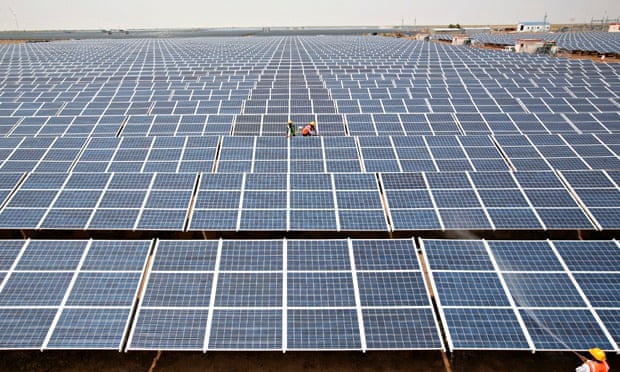
Workers install photovoltaic solar panels at the Gujarat solar park under construction in the western Indian state of Gujarat. Photograph: Amit Dave/Reuters
There could be progress on US-India civil nuclear cooperation, solar power and climate change when US President Barack Obama visits India in two weeks, US officials said on Sunday.
While stressing there were no guarantees that some of the most vexing economic issues between India and the United States would be resolved, the officials said some agreements were conceivable.
“We are working on the civil nuclear liability issue,” a senior State Department official told reporters traveling with US Secretary of State John Kerry to the home state of Indian prime minister Narendra Modi.
“The goal is to have very concrete and tangible things that we can show forward movement on when President Obama and Prime Minister Modi meet, including on climate change,” he said. The leaders are expected to unveil a number of modest initiatives to expand research and access to clean energy technologies.
Obama’s visit to India and trips by Kerry and other U.S. senior officials aim to woo India as a strategic partner and to win greater access to the vast Indian market of 1.2bn people for US companies.
US officials have long argued that Indian policies are a barrier to US investment and trade, including its tariff and customs practices and its requirements that foreign companies in some industries ensure a given percentage of local content.
Asked where Washington and New Delhi might make headway in time for Obama’s visit, the senior US official also cited the solar industry and finding a way to address US concerns about the liability from building nuclear power plants in India.
Under a 2010 nuclear liability law, equipment suppliers are liable for damages from an accident, which companies say deviates from international norms that put the onus on the operator to maintain safety.
India’s national law grew out of the 1984 Bhopal disaster, the world’s deadliest industrial accident, at a factory owned by US multinational Union Carbide Corp which Indian families are still pursuing for compensation.
The law effectively shut out Western companies from a huge market and also strained US-Indian relations since they reached a deal on nuclear cooperation in 2008.
“I don’t know whether [the nuclear civil liability issue] will be resolved in time for the president’s visit, but I would say I think there is progress being made there,” the senior US official said.
India is offering to set up an insurance pool to indemnify global nuclear suppliers against liability in the case of a nuclear accident.
GE-Hitachi, an alliance between the US and Japanese firms, Toshiba’s Westinghouse Electric Company and France’s Areva have received a green light to build two reactors each. They have yet to begin construction several years later, according to India’s Department of Atomic Energy.
theguardian.com |



