Or else he was right. We'll have to see if the rate of emissions starts bending. If we keep CO2 at 400 ppm, we're locked into a 1.5 degree increase. That'll severely disrupt a good portion of our world.
World Is Locked into ~1.5°C Warming & Risks Are Rising, New Climate Report Finds
November 23, 2014
STORY HIGHLIGHTS
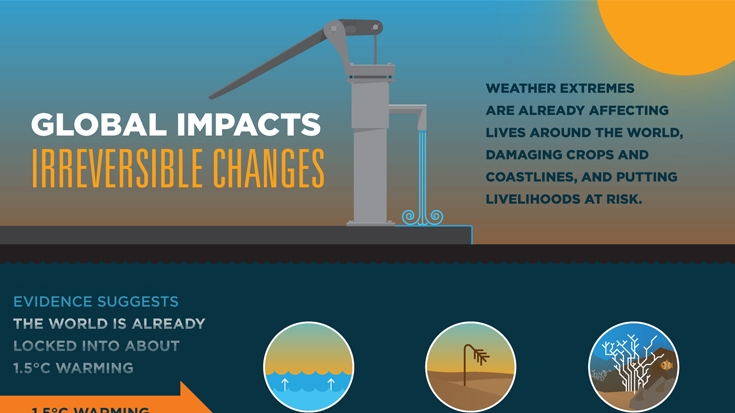
The new "Turn Down the Heat" report explores the risks worsening climate change poses to lives and livelihoods across three regions: Latin America and the Caribbean, Eastern Europe and Central Asia, and the Middle East and North Africa.It finds that globally, warming of close to 1.5°C above pre-industrial times – up from 0.8°C today – is already locked into Earth’s atmospheric system by past and predicted greenhouse gas emissions.Everyone will feel the impact, particularly the poor, as weather extremes become more commons and risks to food, water, and energy security increase.
In the Andes of South America and across the mountains of Central Asia, the glaciers are receding. As temperatures continue to warm, their melting will bring more water to farms and cities earlier in the growing season, raising the risks of damaging floods. Within a few decades, however, the risk of flood will become risk of drought. Without action to stop the drivers of climate change, most of the Andean glaciers and two-thirds of Central Asia’s glaciers could be gone by the end of the century.
These changes are already underway, with global temperatures 0.8 degrees Celsius above pre-industrial times, and the impact on food security, water supplies and livelihoods is just beginning.
A new report exploring the impact of climate change in Latin America and the Caribbean, the Middle East and North Africa, and Eastern Europe and Central Asia and finds that warming of close to 1.5°C above pre-industrial times is already locked into the Earth’s atmospheric system by past and predicted greenhouse gas emissions. Without concerted action to reduce emissions, the planet is on pace for 2°C warming by mid-century and 4°C or more by the time today’s teenagers are in their 80s.
The report warns that as temperatures rise, heat extremes on par with the heat waves in the United States in 2012 and Russia in 2010 will become more common. Melting permafrost will release methane, a powerful greenhouse gas that will drive more warming in a dangerous feedback loop. Forests, including the Amazon, are also at risk. A world even 1.5°C will mean more severe droughts and global sea level rise, increasing the risk of damage from storm surges and crop loss and raising the cost of adaptation for millions of people.
“Today’s report confirms what scientists have been saying – past emissions have set an unavoidable course of warming over the next two decades, which will affect the world’s poorest and most vulnerable people the most,” World Bank Group President Jim Yong Kim said. “We cannot continue down the current path of unchecked, growing emissions.”
As governments gather in Lima for the next round of climate negotiations, this report and others provide direction and evidence of the risks and the need for ambitious goals to decarbonize economies now.
Turn Down the Heat
Turn Down the Heat: Confronting the New Climate Normal is the third in a series of reports commissioned by the World Bank Group from the Potsdam Institute for Climate Impact Research and Climate Analytics. The first report looked at risks globally if the world were to warm by 4°C. The second report focused on three regions – Africa, South Asia, and South East Asia – and the risks to food security, water security, and low-lying cities exposed to dangerous sea level rise and vulnerability to storms.
The new report comes on the heels of strong new warnings from the Intergovernmental Panel on Climate Change (IPCC) about the pace of climate change and the energy transformations necessary to stay within 2°C warming.
worldbank.org |



