I had my hottest entire winter. The rest of the world had the hottest Dec-Jan-Feb ever. That's why people talk about global warming, and not NY warming.
Calif. Continues to Shatter Temperature RecordsPublished: April 8th, 2015
By Andrea Thompson
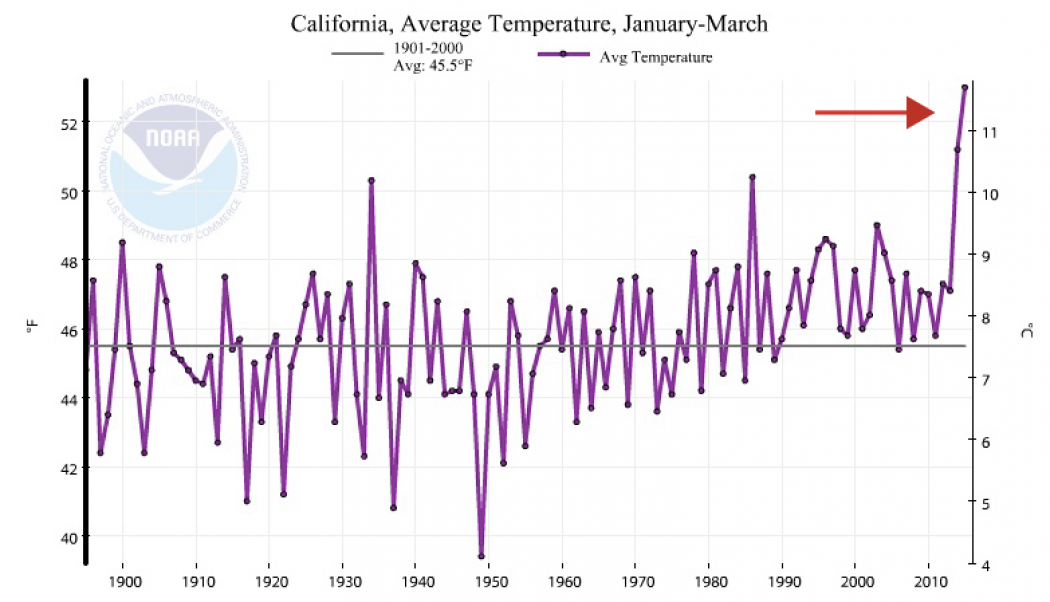
The dubious records keep piling up for California, a state wracked by four years of drought brought on by a pernicious weather pattern that has kept rains at bay and exacerbated by human-induced warming. Just one week after the state measured its lowest-ever snowpack, U.S. scientists have announced that the year so far has been the warmest on record, setting expectations for a long, hot, dry year ahead.
“2015 to date has been truly astonishingly warm in California, and we're breaking almost all the temperature records there are to break,” Daniel Swain, an atmospheric science PhD student at Stanford University, said in an email.
 A time series of California annual temperatures, with an arrow pointing to the incredible heat of the past few years. A time series of California annual temperatures, with an arrow pointing to the incredible heat of the past few years.
Click image to enlarge. Credit: NOAA
The broiling temperatures have played a key role in the state’s dire drought, now in its fourth year and with no signs of abating.
The January-March temperature record bested last year’s record by a solid 1.8°F, according to figures released Wednesday by the National Oceanic and Atmospheric Administration; 2014 turned out to be the warmest year on record in the state.
What the punishing temperatures so far this year mean for how 2015 as a whole will shape up is difficult to say, as “we are only 3 laps into a 12-lap race,” NOAA climatologist Jake Crouch wrote in an email.
“If the rest of 2015 is near average for California in terms of temperature, the state would still be rivaling for one of the warmest years on record,” he said. To top last year’s record, the rest of the year would have to be at least above average, he added.
The continued back-to-back records — California also saw its hottest winter last year and then again this year — speak to the unusual situation the state is in.
“We're shattering temperature records here in California consecutively now year upon year, which is really amazing from a statistical and climatological perspective,” Swain said.
Part of this is due to a stubborn weather pattern that has been in place over several winters, and that some scientists, including Swain, have tentatively linked to climate change. The pattern has locked in a high pressure ridge over the western U.S., sending temperatures soaring and blocking much needed storms.
 Credit: =3¶meter=tavg&state=4&div=0&month=3&year=2015#ranks-form]NOAA Credit: =3¶meter=tavg&state=4&div=0&month=3&year=2015#ranks-form]NOAA
But like the globe as a whole, California has also seen a steady rise in temperatures over recent decades due to the heat-trapping effects of carbon dioxide and other greenhouse gases being emitted into the atmosphere. The buildup of those gases has effectively weighted the climate dice toward more heat records and fewer cold ones, including at the state level.
“I can say that record warm states, whether for a month, season, or year, have been much more common over the past decade than record cold states,” Crouch said.
Since January 2010, there have been 11 times as many statewide monthly heat records as cold records, Crouch calculated. Warm outpaced cold by a factor of 30 when looking at records spanning both the three-month seasons and three-month quarters.
The toasty temperatures in California have exacerbated the drought, which was set in motion by the weather pattern that has largely kept much-needed rains away. As temperatures rise, they amp evaporation, melt snow prematurely, and juice water usage, depleting already dwindling reserves.

The unusually mild winter also meant that any storms that came through dropped mostly rain, and not snow. The snowpack in the Sierra Nevada mountain range is crucial for recharging the state’s reservoirs through the dry spring and summer, as it slowly melts. But this year, there is very little snow to speak of. The estimates made on April 1, typically when the snowpack is at its peak, showed the snows were at a paltry 6 percent of normal. Last year the snowpack was 25 percent of normal for that date, a tie with the winter of 1976-1977, another record-setting period of drought.
Storms this week, while welcome, will have little impact on the drought.
The depth of the drought and the failure of this winter to recharge the state’s water supplies led Governor Jerry Brown last week to institute the first statewide mandatory water restrictions. Cities and towns across the state will be required to reduce water usage by 25 percent on the whole.
“It's going to be a long summer, that's for sure,” Swain said.
climatecentral.org |