Yup.. we'll either have floods and landslides or even less rain. The last big one in '98 was pretty intense.
NASA Shows Human Hothouse Maintaining Record High Temperatures for 2015
It’s an El Nino year. It’s a year in which global CO2 averages are hitting above 400 parts per million for the first time in at least 3 million years. And it’s a year in which CO2 equivalent values for all greenhouse gasses (including methane, nitrogen compounds and other exotic heat trapping gasses) that humans have emitted are nearing 485 parts per million.
Added together — the equatorial Pacific Ocean taking a break in its duties as atmospheric heat sink (El Nino) combined with the immense volume of heat trapping gasses human beings have now loaded into the atmosphere — it’s more than enough to force global temperatures into territory likely not seen since the Eemian interglacial period 150,000 years ago.
Temperatures Continue March into Eemian Ranges
And NASA GISS, in its monthly report, is showing global temperatures that are edging into the Eemian range. First, April of 2015 came in at 0.75 Celsius (C) hotter than the global 20th Century average (0.95 C hotter than 1880). This represents the second hottest value for April on record in the entire 135 year climate record, coming in just a bit cooler than the 0.83 C departure for 2010. Meanwhile, hindsight adjustments have found that the January-through-March period was warmer than earlier indicated — with new departures hitting +0.76 (Jan), +0.80 (Feb), and +0.85 (Mar).
Combined, the average of these first four months is +0.79 C above 20th Century measures. Or about +0.99 C above 1880s values. This puts us well outside the context of the 10,000 year period beginning at the end of the last ice age (Holocene) and edges us into a range more typical to the Eemian. A time when sea levels were between 6 and 8 meters (20-25 feet) higher than today.
Polar Amplification and the Greenland Cool Pool
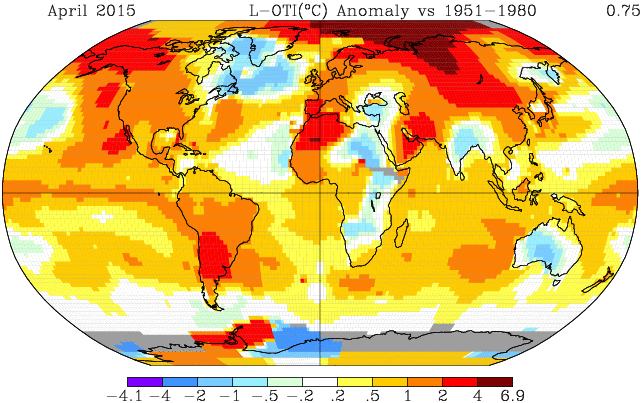
Looking at the global temperature anomaly map provided by NASA, we can see where much of this extra heat accumulated throughout April:
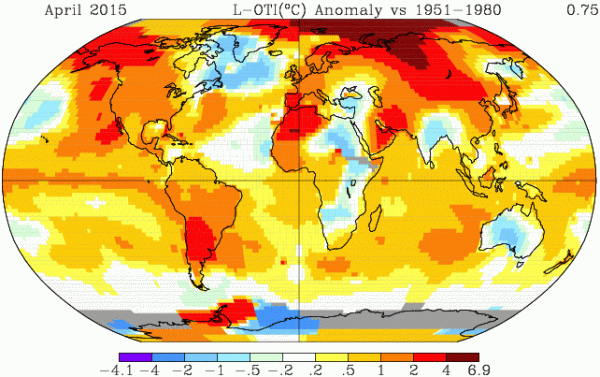
(NASA GISS global temperature anomalies map for April of 2015. Image source: NASA.)
Here we find that polar amplification for the upper Northern Hemisphere latitudes was continuing to hit high marks. Broad south-to-north wind flows over central Asia drove a powerful warming spanning up from Lake Baikal in Russia, on through Central Siberia, up over the Yamal region and into the High Arctic. Average temperatures for the month in this zone ranged from 2 C to as high as 6.9 C above average. Another zone of extreme warmth sprawled out over Western North America and into the Beaufort and Chukchi Sea regions. There, temperatures ranged between 1-4 C above 20th Century averages.
Other notable warm regions included the Equatorial Pacific — showing a band of 1-2 C departures in association with a developing El Nino — and the West Antarctic Peninsula, which saw heating in the range of 2-4 degrees Celsius above average for most of the month.
Overall, most of the globe showed above average readings with cool pools relegated to isolated regions. In particular, the distribution of cool temperatures near Greenland is somewhat disturbing. It’s an indication of increased glacial melt outflows from Greenland ice sheets into the North Atlantic. It’s also a validation of climate model analysis of human-caused global warming — which indicated cooling near Greenland due to a combination of ice sheet and ocean responses to heating the Earth-Ocean System. The ocean response — a dangerous slowing of Atlantic thermo-haline circulation — was also identified in a recent paper by Rahmstorf.
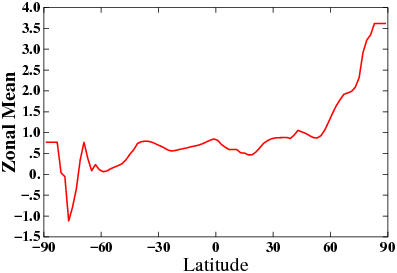
(NASA Latitudinal temperature anomalies again shows strength of Northern Hemisphere polar amplification. Image source: NASA.)
NASA zonal anomalies also continue to validate climate model predictions for human-caused warming. Here we find the predicted extreme polar amplification — more rapid warming of the Northern Hemisphere polar zone than the rest of the world — clearly indicated. There, in the 60-90 North Latitude zone we find temperatures ranging from 1-3.5 Celsius above the 20th Century global average. A rate of warming far exceeding any other region.
All other Latitudinal zones show about a +0.75 C above average temperature departure. The noted exception is the heat sink in the Southern Ocean which continues to uptake atmospheric heat, transfer it to the middle ocean and, by Ekman pumping through storm action, deliver it exactly where it is least needed — along the basal regions of various melting Antarctic ice shelves.
Conditions in Context
Overall, temperatures at +0.99 degrees Celsius above 1880s averages for the first four months of 2015 should be cause for concern. We still have El Nino ramping up in the Pacific. And with some models showing the event could be quite powerful, the added boost to global heating we are seeing now could well ramp higher later this year. In addition, we are entering an Arctic melt season that is showing some risk of pushing Arctic sea ice into new record lows — at least early in the melt season. Such an event would further tilt the globe toward record heat by reducing ice-based light and heat reflectivity in the Arctic at times of 24 hour sunlight (May through July).
As such, there is risk that already record warming seen since 2014 and into 2015 could continue and, potentially, ramp higher through the end of this year.
robertscribbler.wordpress.com |