| | | "These estimates are shocking," Clements and Gaspar wrote. "
and inaccurate counting many things as subsidies that are no such thing.
Even getting past the technical point about targeted tax breaks not being subsidies, since you aren't giving to someone your taking less (and its easy to get past that technical point since the economic effects are identical or nearly so, and they are almost as bad or as bad as direct subsidies) you could only reasonably call targeted tax breaks for specific industries subsidies not generally broad based points of the tax code.
Look at it calls "subsidies" -
Cost of global warming - Even if the alarmists are correct the issue is one of externality, not subsidy, they aren't at all the same thing
Local pollution - Again an externality not a subsidy.
OK so that's about three quarters of the claimed subsidies tossed out right there.
Low prices - Not directly themselves subsidies. The price can be subsidized, but neither the blog post nor the summary of the paper gives any indication that they are subsidized. I'm not going to pay $18 for the paper, just to respond on an SI post, but this seems rather dubious. "Other local factors" is similar unspecified.
Now there are some actual subsidies, for example the price of gasoline, kerosene and/or diesel, is subsidized in many poor countries, esp. (but not only) if they are also oil producers.
OTOH in all or almost all rich countries petroleum products are heavily taxed. In fact governments make more from oil sales then the oil companies do. The net subsidy is negative.
-----------------
To make renewable energy seem cheap, exaggerate the subsidies that fossil fuels get
quotulatiousness.ca
WTF? This is What They Mean by Oil and Gas Subsidies?
August 24, 2011, 2:07 pm
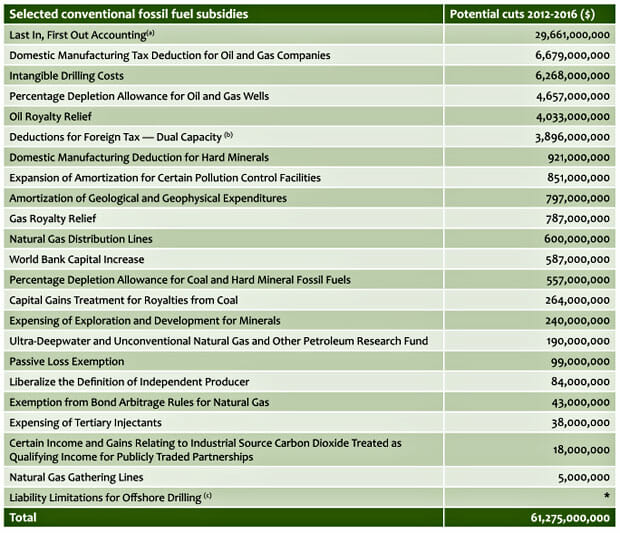
When the Left has talked about oil and gas subsidies, I have generally nodded my head and agreed that any such things should be eliminated, just as they should be eliminated for all industries. They have in the past thrown out huge numbers for such subsidies that seemed high, but I have not really questioned them. But then I see this chart at Kevin Drum's site
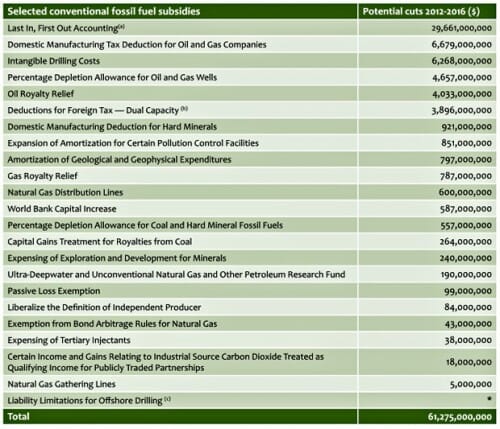
Seriously, nearly half the "subsidy" number is the ability of a company to use LIFO accounting on inventory for their taxes? Since the proposition is to eliminate these only for oil and gas, what is the logic that somehow LIFO accounting is wrong in Oil and Gas but OK in every other industry? In fact, at least the first two largest items are both accounting rules that apply to all manufacturing industry. So, rather than advocating for the elimination of special status for oil and gas, as I thought the argument was, they are in fact arguing that oil and gas going forward be treated in a unique and special way by the tax code, separate from every other manufacturing industry.
In fact, many of these are merely changes to the amortization and depreciation rate for up-front investments. Typically, politicians of both parties have advocated for the current rules to encourage investment. Now I suppose we are fine-tuning the rules, so that we encourage investment in the tax code in everything but oil and gas. I will say this does seem to be consistent with Obama Administration jobs policy, which has been to try to stimulate businesses that are going nowhere and hold back the one business (oil and gas drilling) that is actually trying to grow. I am fine with stopping the use of the tax code to try to channel private investment in politician-preferred directions. But changing the decision rule from "using the tax code to encourage all manufacturing investment" to "using the tax code to encourage investment only in the industries we are personally sympathetic to" is just making the interventionism worse.
This is really weak. Not to mention flawed. Unless I am missing something, a change from LIFO to FIFO or some other inventory valuation rules will create a one-time change in income (and thus taxes) when the change is made. LIFO only creates sustained reductions in taxable income, and thus taxes, if your raw materials prices are consistently rising (it actually increases taxes vs. FIFO if input prices are falling). Given that oil and gas prices are volatile, its hard to see how this does much except extract a one-time tax payment from oil companies at the changeover.
By the way, I am pretty sure I would be all for ending government spending on "ultra-deepwater and unconventional natural gas and other petroleum research," though ironically this is exactly the kind of basic research the Left loves the government to perform.
coyoteblog.com
-----------------
And when your considering how much subsidies and targeted tax breaks distort the economy, you have to consider not just the gross amounts, but the effective subsidy per unit of energy or per dollar spent by the consumer of energy. Since alternatives produce much less energy, which sells for fewer dollars, than fossil fuels, it takes much less to distort those markets.
Oil, is a much bigger market, even if it was subsidized as much as some claim (and it isn't, in fact the net subsidy is negative), would still make sense even if you add the cost of the "subsidies".
Message 28098462
I'm against oil subsidies as well, all energy subsidies for that matter. Lets get rid of all of them. In any case the net subsidy for oil is negative since special targeted taxes on the products of the oil industry bring in more revenue than is lost by tax breaks for the industry, most of which aren't in any way subsidies but rather just the normal business deductions that any business gets. But despite those facts, I could still support eliminating any actual subsidies, or targeted special tax breaks for the oil industry, just not giving them extra taxes, by not letting them qualify for regular deductions that businesses in other industries take.
Message 28091584 |
|