The Symptoms Of Global Warming And Global Cooling Are Identical
Posted on June 27, 2015 by stevengoddard
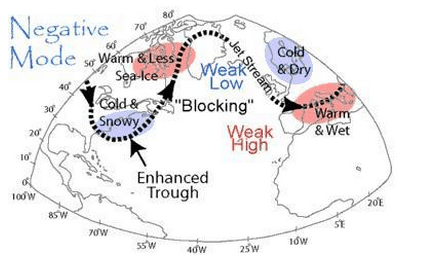
Climate experts blamed this past record cold winter in the east, on an expanded polar vortex caused by global warming and Arctic ice loss.

For years, climate contrarians have pointed to snowfall and cold weather to question the scientific reality of human-induced climate change. Such misinformation obscures the work scientists are doing to figure out just how climate change is affecting weather patterns year-round.
The Arctic connection and the polar vortex: A look at recent North American winters
Winters have generally been warming faster than other seasons in the United States and recent research indicates that climate change is disrupting the Arctic and ice around the North Pole.
The Arctic summer sea ice extent broke all records during the end of the 2012 sea ice melt season. Some researchers are pointing to a complex interplay between Arctic sea ice decline, ocean patterns, upper winds, and the shifting shape of the jet stream that could lead to extreme weather in various portions of northern mid-latitudes — such that some places get tons of snow repeatedly and others are unseasonably warm.
In the Arctic, frigid air is typically trapped in a tight loop known as the polar vortex. This super-chilled air is not only cold, it also tends to have low barometric pressure compared to the air outside the vortex. The surrounding high-pressure zones push in on the vortex from all sides so the cold air is essentially “fenced in” above the Arctic, where it belongs.
As the Arctic region warms faster than most other places, however, the Arctic sea ice melts more rapidly and for longer periods each year, and is unable to replenish itself in the briefer, warmer winter season. This can destabilize the polar vortex and raises the barometric pressure within it.
It’s Cold and My Car is Buried in Snow. Is Global Warming Really Happening? | Union of Concerned Scientists
They sound so sincere! Only problem is that they blamed very similar winters in the 1970s on global cooling, and Arctic ice gain.

Telltale signs are everywhere —from the unexpected persistence and thickness of pack ice in the waters around Iceland to the southward migration of a warmth-loving creature like the armadillo from the Midwest.Since the 1940s the mean global temperature has dropped about 2.7° F. Although that figure is at best an estimate, it is supported by other convincing data. When Climatologist George J. Kukla of Columbia University’s Lamont-Doherty Geological Observatory and his wife Helena analyzed satellite weather data for the Northern Hemisphere, they found that the area of the ice and snow cover had suddenly increased by 12% in 1971 and the increase has persisted ever since. Areas of Baffin Island in the Canadian Arctic, for example, were once totally free of any snow in summer; now they are covered year round.
Scientists have found other indications of global cooling. For one thing there has been a noticeable expansion of the great belt of dry, high-altitude polar winds —the so-called circumpolar vortex—that sweep from west to east around the top and bottom of the world. Indeed it is the widening of this cap of cold air that is the immediate cause of Africa’s drought. By blocking moisture-bearing equatorial winds and preventing them from bringing rainfall to the parched sub-Sahara region, as well as other drought-ridden areas stretching all the way from Central America to the Middle East and India, the polar winds have in effect caused the Sahara and other deserts to reach farther to the south. Paradoxically, the same vortex has created quite different weather quirks in the U.S. and other temperate zones. As the winds swirl around the globe, their southerly portions undulate like the bottom of a skirt. Cold air is pulled down across the Western U.S. and warm air is swept up to the Northeast. The collision of air masses of widely differing temperatures and humidity can create violent storms—the Midwest’s recent rash of disastrous tornadoes, for example.
TIME Magazine Archive Article — Another Ice Age? — Jun. 24, 1974
In 1977 National Geographic also blamed the almost identical weather pattern as 2015 – on global cooling.

 
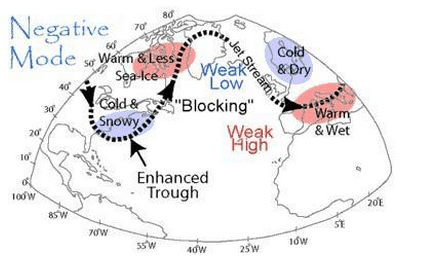
A ridge of high pressure over California, a deep dip in the jet stream on the East Coast.

Heat and drought in California
 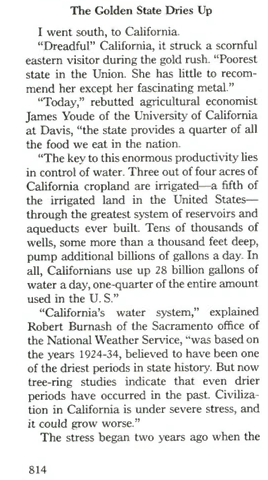
Bitter cold and deep snow in the East.
 
People like the “Union of Concerned Scientists” sound so sincere and serious, but in fact they are simply propagandists who write sciency sounding stuff to fool politicians, journalists and other global warming useful idiots. |