By most people, you mean Watts, Goddard, and you. That and $5 should get you a cup of coffee somewhere.
Hansen et al.
Posted on July 28, 2015 |
A new paper by Hansen et al., Ice melt, sea level rise and superstorms: evidence from paleoclimate data, climate modeling, and modern observations that 2 °C global warming is highly dangerous is currently under review at the journal Atmospheric Chemistry and Physics Discussion.
The paper explores the possibility of, and consequences of, much more rapid melting of earth’s great ice sheets in Greenland and Antarctica. It surveys evidence from the previous interglacial (the Eemian, about a hundred thousand years ago) of rapid fluctuations in sea level, its potential impact on the ocean’s overturning circulation, and of extreme storms as a consequence. It also reports the results of model simulations which include more, and rapidly increasing, injection of fresh water in regions of the ocean (around Antarctica and the north Atlantic) near the great ice sheets.
One thing to note is that this is not just the work of James Hansen; rather the many authors include a host of top experts: J. Hansen, M. Sato, P. Hearty, R. Ruedy, M. Kelley, V. Masson-Delmotte, G. Russell, G. Tselioudis, J. Cao, E. Rignot, I. Velicogna, E. Kandiano, K. von Schuckmann, P. Kharecha, A. N. Legrande, M. Bauer, and K.-W. Lo.
As for the overall results, I should let the abstract speak for itself:
Abstract
There is evidence of ice melt, sea level rise to +5–9m, and extreme storms in the prior interglacial period that was less than 1 C warmer than today. Human-made climate forcing is stronger and more rapid than paleo forcings, but much can be learned by combining insights from paleoclimate, climate modeling, and on-going observations. We argue that ice sheets in contact with the ocean are vulnerable to non-linear disintegration in response to ocean warming, and we posit that ice sheet mass loss can be approximated by a doubling time up to sea level rise of at least several meters. Doubling times of 10, 20 or 40 years yield sea level rise of several meters in 50, 100 or 200 years. Paleoclimate data reveal that subsurface ocean warming causes ice shelf melt and ice sheet discharge. Our climate model exposes amplifying feedbacks in the Southern Ocean that slow Antarctic bottom water formation and increase ocean temperature near ice shelf grounding lines, while cooling the surface ocean and increasing sea ice cover and water column stability. Ocean surface cooling, in the North Atlantic as well as the Southern Ocean, increases tropospheric horizontal temperature gradients, eddy kinetic energy and baroclinicity, which drive more powerful storms. We focus attention on the Southern Ocean’s role in affecting atmospheric CO2 amount, which in turn is a tight control knob on global climate. The millennial (500–2000 year) time scale of deep ocean ventilation affects the time scale for natural CO2 change, thus the time scale for paleo global climate, ice sheet and sea level changes. This millennial carbon cycle time scale should not be misinterpreted as the ice sheet time scale for response to a rapid human-made climate forcing. Recent ice sheet melt rates have a doubling time near the lower end of the 10–40 year range. We conclude that global warming above the preindustrial level, which would spur more ice shelf melt, is highly dangerous. Earth’s energy imbalance, which must be eliminated to stabilize climate, provides a crucial metric.
Much of the work is speculative, but it is supported by both evidence and literature review. Of course some critics will find countervailing literature, and call the evidence into question. I’d say those are valid, even important, things to do. But this paper doesn’t really claim to be a definitive exposition of how climate change will unfold, rather it’s an exploration of possibilities, in particular the possibility and consequences of rapid ice sheet decay.
A big source of uncertainty is the use of truly-exponential ice sheet decay. Recent results from the GRACE (Gravity Recovery And Climate Experiment) satellite show that linear models are definitely inadequate:

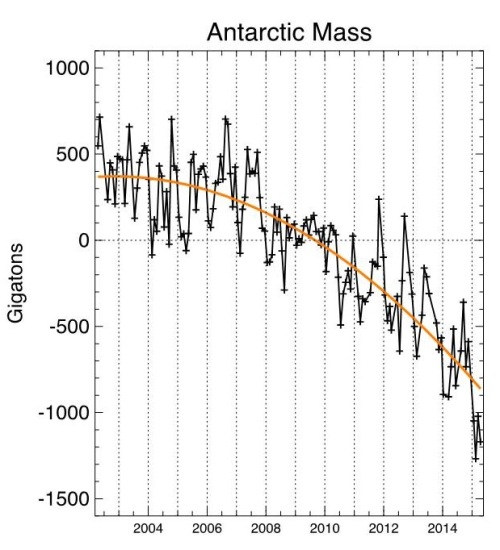
It’s just one of the reasons that there is now near-consensus that the IPCC projections for 21st-century sea level rise are not just out of date, but too low. However, there’s quite a difference between nonlinear mass loss and truly exponential, and we simply don’t have enough data yet to know. But just as we can’t yet reliably claim exponential mass loss, we can’t rule it out either. Hence, although this idea is speculative, it’s also possible, and I believe it’s crucial for us to explore the consequences of what will happen if it turns out to be the case.
One of the consequences, of course, will be extreme sea level rise — enough to make coastal regions simply unliveable. The result is dire, and the cost almost unimaginable. That alone makes any realistic possibility worthy of consideration.
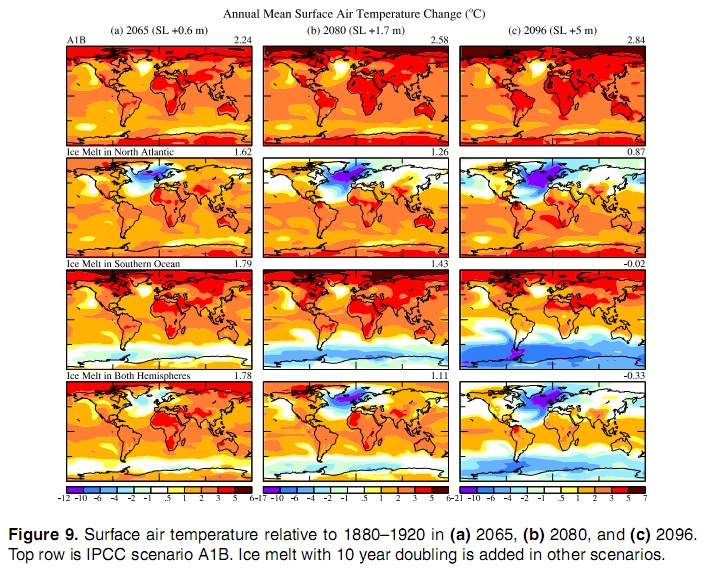
Yet another consequence is massive injection of fresh water in some ocean regions and its effect on ocean circulation. Their model simulations suggest that the reduced circulation will so hamper heat transport from equator to poles that it can lead to considerable cooling of surface air temperature, enough to counter greenhouse-gas forcing, depending on how fast the ice sheets decay (the doubling time for mass loss) and whether large ice melt happens in the northern hemisphere, the southern, or both:

An aspect I find worrisome is that we’re already seeing signs of freshwater injection at both poles. This is indicated by the presence of a cool spot in the north Atlantic near Greenland,

and by the recent but apparently persistent increase in sea ice area surrounding Antarctica.
Countering the increase of surface air temperature comes at more than one price. Not only does it necessitate so much sea level rise as to drown cities and areas where billions of people live (including many of the greatest cities in the world, such as here in the U.S.), it also reduces poleward heat transport enough to amplify the equator-to-pole thermal gradient, and that contributes to a large increase in superstorms.
The upshot is that, if ice melt proceeds as the new work suggests it actually might, the future is not pretty. It’s ugly.
Definitely, there’s much about this paper that’s speculative. But it’s far from impossible. I believe that when it comes to the speculative but possible, it’s crucial for us to be aware of the worst-case scenarios and what they mean for the near future — the rest of this century. Hansen et al. have raised one possibility, and despite all the arguments of its implausibility there’s just as much evidence of its plausibility. The severity of it’s consequences, however, is not really in doubt. Which makes for a clear and frightening illustration of the principle that “uncertainty is not your friend.”
The comments which have been submitted so far are, in my opinion, a very strong argument NOT to have this kind of open discussion review. One of them is, simply put, crackpot denialism. The very first comment was submitted by journalist Andrew Revkin, but it looks to me like nothing in it that’s substantive is by Andrew Revkin. Instead, its his report of what he was told by geologists he contacted. What the hell is going on here? If those geologists want to raise objections or contribute comments, great, let them do so — but second-hand, hearsay “reporting” from a reporter who lacks the knowledge base to make his own comments, does not constitute valid review.
This is a very long paper, with a tremendous amount to digest, and honestly I have some doubts about my own understanding of it; it needs more careful reading, and is outside my own area of expertise. Maybe the most salient comment so far is from one of the invited reviewers, David Archer, summed up in the title of his comment: “Very important but strenuous paper.”
tamino.wordpress.com |