SI
SI
discoversearch

We've detected that you're using an ad content blocking browser plug-in or feature. Ads provide a critical source of revenue to the continued operation of Silicon Investor.  We ask that you disable ad blocking while on Silicon Investor in the best interests of our community.  If you are not using an ad blocker but are still receiving this message, make sure your browser's tracking protection is set to the 'standard' level.
Strategies & Market Trends : Value Investing

 Public ReplyPrvt ReplyMark as Last ReadFilePrevious 10Next 10PreviousNext  
To: MNTNH who wrote (55797)8/4/2015 10:06:37 AM
From: E_K_S  Read Replies (1) of 78714
 
Re: XCO and other distressed Debt E&P's

Some good observations. Their assets are based on 'proved' reserves and the current price of Oil/NG. Remember that those reserves can be overstated too and over time get depleted unless new wells are brought online.

What I found interesting is that Bloomberg Radio interviewed an Oil analyst and asked a simple question: What total amount of LT Debt (everything else equal) is acceptable for the survivors? His answer was no more than 40%.

My thinking then would be to take that number as the base then discount the LT debt/ Total Assets to a value that represents 40%. Most of the distressed debt I look at currently has their LT Debt at 50% - 60% of their total assets. That number is probably increasing too over time, especially in a low price environment. Therefore, the long term unsecured senior debt s/d be discounted from PAR accordingly.

Two big things impact this ratio (LT Debt/ Total Assets): (1) the value of the assets (ie proved reserves); and (2) depletion rates vs replacement vs cash burn. In a very low price environment (over time) both #1 and #2 combine to increase this ratio LT Debt/Total Assets. Not a good combination either.

Finally, Spekulatius noted that as working capital shrinks (because of higher costs and/or continued low price environment) any new debt and/or credit facility modification(s) will be 'secured' pushing the unsecured debt to the back of the line.

Therefore, the Bond market is pretty efficient pricing this Senior Debt taking in all of these factors.


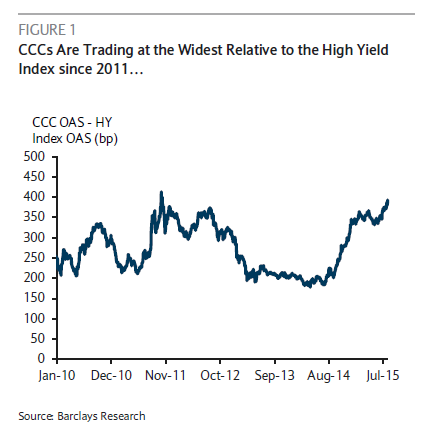
A Towering Bond Trade Has Been Quietly Falling Apart
Will the brisk business in CCC-rated debt recover or collapse?

The question now is whether investors continue to shirk CCC-rated debt or see its recent weakness as an opportunity to pick up some bonds on the cheap. . . . .


-------------------------------------------------------------------------------

This will probably get worse before it gets better.

EKS
Report TOU ViolationShare This Post
 Public ReplyPrvt ReplyMark as Last ReadFilePrevious 10Next 10PreviousNext