The sustained decline in the official jobless rate – now approaching the Fed’s estimate of “full employment” – is a misleading indicator of labor market slack. Indeed, the stagnation in nominal wage growth is consistent with the weakness in the employment/population (E/P) ratio. That said, even the E/P ratio may be overstating the health of the jobs market.
After dropping to three-decade lows in the wake of the Great Recession, the E/P ratio, has barely improved since the fall of 2013, reversing only about one-fifth of its decline from its pre-recession highs. Furthermore – as a breakdown of the E/P ratio by education level shows –this modest improvement is illusory.
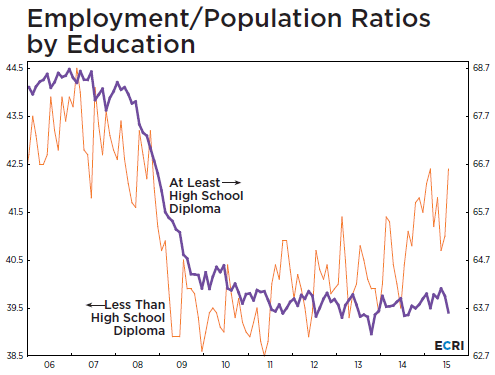
Since 2011, when the E/P ratio for those with less than a high school diploma bottomed, that metric has regained almost two-thirds of its recessionary losses (orange line in chart). But the E/P ratio for high school or college graduates – i.e., eight out of nine American adults – has not recovered any of its recessionary losses, and stands about where it started, one, two and three years ago (purple line).
businesscycle.com
In some ways the shift if good. More demand for lower skilled labor, even if its only for low paying jobs, will help out those who face the most economic dificulty. Still it doesn't seem like something that makes for a solid recovery.
Ignoring the distribution of jobs, the overall ratio hasn't improved much. Not enough to make for a solid recovery, not even as much as I would have guessed it had improved. At least by that measurement things are worse then I thought. |



