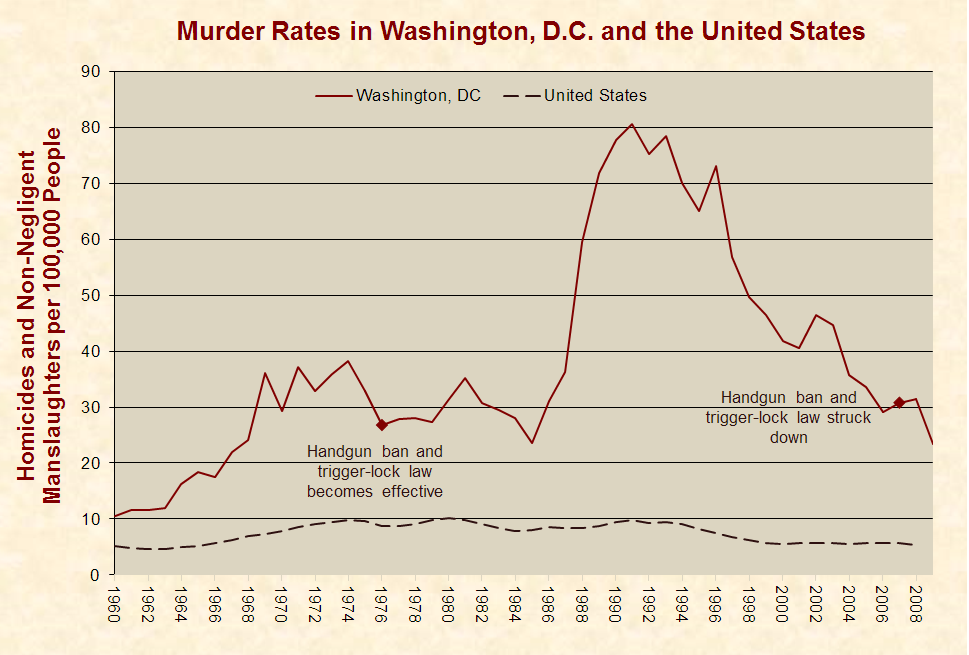
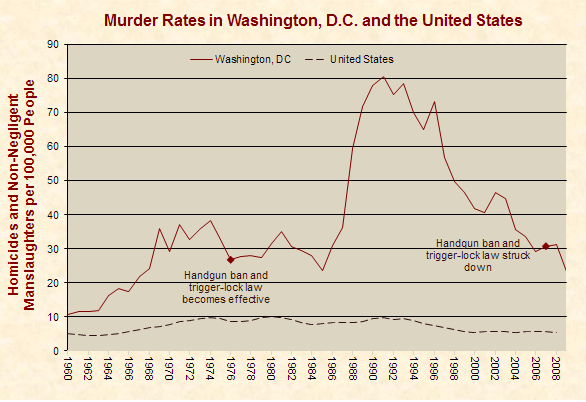
* In 1976, the Washington, D.C. City Council passed a law generally prohibiting residents from possessing handguns and requiring that all firearms in private homes be (1) kept unloaded and (2) rendered temporally inoperable via disassembly or installation of a trigger lock. The law became operative on Sept. 24, 1976. [33] [34]
* On June 26, 2008, the U.S. Supreme Court, in a 5-4 ruling, struck down this law as unconstitutional. [35]
[36]
* During the years in which the D.C. handgun ban and trigger lock law was in effect, the Washington, D.C. murder rate averaged 73% higher than it was at the outset of the law, while the U.S. murder rate averaged 11% lower. [37]
* In 1920, Britain passed a law requiring civilians to obtain a certificate from their district police chief in order to purchase or possess any firearm except a shotgun. To obtain this certificate, the applicant had to pay a fee, and the chief of police had to be "satisfied" that the applicant had "good reason for requiring such a certificate" and did not pose a "danger to the public safety or to the peace." The certificate had to specify the types and quantities of firearms and ammunition that the applicant could purchase and keep. [38]
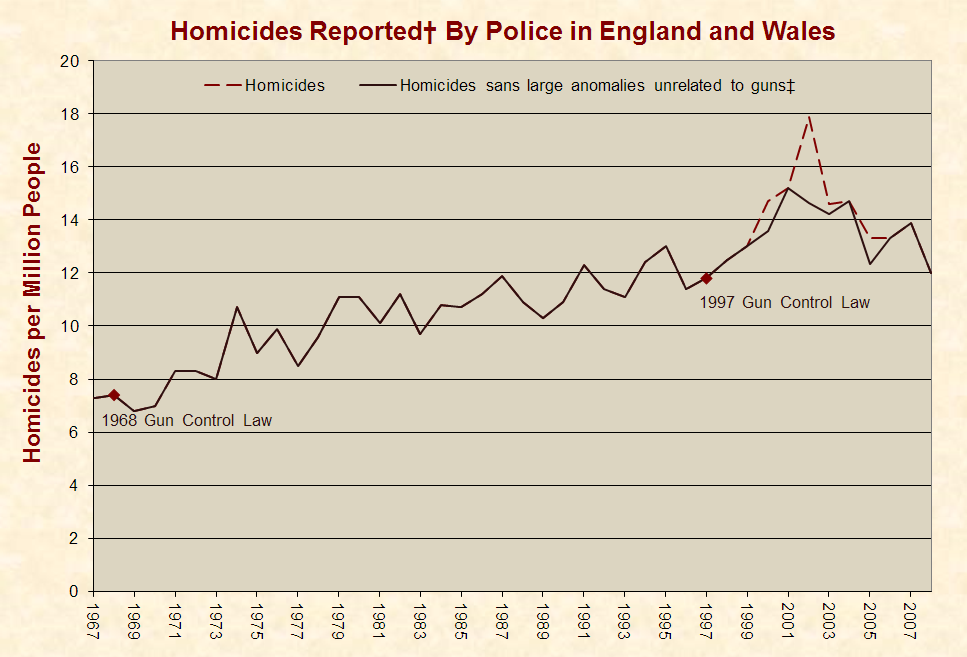
* In 1968, Britain made the 1920 law stricter by requiring civilians to obtain a certificate from their district police chief in order to purchase or possess a shotgun. This law also required that firearm certificates specify the identification numbers ("if known") of all firearms and shotguns owned by the applicant. [39]
* In 1997, Britain passed a law requiring civilians to surrender almost all privately owned handguns to the police. More than 162,000 handguns and 1.5 million pounds of ammunition were "compulsorily surrendered" by February 1998. Using "records of firearms held on firearms certificates," police accounted for all but fewer than eight of all legally owned handguns in England, Scotland, and Wales. [40]
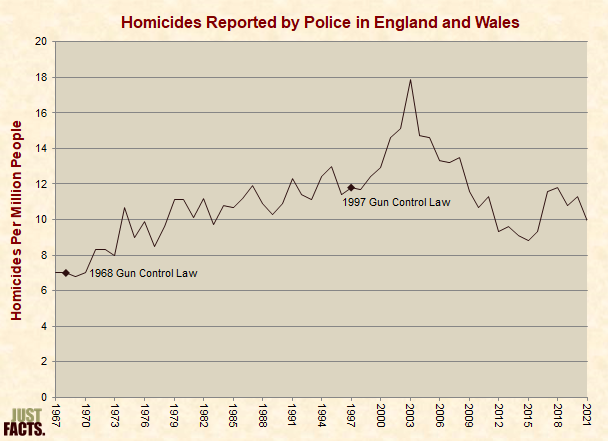
* Years are calendar years prior to 1998 and fiscal years (April 1 - March 31) thereafter.
† Homicide data is published according to the years in which the police initially reported the offenses as homicides, which are not always the same years in which the incidents took place.
‡ Large anomalies unrelated to guns:
• 2000: 58 Chinese people suffocated to death in a shipping container en route to the UK
• 2002: 172 homicides reported when Dr. Harold Shipman was exposed for killing his patients
• 2003: 20 cockle pickers drowned resulting in manslaughter charges
• 2005: 52 people killed in the July 7th London subway/bus bombings
|
[41]
* Not counting the above-listed anomalies, the homicide rate in England and Wales has averaged 52% higher since the outset of the 1968 gun control law and 15% higher since the outset of the 1997 handgun ban. [42]
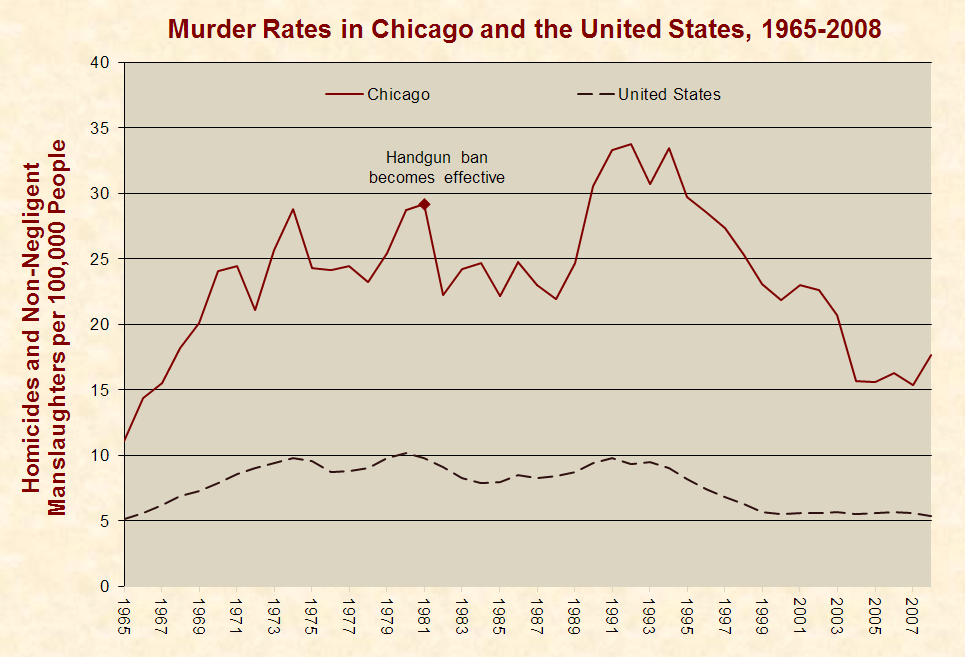
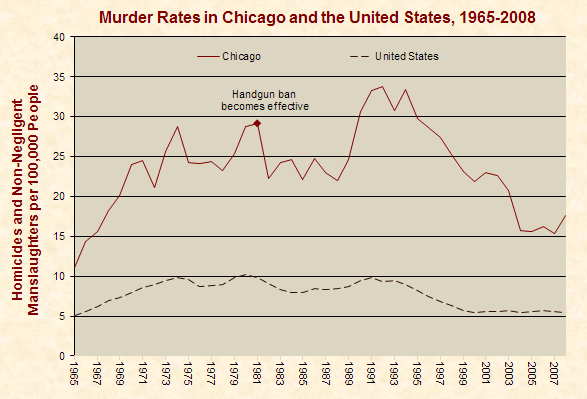
* In 1982, the city of Chicago instituted a ban on handguns. This ban barred civilians from possessing handguns except for those registered with the city government prior to enactment of the law. The law also specified that such handguns had to be re-registered every two years or owners would forfeit their right to possess them. In 1994, the law was amended to require annual re-registration. [43] [44] [45]
* In the wake of Chicago's handgun ban, at least five suburbs surrounding Chicago instituted similar handgun bans. When the Supreme Court overturned the District of Columbia's handgun ban in June 2008, at least four of these suburbs repealed their bans. [46] [47] [48] [49] [50]
* In June 2010, the U.S. Supreme Court ruled (5-4) that Chicago's ban is unconstitutional. [51]
[52]
* Since the outset of the Chicago handgun ban, the Chicago murder rate has averaged 17% lower than it was before the law took effect, while the U.S. murder rate has averaged 25% lower. [53]
[54]
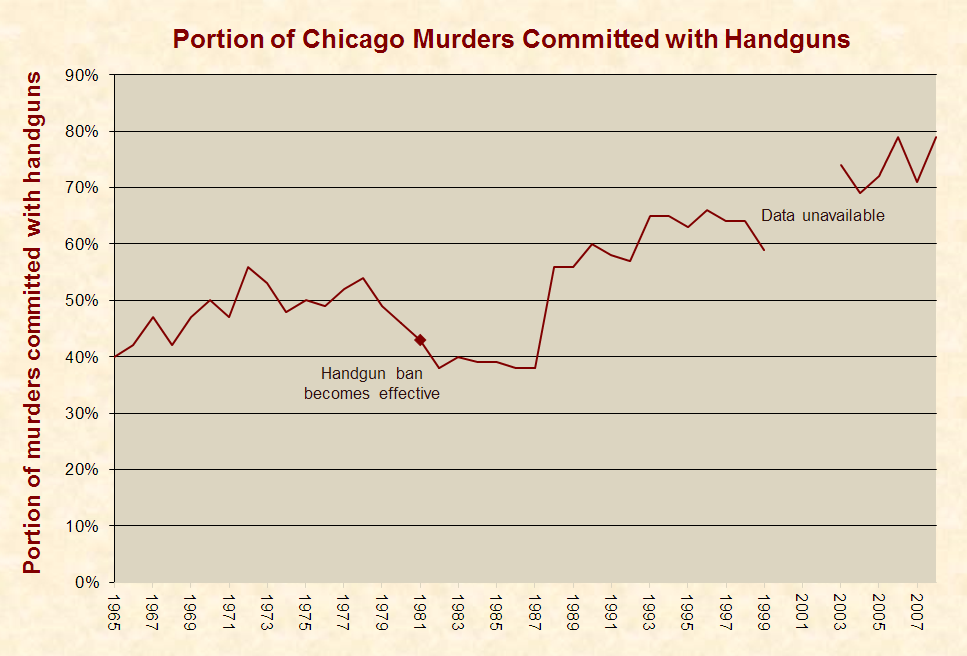
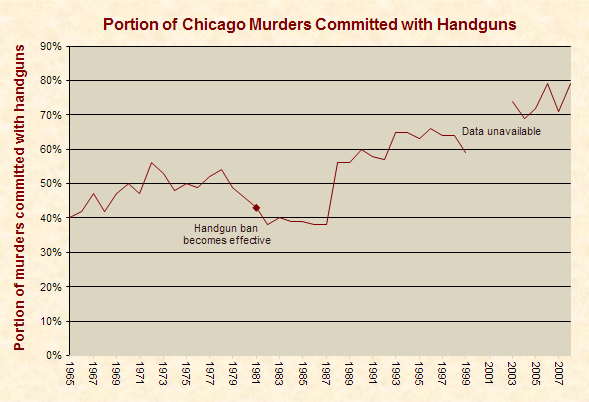
* Since the outset of the Chicago handgun ban, the percentage of Chicago murders committed with handguns has averaged about 40% higher than it was before the law took effect. [55]
* In 2005, 96% of the firearm murder victims in Chicago were killed with handguns. [56]
justfacts.com |