Obama targets drug abuse in West Virginia (GOOD THING CHICAGO IS CLEAN)
0
Share
     
Share this with your friends!
From
To 0,
foreach: searchResults">
0">
Compose your message
Say something about this...
<span class="janrainShareInputCounterExcess" data-bind="
visible: showCharCount,
text: remainingCharCount,
css: { janrainShareInputCounterExcess: remainingCharCount()
Share
Obama targets drug abuse in West Virginia http://www.bdtonline.com/news/obama-targets-drug-abuse-in-west-virginia/article_2a024548-7855-11e5-876d-f7be7577994d.html
Story Print Create a hardcopy of this page Font Size: Default font size Larger font size
Previous Next
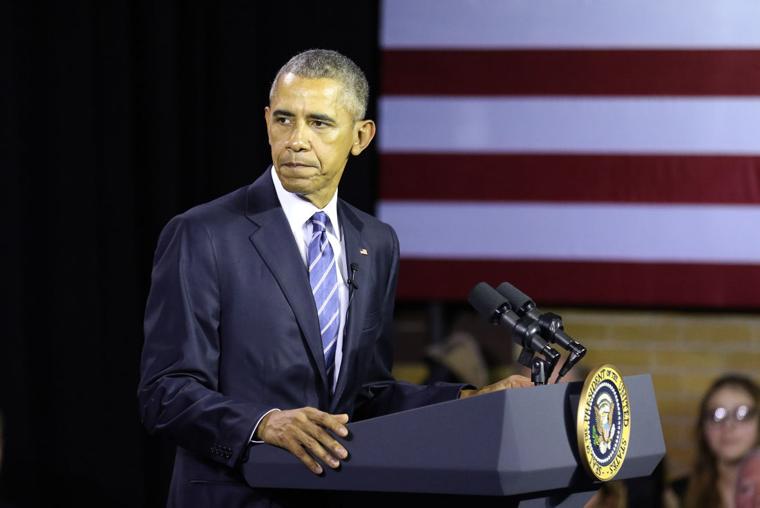
 Obama in CharlestonChris Jackson/The Register-Herald President Barack Obama joined several others including the Director of National Drug Control Michael Boticelli, Cary Dixon, from Huntington, U.S. Secretary of Health and Human Services Sylvia Burwell - a West Virginia native - Dr. Michael Brumage and Brent Webster, Charleston Police Chief, to talk about opioid addiction in the state and country at the East End Family Resource Center in Charleston on Wednesday. West Virginia leads the nation in overdoes deaths from opioids. Obama in CharlestonChris Jackson/The Register-Herald President Barack Obama joined several others including the Director of National Drug Control Michael Boticelli, Cary Dixon, from Huntington, U.S. Secretary of Health and Human Services Sylvia Burwell - a West Virginia native - Dr. Michael Brumage and Brent Webster, Charleston Police Chief, to talk about opioid addiction in the state and country at the East End Family Resource Center in Charleston on Wednesday. West Virginia leads the nation in overdoes deaths from opioids.
Posted: Thursday, October 22, 2015 5:00 am
Obama targets drug abuse in West Virginia By Pamela Pritt for the Daily Telegraph bdtonline.com
CHARLESTON — President Barack Obama visited West Virginia Wednesday to talk abut prescription drug abuse, what the nation can do about that problem and to lead a conversation for people who might not want to talk about it.
Obama was part of an on-stage panel at the East End Family Resource Center, which was filled to capacity by state lawmakers, educators and guests who have been affected by prescription drug abuse, either themselves or in their families.
“Too many families suffer in silence,” the president said. Obama said that drug abuse can affect families in every socio-economic rank, every race and both genders. “We can’t fight the epidemic without fighting the stigma.”
Obama said addiction is a disease and the country should begin to treat it as such.
“With no other disease do we expect people to wait for treatment until they’re a harm to themselves,” he said.
The president noted that opiod addiction, if it doesn’t affect a family directly, affects communities for which everyone should take responsibility. He likened cases of addiction to having a fire department. “You have a fire department so that if your neighbor’s house catches on fire, yours doesn’t burn down, too,” he said.
“These are our kids,” he said. “It’s our neighborhood.
“You don’t know if it’s going to be your child,” he said later. “There but for the grace of God go I. That’s what we have to remember.”
While it’s true addiction does not discriminate in class or color or gender, Obama said it is also true that the poor and disadvantaged are more vulnerable to drugs.
“Those kids who don’t look like us and don’t live in the same neighborhood as us are just as precious,” he said.
He said economic development and broad-based growth are part of the solution, noting that part of the Mountain State’s drug problem “has to do with economics.”
West Virginia has the lowest rate of workforce participation in the country, and a significantly higher unemployment rate at around 7 percent, as compared to the nation’s at 5.1 percent.
Neighborhoods in West Virginia are particularly afflicted, as the Mountain State leads the nation in drug overdose deaths at a rate of 34 per 100,000 people, twice the national average.
Obama also announced initiatives to address those staggering numbers, including:
• Prescriber training for health care professionals who prescribe opiods. The initiative begins with federal departments and agencies to set an example for the private sector.
• Improving access to treatment, also a federal initiative, directing agencies to identify barriers to medication-assisted treatment for opiod abuse disorders and develop action plans to address those barriers.
The president also announced state, local and private sector actions to which 40 provider groups have committed:
• 540,000 health care providers will complete opiod prescriber training in the next two years.
• Double the number of doctors certified to prescribe buprenorphine, an opiod receptor modulator, for opiod use disorder treatment, from 30,000 to 60,000 over the next three years.
• Double the number of providers that prescribe Naloxone, which can reverse an opiod overdose.
• Reach more than 4 million health care providers with awareness messaging, appropriate prescribing practices and actions they can take to be part of the solution.
The Fraternal Order of Police will provide its 330,000 members with Opiod Overdose Resuscitation cards to help identify and respond to overdoses, and CBS, Turner Broadcasting, Google and Café Mom are among the media outlets that have committed $20 million in donated airtime and advertising space to address opiod addiction.
The president said changing the way the country perceives those with addiction problems and solving the crisis transcend partisan politics, including where to lay the blame for the crisis. He said he is “deeply encouraged” that drug abuse treatment and prevention are bi-partisan issues.
“That’s how we’re able to get stuff done,” he said.
Sen. Shelley Moore Capito, R-W.Va. and Charleston’s mayor, Republican Danny Jones, attended the event.
“We’re putting an end to old politics,” Obama said. He said Democrats and Republicans alike are responsible for “ramping up” enforcement-only attacks on drug abuse. At an average cost of $20,000 to incarcerate someone, the president said money would have been more wisely spent on treatment and rehabilitation.
However, he said, drug traffickers who come to this country will be dealt with by law enforcement.
“We’re supporting innovative policing,” he said, like Charleston’s program that checks on students in schools the day after an arrest in their home. “I like that,” the president said.
But that means the government budgets from the top down must invest in treating addiction as an illness with treatment options rather than as a crime. The president’s premier legislation, the Affordable Care Act, or Obamacare to its detractors, makes addiction treatments insurable, but for West Virginians that means traveling outside the state, a situation illustrated bravely and sadly by David Grubb.
Grubb, an East End resident with five daughters, said his second oldest suffers from heroin addiction. Grubb and his wife found their daughter unconscious this summer, a needle close to her arm, her face already turning blue.
He said his daughter was saved by emergency medical personnel and is in treatment for the fourth time, he said. But it took searching and researching for a facility that could take her.
West Virginia has more than 60,000 people who are addicted to drugs and 750 beds.
Obama said the ACA isn’t enough if treatment centers are not available and availability is not enough if someone has to mortgage their house to enter a treatment center.
Secretary of Health and Human Services Dr. Sylvia Mathews Burwell, a Hinton native, joined the president on the stage. Burwell’s agency will invest $100 million in ACA funding to expand substance abuse disorder treatment with a focus on medication-assisted treatment for opiod use disorders in community health centers across the U.S.
HHS also recently awarded $11 million in new grants to states to support medication-assisted treatment and $1.8 million to help rural communities purchase Naloxone and train first responders in its use. |



