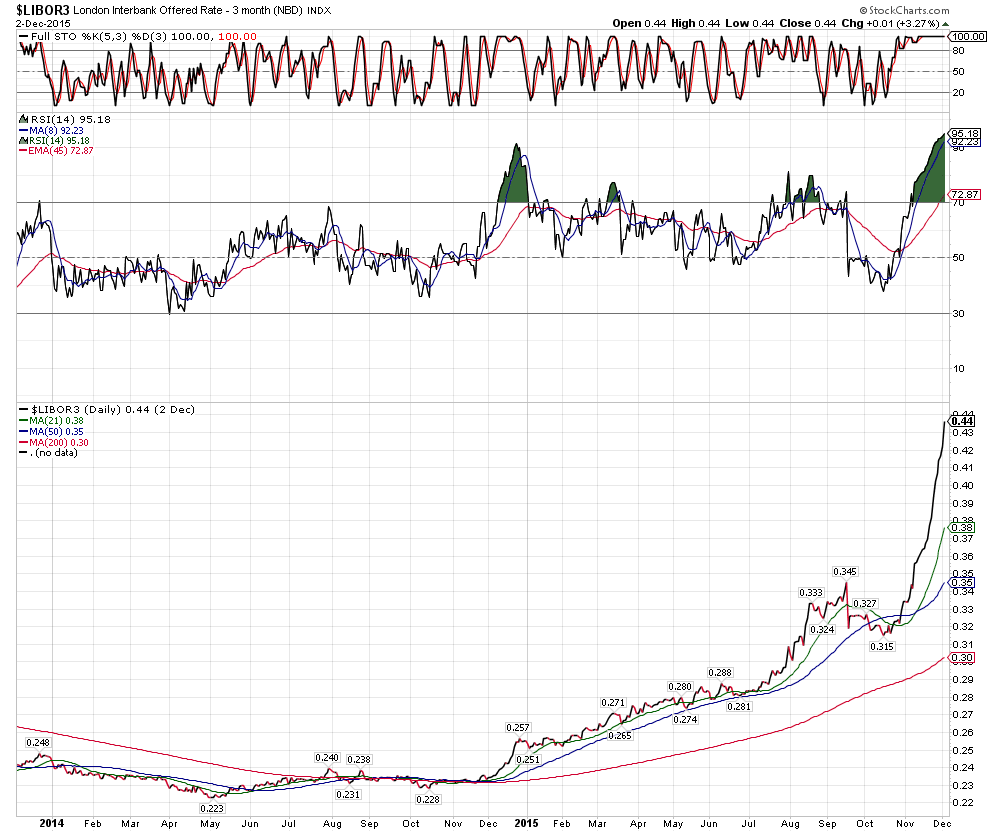
Libor rates have really been on the increase the past month.... and yet it has been getting no coverage in the WSJ, Bloomberg, FT.... CNBC..... I rate this as a pretty big deal.
global-rates.com
the evaporation of Liquidity and trust continues to proliferate.... negative swap spreads on Government bonds creates quirky legal liability questions that the lawyers will raise.... in bankruptcy cases.
QE programs in the US are in theory ending with the FED set to raise rates.... The Trillions of dollars of corporate bonds do not have a liquidity mechanism for heavy selling of them.... and we are coming to the end game of the ultra low ability to borrow money.
The extreme currency stability that we had seen between the USD, EUR, JPY, and GBP also appears to be dissipating.
One of the upshots is that it is now much more expensive for banks to hold securities on their own books and therefore provide liquidity in the market. Deutsche Bank recently noted that the amount of outstanding corporate bonds has doubled since 2001 but dealer inventories of these securities have fallen 90pc over the same period.
This could be a problem. The world is awash with debt. With central banks increasing their balance sheets through quantitative easing, simultaneously pushing down interest rates and taking huge chunks of the market out of circulation, investors have had to stray beyond developed market government bonds in search of yield.
Companies and emerging market countries have been happy to oblige. Since 2004, the stock of emerging market, non-financial corporate debt, for example, has more than quadrupled to $18 trillion, according to the International Monetary Fund. And this is increasingly being gobbled up by flighty retail investors – In
1990 mutual funds held around 4pc of all corporate bonds in circulation; today they hold more than 20pc
Message 30322428
Or perhaps the amount of liquidity available before the crisis was the aberration and we now need to reset our expectations. Should, for example, investors be allowed to withdraw money, at a moment's notice, from funds that invest in rarely-traded securities?
Regulators have made a trade-off. Banks have been made less risky. But, as Bill Gross, the famous bond investor, said earlier this year, that risk hasn’t been eliminated – it’s just moved elsewhere in the system.
Bear Sterns was actually one of the bigger commodity houses and so you are right that JPM Chase inherited the business. ... I had gotten an email from the Global Risk Management Associate about a year ago pointing out that overseas based players like Barclays and a few other firms were downsizing their commodity business.
AIG was the 800 pound gorilla in the US insurance market ..based on it's market cap and AIG was the firm that was really at ground zero of blowing up by having written 5 or 8 times their capitalization in Credit Default Swaps.... and I find it kind of typical that No one in Government or in the media ever examine what the large global insurance and especially the ReInsurance companies books look like and what type of risk exposures they have. They have very good attorneys and their lobbyists give generously to the political apparatus.
 |



