TCS ... Yes, ... Well ...
Here's their last 5 Quarterlies ...
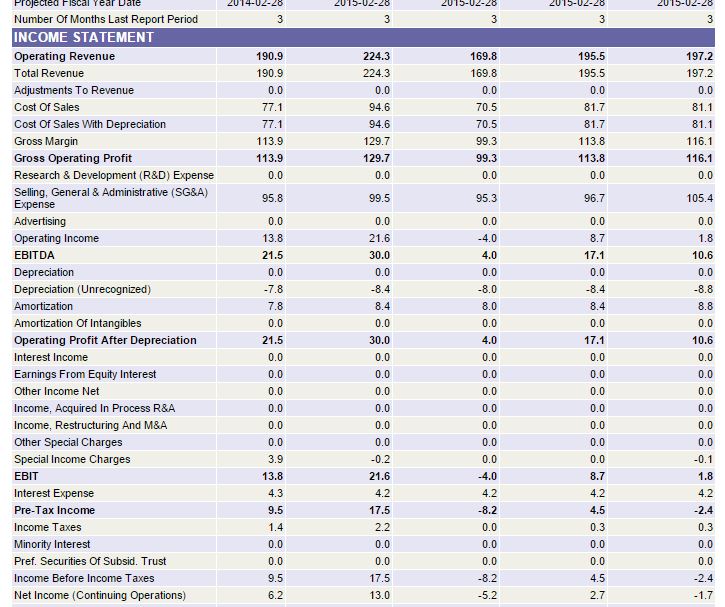
.... apart from the fact that stores generally have very small Margins, which makes them vulnerable to any "changes in circumstances", the financial fact(s) of the matter is that TCS's SG&A has risen despite the fact that their Quarterly Revenue has remained much the same.
Therefore, after deducting their Compulsory expenses of CoS and SG&A, they only have ~5% of their Revenue left over at EBITDA, e.g. 10.6/197.2 =~5.4%.
As Spekulatius mentioned their debt level is relatively high, so one sees that Debt Expense, i.e. Interest Expense, is EATING UP about 40% of their Revenue left over at EBITDA, i.e. 4.2/10.6=~40%.
Then there's still Tax to pay, so TCS ends up with a Negative Bottom line.
That's happened twice in the last 9 months.
So to adequately reverse that rather poor financial performance (which, after all, is what investors are primarily interested in in terms of a "return on their investment") it seems that TCS will need to jack up their top line Revenue by a fairly appreciable amount, without adding too much to SG&A for example, before they can show a reasonable and respectable ratio of Bottom lIne/ Top Line Revenue.
In the past one has seen 6.2/190.9= +3.2%, 13/224.3= +5.8%, -5.2/169.8= -3%, 2.7/195.5= +1.4%, -1.7/197,2= - 0.9%
Are those attractive Net Profit margins ?
Proof of the Pudding :-
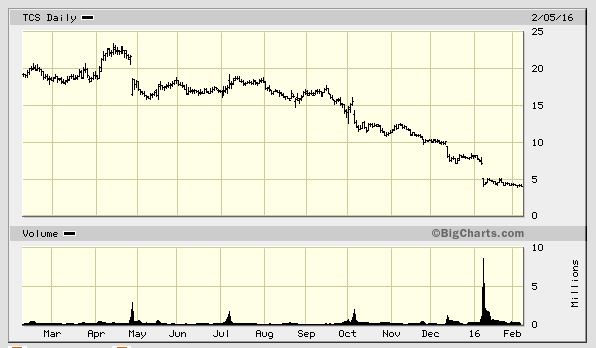
E_K_S mentions the "Graham Number" calculation ... well let's remember what is contained in the formula and derivation of that Number :-
Included in the formula are two fractions, namely "Net Income/Shares Outstanding", another way of saying EPS, and "Shareholder's Equity/Shares Outstanding". If there is no change in "Shareholder's Equity" due to no new shares issued and "Shares Outstanding" stays much the same, then the latter ratio doesn't affect matters much.
And any mathematical formula can only provide an answer based on the input data.
What the formula doesn't tell you about, for example, is how much of a company's Revenue is left over after all expenses are deducted. And that Bottom Line number gets algebraically added, after any dividend payment, to a far more important number on the Balance Sheet than "Shareholder's Equity", namely "Retained Income".
My guess is that there are far better margins out there, coupled with better financial performances ...
|



