Reagan WH tried to gently reject Trump.
The Daily 202: Reagan White House viewed Trump and his 'large ego' warily
THE BIG IDEA:
SIMI VALLEY, Calif. — Alarm bells went off in Ronald Reagan’s White House in the fall of 1987 when Donald Trump announced that he was considering a request to headline the biggest annual fundraiser for congressional Democrats.
[ The Trump's had been connected to Democrats for years. Trump's first project in Manhattan got a tax abatement from Mayor Abe Beame (a pal of Fred Trump) which has been worth $400M to the Trump Org. over the last 40 years. ]
John Kerry, then the chairman of the Democratic Senatorial Campaign Committee, and Jim Wright, the speaker of the House, personally pitched Trump on chairing the event. Wright (D-Tex.) even trekked to Trump Tower, along with the chairman of the Democratic Congressional Campaign Committee, as part of the courtship process.
Trump apparently leaked news of their visit to the New York Times, which ran a story about it on the front page. Rep. Beryl Anthony (D-Ark.), the DCCC chairman, told the paper, “The message Trump has been preaching is a Democratic message.” The congressman specifically cited Trump’s push for peace in Central America and his advocacy for speeding up nuclear disarmament negotiations with the Soviet Union. A spokesman for Kerry (D-Mass.) was quoted praising Trump as “an independent thinker.”
White House Political Director Frank J. Donatelli alerted Chief of Staff Howard Baker about the story. “It would be most helpful if you would place a phone call to Don Trump today,” Donatelli wrote in a memo. “He has a large ego and would be responsive to your call.” He underlined the word “large” before ego.
Donatelli told Baker, the former Senate majority leader, to make the case to the New York developer that Republican economic policies had made possible the previous 60 months of growth. But the real message of the call to Trump was this: “If he chooses to raise Democratic funds, do it for the individual candidates and not for the entire party.” Ultimately, Trump decided not to chair the event.
-- Over the past year, Trump has routinely compared himself to Reagan and embellished his ties to the GOP icon. The Donatelli memo is one of several pieces of evidence in the archives at the Reagan presidential library here that show no meaningful relationship ever existed between the two men.
Trump was a registered Republican, but he maxed out to Jimmy Carter in 1980 and contributed to Walter Mondale ahead of 1984. (Covering his bases, Trump also cut a $1,000 check to Reagan’s reelection campaign.)
In that fall of 1987, Trump was flirting with a potential run for president — even flying to New Hampshire to fan speculation. He spent about $100,000 to run full-page ads in several national newspapers, including The Post, with a critique of the Reagan foreign policy. “There’s nothing wrong with America’s Foreign Defense Policy that a little backbone can’t cure,” Trump said in the ad, which was written as an open letter. Using language that sounds a lot like his stump speech today, he complained that “America should stop paying to defend countries that can afford to defend themselves.” He then described the Persian Gulf as “an area of only marginal significance to the United States for its oil supplies.”
“The world is laughing at America’s politicians as we protect ships we don’t own, carrying oil we don’t need, destined for allies who won’t help,” Trump, then 41, wrote in the ad. “Let’s not let our great country be laughed at anymore.”
-- A review of every Trump mention in the Reagan files shows that White House aides spent much of the 1980s trying to gently reject the mogul’s self-aggrandizing overtures without bruising that “large ego” of his. Here are seven examples:
* In 1983, a request came in for a presidential telegram congratulating Trump on the grand opening of his eponymous tower on Fifth Avenue. A lawyer in the counsel’s office wrote “NO” and explained internally that it would be inappropriate because it was a “commercial” venture.
* In 1984, Trump requested that Reagan attend a gala to honor Vietnam veterans in New York City and said he would schedule it for any day that worked on the president’s calendar. The White House said no.
* In 1986, Trump sent a letter to Nancy Reagan inviting her to stay at his Mar-a-Lago property when she came down for the American Red Cross Ball at the Breakers in Palm Beach. (The staff in the East Wing had no idea what he was talking about; she had not been invited to the ball.)
“Security surrounding the estate is considered the very best protection available,” The Donald boasted to the first lady. “You may also know that Mar-a-Lago was originally designed … as the ‘southern White House.’”
Mrs. Reagan drafted by hand a thanks-but-no-thanks reply that included the line, “I am familiar with Mar-a-Lago.” Then she crossed it out.
* In 1987, Trump urged Reagan to pick former senator Paula Hawkins (R-Fla.) as transportation secretary. The president went with Jim Burnley instead.
* In 1988, the New York Board of Trade gave Trump an “outstanding executive” award. The head of the group sent the White House a letter asking if POTUS could come. “Advanced word is that Mr. Trump will have some stimulatingly interesting comments to make during his talk at the dinner,” he wrote. The scheduling office never seriously entertained the idea.
* Around the same time, Trump sent a glossy pink invitation to 1600 Pennsylvania Avenue inviting the president and first lady to an 11 p.m. LaToya Jackson concert at his Atlantic City casino. This was ignored.
* Back in 1983, Trump snagged a picture with the president during a photo line at a White House event. The president, not paying close attention, signed it “Reagan Reagan.” Five years later, Trump included the image in his book “The Art of the Deal.” An aide in the social secretary’s office noticed the mistake. She sent an apologetic note and a corrected picture — signed with an autopen.
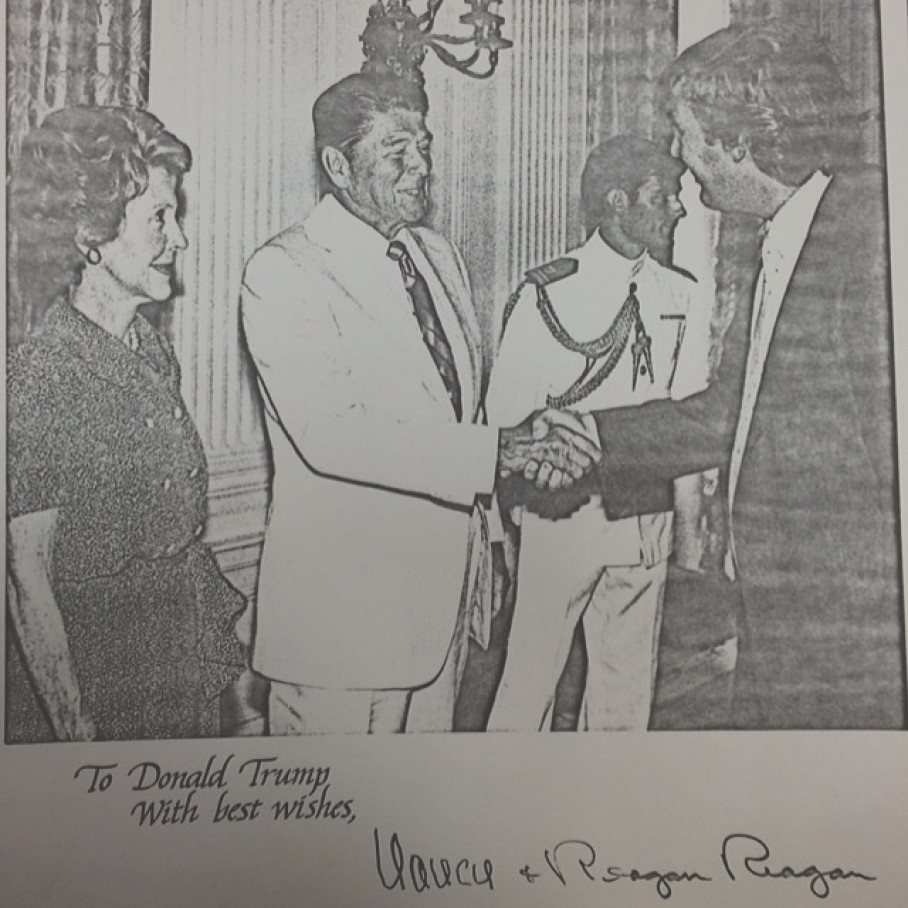
Notice that the signature says "Reagan Reagan."
-- In recent weeks, it has become fashionable among certain talking heads to compare the presumptive Republican nominee to Reagan. Trump apologists on the right excuse their favored candidate’s stumbles by arguing that Reagan, too, was loathed by the GOP establishment and perceived as an intellectual lightweight. Trump critics on the left note that Reagan was once accused of preying on people’s racist and xenophobic fears. Both sides point out that the Gipper moved rightward over time, got into politics late, built a national following as a show-business personality and benefited from being underestimated by his opponents.
-- These analogies are simplistic and deeply unfair to Reagan, who had a proven record as a two-term governor of California (the country’s most populous state) and ran for president twice before securing the GOP nomination in 1980. Indeed, stylistically and substantively, Trumpism is not a continuation of Reaganism — but a rejection of it:
Reagan did not seethe with anger and resentment. He projected a sunny optimism.
He was motivated more by core ideological convictions than the pursuit of power.
He did not want to withdraw from the world. Rather, he wanted to aggressively check Soviet power and display global leadership.
At the museum here, there’s a lot of talk about tearing down walls — and none about building them. Hailing from a border state, Reagan in 1986 signed the last significant piece of immigration reform legislation, which granted amnesty to 2.7 million illegal immigrants. He never called for blocking Muslims from entering the United States.
-- Reagan’s oldest son, Michael, said earlier this month that his dad “would not tarnish himself by voting [for] Trump.” Several Reagan advisers have made the same point, both publicly and privately.
-- Donatelli, who wrote the 1987 memo about Trump’s ego, is undecided about 2016. “I had hoped we might see a Republican nominee that would develop a broad message of inclusion and economic opportunity as a way to win new converts to the GOP,” he told me yesterday. “I'm still hoping that will occur. Winning 65 million votes is a daunting task under the best of circumstances. You win the election by making the status quo, not you, the issue.”
Trump and Reagan “couldn’t be more different," he said. “Reagan was a small government conservative with definite and long-held public policy views. ... Mr. Trump's views seem far more impressionistic,” said Donatelli, 66, who chairs the Reagan Ranch Board of Governors and has served as deputy chairman of the Republican National Committee. “Most important, Reagan's good humor and optimism gave the public reassurance that he could and would effectively manage the vast powers of the presidency. That's a test that every presidential candidate has to pass.”
https://www.washingtonpost.com/news/powerpost/paloma/daily-202/2016/06/22/daily-202-reagan-white-house-viewed-trump-and-his-large-ego-warily/5769f9e3981b92a22d278fa5/?postshare=4991466598380422&tid=ss_tw |



