RE-SENEA
Potentially & hypothetically Amazon aside- IMO a new key area for growth that's a positive is portion control packaging for lunches. How better can a mom send in some veggies that kids have been mostly been stereotyped to throw away. :+ ) Well I bring some corn & green beans into work sometimes.
New Libby’s® Vegetable Pouches Help Deliver Dinner in a Flash
by Libbys on September 7, 2016
Marion, N.Y. (September 7, 2016) – Libby's® Fruits & Vegetables announced today the launch of brand-new Libby's® Vegetable Pouches, which will begin rolling out at retailers across the country. A first for the vegetable market, Libby's® Vegetable Pouches will sit alongside their canned counterparts on the shelf, but cook in less than 60 seconds in their own pouch – no pots or heating containers needed. The result: hot, nutritious vegetables in a flash and more time to enjoy food and family.
“Although most parents know vegetables are healthy, they are served at only 23 percent of dinners[1]. Libby’s understands that parents need options for bringing vegetables to the table that they can feel good about and that help preserve important family time,” said Bruce Wolcott, Vice President of Marketing for Seneca Foods. “New Libby's® Vegetable Pouches bring farm-fresh goodness to busy families, providing a wholesome addition that cooks quickly and is easy to enjoy together.”
Libby’s designed these state-of-the-art, lightweight pouches containing Libby's® Vegetables to make preparing and serving hot vegetables more convenient than ever. Libby's® Vegetable Pouches:
Come in five family favorites – Sweet Peas, Cut Green Beans, Sliced Carrots, Whole Kernel Sweet Corn and Mixed Vegetables – and are all grown and packed in the United States
Stand up straight, are flexible, easy to open and fit nicely into kitchen cabinets, taking up less space
Are shelf-stable – no need for refrigeration
Can be served hot or cold, by themselves or as the star ingredient in side dishes, appetizers and other recipes
To introduce the new Vegetable Pouches, Libby’s is teaming up with Donatella Arpaia, Celebrity Chef, Restaurateur and Head Judge on Food Network’s Iron Chef America, to develop exclusive recipes featuring the Vegetable Pouches. Arpaia’s recipes will be featured in the Libby's® Digital Recipe Box at www.getbacktothetable.com, among hundreds of others that provide quick and easy ideas for preparing and serving vegetables.
FWIW-
Anyway aside from the packaging point. What I liked seeing was a previous strong Qtr for B& G foods for Green Giant, a SENEA contract customer. Also a strong Qtr. for competitor Pinnacle's Birds Eye Foods. I'm just guessing it might offer SENEA some pricing leverage.
Pinnacle snip
EBIT for the Birds Eye Frozen segment increased 23.2% to $46.8 million in the second quarter of 2016, compared to $38.0 million in the second quarter of 2015, reflecting the benefits of the net sales growth and productivity savings, partially offset by very modest input cost inflation, a double-digit increase in marketing investment and items affecting comparability, particularly unrealized mark-to-market impacts. Excluding items affecting comparability, Adjusted EBIT advanced 24.5% to $45.4 million, compared to $36.5 million in the year-ago period.
B&G snip
“…Green Giant volume came in as expected in the second quarter, and the profitability of the brand continues to surpass our initial expectations, partly due to the timing of advertising and marketing spend,” said Robert Cantwell, president and chief executive officer, during a conference call
“By the beginning of September, we anticipate launching four new vegetable platforms with 15 new items. So far customer acceptance of our new Green Giant products has been above and beyond our initial expectations, with those customers who have accepted the products accepting an average of 12 items each.”
Mr. Cantwell declined to elaborate on the new products, saying the company would formally introduce them in August.
P.S.
Sweet corn for dinner? Minnesota harvest season arrivesCurtis Linge watched as a combine rolled through acres of sweet corn just north of Austin, Minn. It was the first day of harvest for his company, Lakeside Foods. Things were looking pretty good.
"It's been a good season," said Linge, 63, who's worked in the vegetable processing business for more than 40 years. "We have had some heat here, but the moisture's been adequate. Looks to be a very good crop at this time."
Corn on the cob is a staple of summer eating. But the sweet corn harvest is more than just selling freshly picked ears at a roadside stand. It's a huge Minnesota industry.
Sweet corn is grown on about 100,000 acres of farmland across the state, making it the nation's leader with a third of U.S. production. Most of the crop will either be frozen or canned for resale.
Combine driver Calvin Boyd said that sweet corn is picked at 70 percent moisture, whereas feed corn is picked at 15 percent moisture. Jackson Forderer | MPR News Lakeside's production is part of a statewide sweet corn picking season that includes companies like Birds Eye, Seneca Foods and Del Monte as well as the famous Green Giant label.
The field by Linge was headed for Lakeside's processing plant in Owatonna, Minn. There, the kernels will be packed into cans destined for mainly grocery stores and restaurants.
It was yielding about 7 tons of ear corn an acre, close to what was hoped for. If that's the average yield this year in Minnesota, the state will produce the equivalent of about 700 million cans of corn.
For some companies, harvest season can be almost two months long. That's because the canning plants dictate growing schedules. Since the plants have limited capacity, staggered schedules insure the daily harvest is only what the canning line can handle.
For instance, the stalks on Paul Platz's farm about 10 miles north of New Ulm in southern Minnesota are only a little past knee high. The crop is fine. The short height is because it was only planted a month ago, said Platz, a contract grower for Seneca Foods.
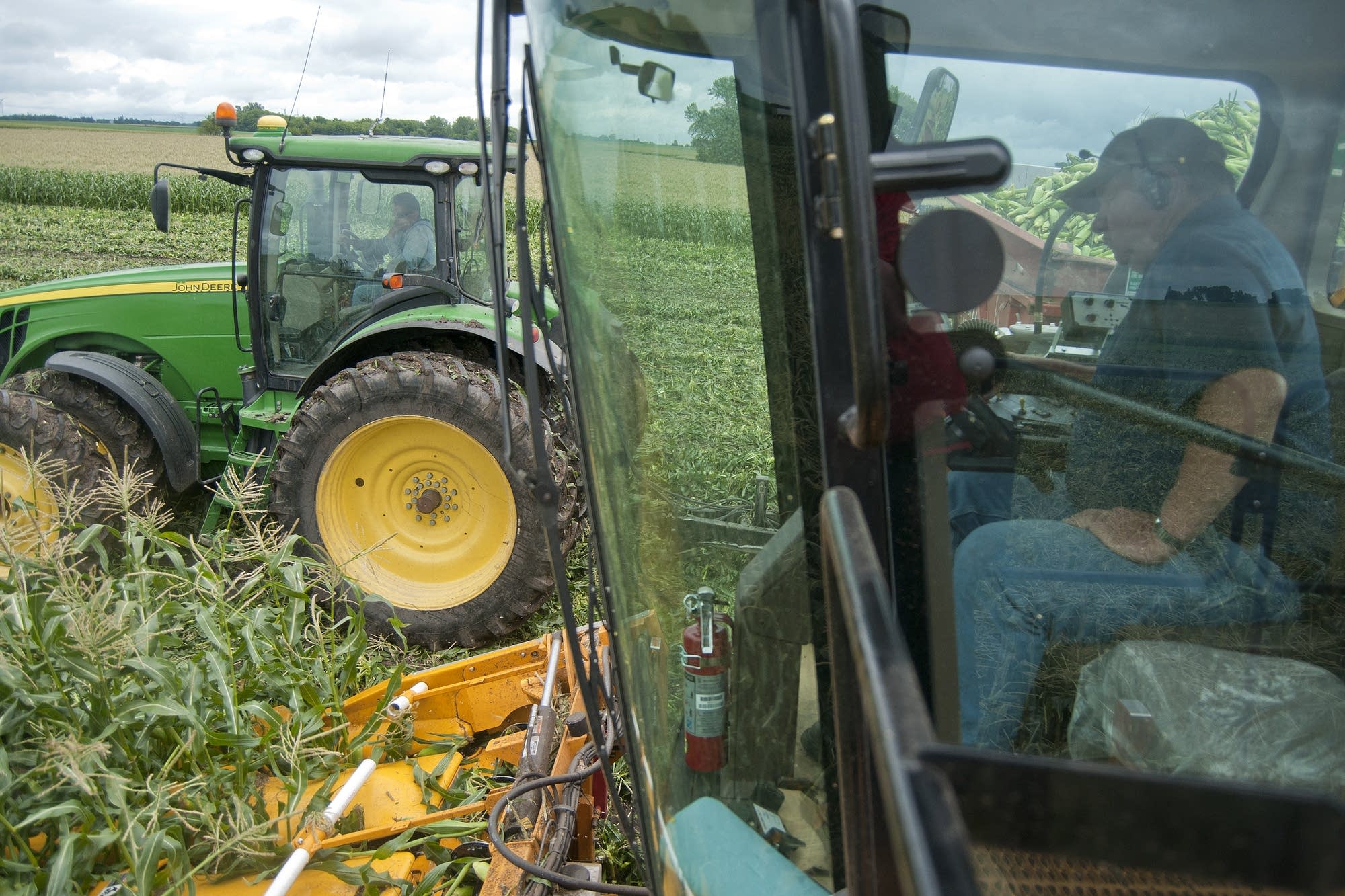 Calvin Boyd, right, drives a combine picking sweet corn as Tony Felstead, left, follows him to collect the crop in a dump trailer on a field south of Blooming Prairie. Jackson Forderer | MPR News Platz said he prefers to plant his sweet corn late in the season. It gives him more time to get his other work done. Besides conventional corn and soybeans, he also plants peas, a sign that grocery store vegetables can be a profitable pursuit for farmers. Calvin Boyd, right, drives a combine picking sweet corn as Tony Felstead, left, follows him to collect the crop in a dump trailer on a field south of Blooming Prairie. Jackson Forderer | MPR News Platz said he prefers to plant his sweet corn late in the season. It gives him more time to get his other work done. Besides conventional corn and soybeans, he also plants peas, a sign that grocery store vegetables can be a profitable pursuit for farmers.
Although his sweet corn is on the short side, Platz can already see the beginning growth of the cob inside the plant, and its potential.
"It's really fragile right now," he said as he cut open a stalk with a pocket knife, "but that's your cob."
mprnews.org |



