SI
SI
discoversearch

We've detected that you're using an ad content blocking browser plug-in or feature. Ads provide a critical source of revenue to the continued operation of Silicon Investor.  We ask that you disable ad blocking while on Silicon Investor in the best interests of our community.  If you are not using an ad blocker but are still receiving this message, make sure your browser's tracking protection is set to the 'standard' level.
Strategies & Market Trends : The Financial Collapse of 2001 Unwinding

 Public ReplyPrvt ReplyMark as Last ReadFilePrevious 10Next 10PreviousNext  
Recommended by:
3bar
bart13
To: elmatador who wrote (159)3/20/2017 5:37:27 PM
From: John Pitera2 Recommendations  Read Replies (3) of 13803
 
Germany has an entirely different mindset when it comes to their economy and financial affairs. They are running a yearly 236 Billion budget surplus.... and have a very serious concern of currency debasement and inflation stemming from the Weimar Repulic Hyperinflation of 1922-23.

As this article illustrates, no wonder Trump and Merkel had a terse meeting at the end of last week... Especially since Germany is stated to be paying only 1.36% of GDP towards NATO, instead of the 2% benchmark level that each member is supposed to be paying.

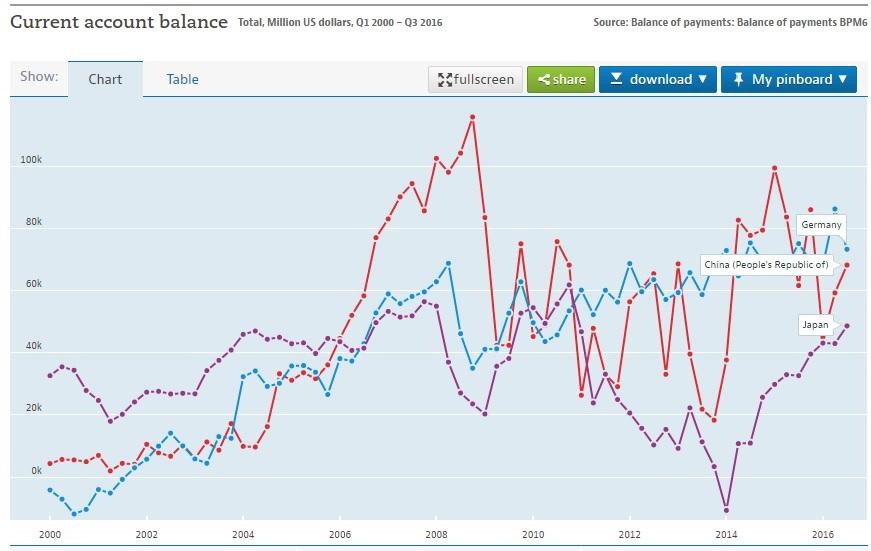
This figure shows trade surpluses over time from 2000 through the third quarter of 2016. (The data is quarterly, so you would need to add it up to get the annual numbers). The red line spiking high in the middle of the figure shows China's trade surpluses, which were near-zero in the early 2000s before taking off, and are now slightly below German levels. The purple line shows Japan's trade surpluses, including that intriguing moment in 2014 when Japan ran a trade deficit for a quarter. The blue line shows Germany's trade surpluses, which start off as trade deficits back around 2000 and have climbed since then.


China's economy is much larger than Germany's. So given that their trade surpluses are roughly similar in absolute size, Germany's trade surplus will be a much larger share of it.

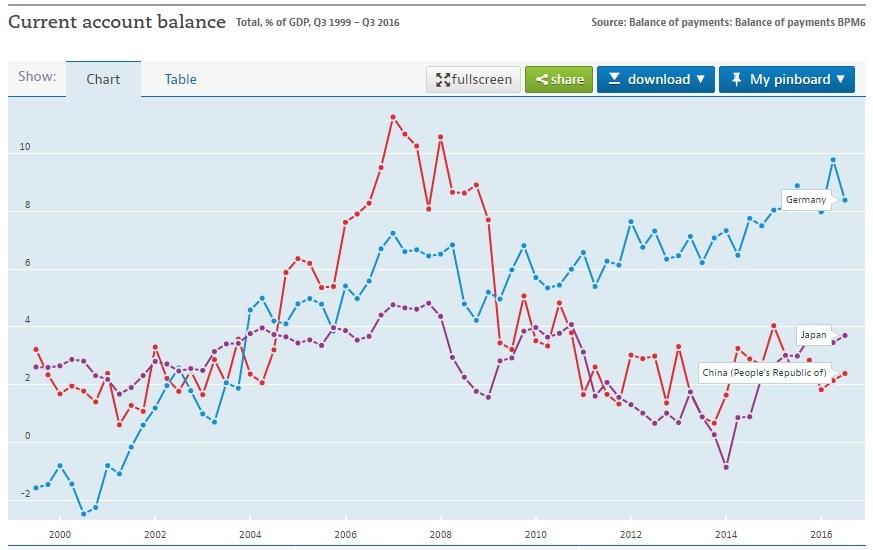
Here is the same trade data expressed as a share of GDP. Germany's trade surpluses are now up to about 8% of GDP. As a share of GDP, Japan's trade surpluses are larger than those of China.


Like a lot of economists, I think the seemingly belief that trade surpluses are a sure-fire sign of economic health while US trade deficits are a sign that the rest of the world is taking advantage of us is a signal of illiteracy in economics. I won't argue that case here, beyond noting that Japan's trade surpluses during the last quarter-century have not meant that Japan's economy was growing in a robust manner.


very good article.... it's a complicated world.

John
Report TOU ViolationShare This Post
 Public ReplyPrvt ReplyMark as Last ReadFilePrevious 10Next 10PreviousNext