If this continues, you might be the only one in the world who saw it coming....
So Far, 2017 is in the Running to be the 4th Consecutive Hottest Year on Record
We haven’t quite gotten to the global ‘year without a winter’ yet. But it sure looks like we’re heading in that direction –fast.
Due to the highest volume of heat-trapping gasses hitting the Earth’s atmosphere in all of the past 4-15 million years combining with a warming of Pacific Ocean surface waters, the period of 2014 through 2016 saw an unprecedented three consecutive record hot years. With Pacific Ocean waters cooling during late 2016, it appeared that 2017 would become ‘just’ the 2nd to 5th hottest year ever recorded. But that was before the waters off South America’s west coast began to blaze with unexpected heat during early 2017 even as temperatures at the poles climbed to surprisingly warm levels.
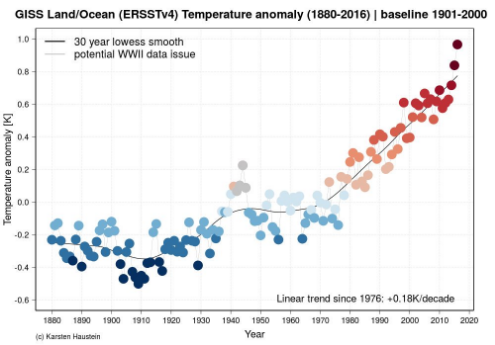
(Due to the combined effects of extremely high levels of heat trapping gasses in the Earth’s atmosphere and a switch to the warmer phase of natural variability, the global rate of temperature increase has rocketed over the past three years. 2017 was not expected to continue this trend. But it might. Image source: Karsten Haustein. Data Source: NASA GISS.)
These two sources of unexpected added heat have left their mark. And though it’s still early in the global warming game for 2017, there appears to be an odd, but not entirely outlandish, chance that this year could beat out 2016 as the hottest year ever recorded.
The month of January 2017 came in at 1.14 C hotter than 1880s averages. Meanwhile February measured 1.32 C hotter than this 19th Century benchmark. In total, the first two months of 2017 averaged about 1.23 C hotter than 1880s — which is a hair hotter than 2016’s never-before-seen by humans annual average temperature.
Karsten Haustein @khaustein
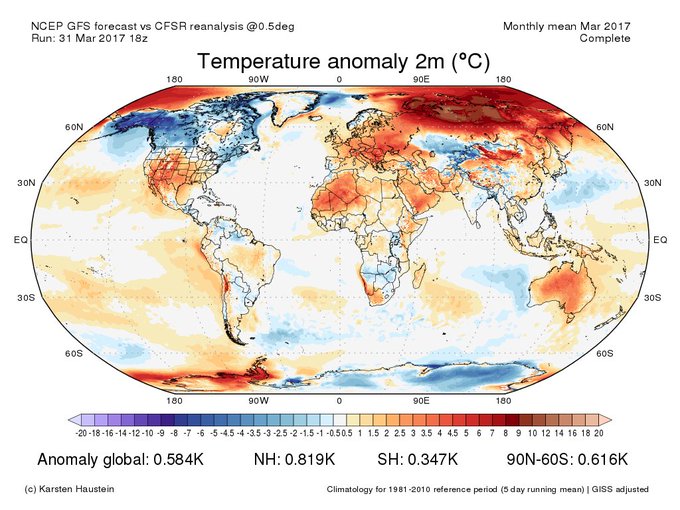
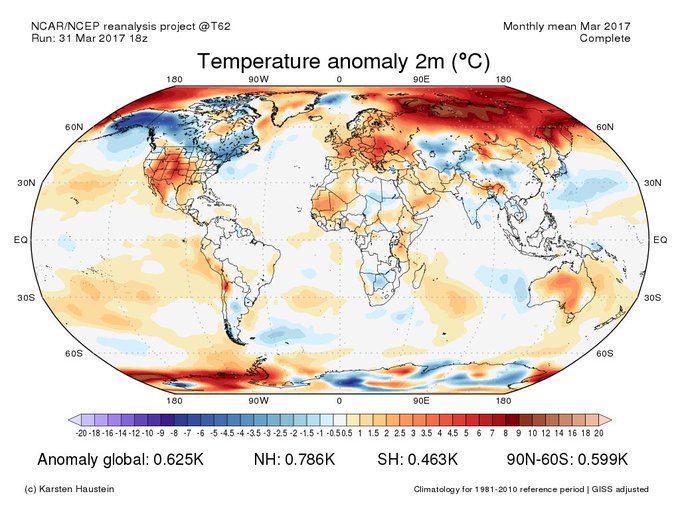
Both, March GFS analysis & NCEP reanalysis 0.03K warmer than Feb. Corresponds to +1.07K in @NASAGISS Easily 2nd warmest March #climatechange
7:14 AM - 2 Apr 2017
1313 Retweets
1515 likes
(Extreme warmth over parts of Siberia and the Arctic appear to have helped push March of 2017 into the range of second hottest on record. The first three months of 2017 currently appear to be running in a range that’s ahead of 2016 annual record hot average.)
Looking ahead, early indications are that March was also around 1.3 C hotter than 1880s. If a first or second hottest March on record pans out as indicated by early NCEP and GFS model reanalysis, then the first three months of 2017 will come in nearly 0.1 C hotter than all of last year.
During the present human-forced warming trend, it has tended to take about ten years for a global temperature increase of 0.15 degrees Celsius to occur. And that rate of warming is about 30 times faster than the warming that occurred at the end of the last ice age. Since 2013, the world has warmed 0.25 C — which could jump to 0.3 to 0.35 C in the period of 2013 to 2017 if the present trend for this year continues.
There are many months still to go in 2017. So this potential isn’t at all certain at this time. However, with the Pacific Ocean heating up again, it appears that 2017 is going to give 2016 a real run for its ‘hottest ever’ title.
robertscribbler.com |



